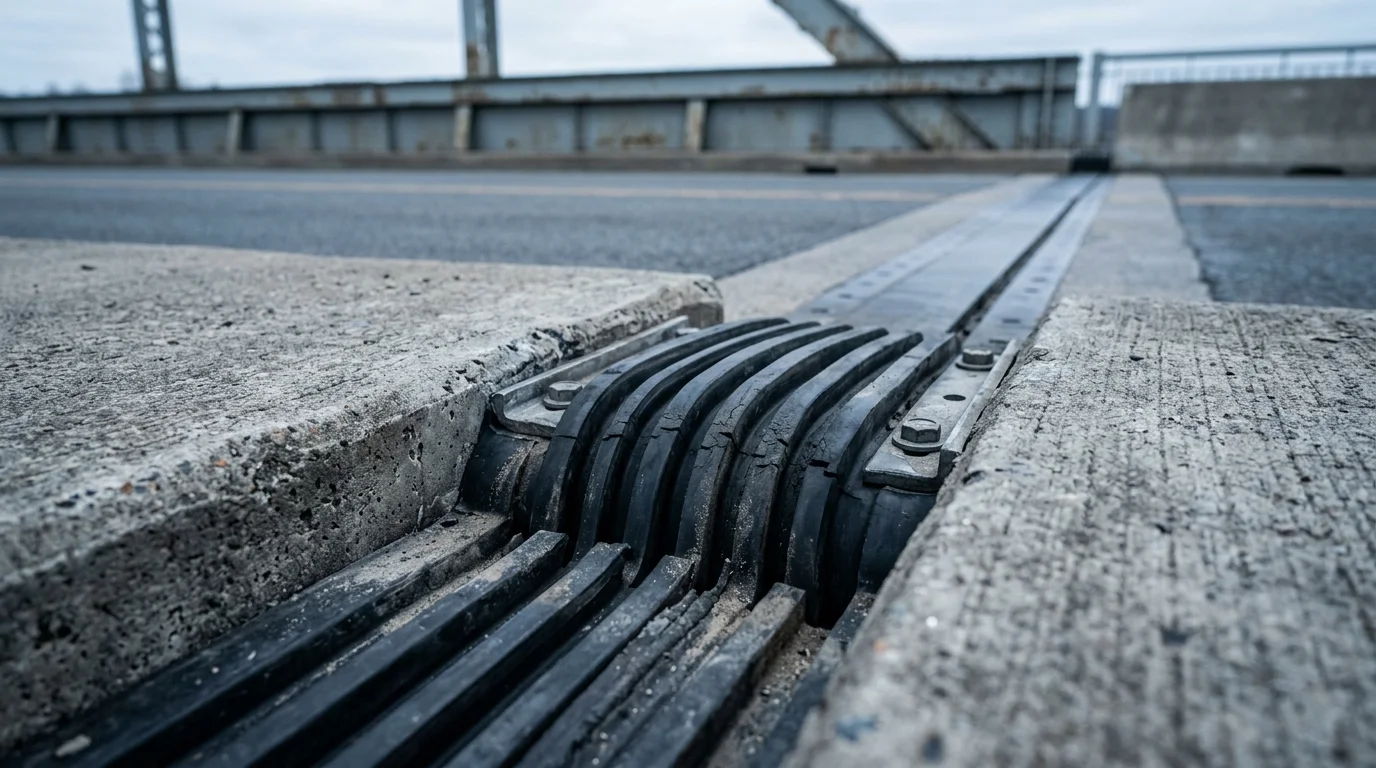
Working Condition Assessment – Evaluate Environmental Factors First
Last year, the expansion joint sealing strips on a sea-crossing bridge developed cracks in the 8th year of service, designed for a 15-year lifespan, the actual life was nearly halved. The problem lay in the selection phase: the designer only considered the displacement parameter, ignoring the combined effect of ozone concentration and UV intensity on rubber aging. This is not an isolated case. According to the “General Technical Conditions for Highway Bridge Expansion and Contraction Devices” (JT/T 327-2016), sealing strip selection requires integrating 7 environmental parameters, but most projects only check 3 of them.
Core Logic: The weight of environmental factors on sealing strip aging often exceeds that of displacement. The aging rate under the combined action of ozone and UV is higher than that of a single factor (per ASTM D1149 Rubber Ozone Aging Standard).
Checkpoints:
- Ozone Concentration: Ozone concentration in urban industrial areas and coastal regions can reach levels exceeding the limit in GB/T 7762-2014 (0.05ppm). If exceeded, the lifespan of EPDM sealing strips shortens from 15 years to 8-10 years.
- UV Intensity: In areas with altitudes >1000 meters or low latitudes (e.g., Yunnan, Hainan), UV intensity is higher than in plains. In such cases, consider CR (Chloroprene Rubber) or FKM (Fluorocarbon Rubber), whose UV resistance is higher than EPDM (per ISO 4892-3 UV Aging Test).
- Temperature Extremes: In northern winters below -30°C, EPDM sealing strips (temperature resistance -40°C) are still usable, but CR (temperature resistance -30°C) may become brittle. In southern summers, bridge deck temperatures can reach 70°C; both EPDM (temperature resistance 120°C) and FKM (temperature resistance 200°C) are safe.
- Displacement: For small displacement (≤80mm), choose Option A: EPDM standard sealing strip; for medium displacement (80-160mm), choose Option B: CR heavy-duty sealing strip; for large displacement (>160mm), choose Option C: FKM extreme sealing strip.
Typical Mistake: Selecting based solely on displacement, ignoring environmental factors. An EPDM sealing strip used on a coastal viaduct developed ozone cracking after 3 years. The problem was solved after replacing it with CR.
Standard Cross-Reference – Lock Down Parameter Minimums with National/Industry Standards
Core Logic: Sealing strip parameters are not “the higher the better,” but “match the standard.” Over-design increases costs; under-design leads to failure.
Checkpoints:
- Shore Hardness: EPDM sealing strips (Shore A 60) are suitable for conventional highway bridges; CR (65A) for heavy-duty traffic; FKM (70A) for extreme conditions. A hardness deviation exceeding ±5A affects sealing performance (per GB/T 531.1-2008).
- Temperature Range: EPDM (-40~120°C) covers 95% of domestic bridges; CR (-30~100°C) requires attention in northern winters; FKM (-20~200°C) is suitable near industrial heat sources.
- Movement Capability: The movement capability of the sealant must match the expansion joint displacement. Option A uses silicone weather-resistant sealant (±25%), Option B uses MS polymer sealant (±35%), Option C uses fluorosilicone sealant (±50%). Mismatch can cause sealant layer cracking (per JC/T 881-2017).
- Backer Material: PE closed-cell foam (Option A) is suitable for conventional environments; PU open-cell foam (Option B) has a rebound rate ≥90%, suitable for heavy loads; ceramic fiber (Option C) withstands 1200°C, suitable for extreme high temperatures.
Typical Mistake: Matching an EPDM sealing strip with MS polymer sealant – EPDM withstands -40°C, but MS sealant may fail below -30°C. The cooperative working temperature range of the sealant and sealing strip must be verified.
Material Confirmation – Verify “True Parameters” with Test Reports
Core Logic: Parameters provided by suppliers may be “theoretical values” rather than “measured values.” Request third-party test reports and verify key indicators.
Checkpoints:
- Ozone Aging Test: Per GB/T 7762-2014, stretch 20% at 50pphm ozone concentration, no cracking for 72 hours. EPDM sealing strips should pass this test; CR and FKM perform better.
- UV Aging Test: Per ISO 4892-3, irradiance 0.55W/m²@340nm, tensile strength retention rate ≥80% after 1000 hours. CR and FKM should be ≥90%.
- Compression Set: Per GB/T 7759.1-2015, 70°C×24 hours, compression rate 25%, deformation ≤30%. EPDM sealing strips should be ≤25%, CR ≤20%, FKM ≤15%.
- Oil Resistance: If there is a risk of fuel leakage on the bridge deck (e.g., near a gas station), verify the oil resistance of the sealant and sealing strip. FKM offers superior oil resistance.
Installation and Acceptance – Avoid Common Pitfalls
Core Logic: Even the best seal will fail if installation is improper. Follow manufacturer instructions and standard procedures.
Checkpoints:
- Surface Preparation: The joint surfaces must be clean, dry, and free of oil, dust, or laitance. Use abrasive blasting or grinding as needed.
- Primer Application: Apply primer as recommended by the sealant manufacturer. Allow proper curing time before sealant application.
- Sealant Installation: Ensure the sealant is fully bonded to the joint sides, with no voids or air pockets. Tool the sealant to ensure proper shape and adhesion.
- Curing: Allow sufficient curing time before traffic loading. Protect the seal from rain and debris during curing.
Typical Mistake: Applying sealant over a damp surface, leading to adhesion failure and premature leakage.
Material Parameter Table
| Material | Shore Hardness (A) | Temperature Range (°C) | UV Resistance | Ozone Resistance | Oil Resistance | Typical Application |
|---|---|---|---|---|---|---|
| EPDM | 60 | -40 to 120 | Moderate | Good | Poor | Conventional highway bridges |
| CR | 65 | -30 to 100 | High | Good | Moderate | Heavy-duty traffic, coastal areas |
| FKM | 70 | -20 to 200 | High | Excellent | Excellent | Extreme conditions, industrial heat sources |
Next Steps – What to Prepare for Procurement
To ensure a successful expansion joint seal selection, prepare the following information before contacting suppliers:
- Environmental Data: Ozone concentration (ppm), UV index (or altitude/latitude), temperature range (min/max), and any chemical exposure (e.g., deicing salts, fuel).
- Joint Displacement: Maximum and minimum movement (mm) expected from thermal, seismic, or traffic loads.
- Bridge Type and Location: Whether it is a highway bridge, sea-crossing bridge, or urban viaduct; coastal or industrial area.
- Required Standards: Specify which national or industry standards (e.g., JT/T 327-2016, GB/T 7762-2014) must be met.
For more detailed technical support, visit our capabilities page or contact us.
📎 Related industry scenario: Bridge Expansion Joint Seals
Deep Reading
More systematic selection, procurement, or inspection guides.
- Fastener Selection for Agricultural Processing Equipment: From Failure Mechanisms to Acceptance Decisionwhitepaper
A more systematic guide on a related selection or inspection topic.
- How to Select Fasteners for T&D Systems in Southeast Asia: An Engineering Application & Procurement Decision Guidewhitepaper
A more systematic guide on a related selection or inspection topic.
- Prestressed Anchorage for Bridges: Failure Mechanisms and Site-Based Condition Gradingwhitepaper
A more systematic guide on a related selection or inspection topic.
This article helps with selection and application. But in real projects, specifying the right part is only step one, finding the right factory, controlling quality, and delivering on time is the real challenge. We cover fasteners, rubber, plastics, and industrial textiles across four categories, from Zhejiang industrial clusters to your project site, one team, end to end.
See Our Supply Chain Capabilities →