Fastener and Hardware Engineering Reference — Standards, Dimensions and Why They Are What They Are
Reference material for engineers, buyers and maintenance teams: how thread forms, property classes, torque values and coatings are defined, and where the numbers come from.
Free charts and calculators sit beside longer explainers; every figure is tied to the standard, formula or inspection record behind it.
- Threads and geometry: metric, Unified and Whitworth profiles; why the 60° form won; pitch series and engagement.
- Materials and grades: property classes 4.8–12.9, stainless A2/A4, heat treatment and hydrogen embrittlement.
- Standards and documents: ISO, DIN, ASTM, EN, GOST, GB; MTC/EN 10204, coating and test reports.
Written for engineers, procurement teams, maintenance crews and learners.
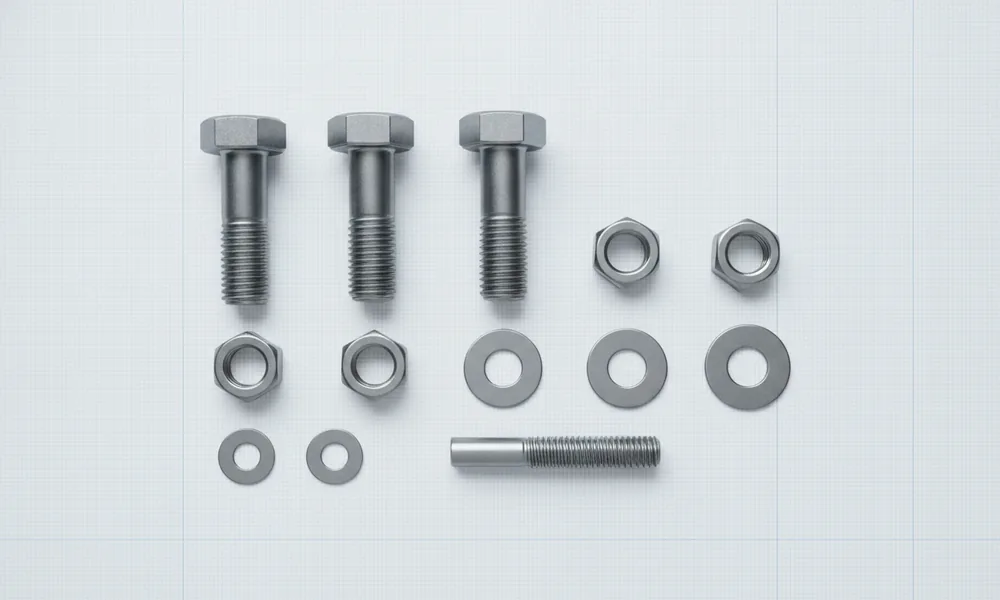
Three Ways Into the Library: Basics, Materials, Standards
Fastener Basics
- Thread profiles and pitch: why metric threads use 60°, how coarse and fine pitches differ, and what changes at the joint.
- Property classes and preload: what 8.8, 10.9 and 12.9 mean, and how a torque value is derived from them.
- Failure modes: loosening, stripping, fatigue and hydrogen embrittlement — what to inspect and when.
Materials & Manufacturing
- Steel grades, heat treatment and the property-class link; stainless A2/A4 and when they are the wrong choice.
- Coatings: hot-dip galvanizing, zinc plating, Dacromet and black oxide — thickness, friction and hydrogen risk.
- Manufacturing limits: heading, rolling, machining and the tolerances that actually matter.
Standards & Selection
- How ISO, DIN, ASTM, EN, GOST and GB relate, and where the same nominal size is not interchangeable.
- Reading an MTC/EN 10204 certificate and the fields that catch a mismatch before delivery.
- Using the free charts and calculators within their stated scope, not as a substitute for the project specification.
How this site's technical content is produced
Technical pages, library entries and charts on this site start from questions raised in engineering and procurement: a size that does not match between two standard systems, a property class written on a drawing, a finish question at the quotation stage. A subject is chosen because it is asked repeatedly, not because it fills a keyword list.
Articles are written against the standard editions they cite and against the production and inspection records of the product families involved. Where a statement rests on a standard clause, the clause is named in the text. Where a value comes from a calculation, the formula and input assumptions are shown so the reader can reproduce the result.
Before publication, the draft is checked by the editorial team against the cited standard and, where the article describes practice, the applicable production or inspection records. The editorial policy page sets out the review cycle, the correction process and the limits of what this site claims. The about page describes the supply chain behind the content.
What you can verify before you buy
Before an order, four things can be checked without relying on a brochure. First, the standard system and the property class: the site works to DIN, ASTM, EN, GOST and GB, with property classes 4.8 to 12.9 and stainless A2 and A4, so a part can be matched to the system named on your drawing. Second, the finish: hot-dip galvanizing, zinc plating, black oxide and Dacromet are quoted as separate lines when they change the part.
Third, the batch documents: material test certificates to EN 10204 (MTC) and inspection reports are agreed per order and written on the purchase order; the article on reading an MTC explains the fields to check. Fourth, the free charts and calculators for sizes, weights and torque: they are reference tools for estimation and comparison, not a substitute for the project specification, the inspection plan or the approval of a licensed engineer.
Corrections and contact
If a page contains an error, or a standard is revised, write to sales@yaxiio.com with the page address and the clause or figure concerned. Corrections are logged and the page is updated against the current edition; the editorial policy explains how revisions are recorded. The same mailbox handles documentation questions, while price, drawing and order questions go through the contact page so they are answered with the list in front of us. Please include the standard number where the page cites one.