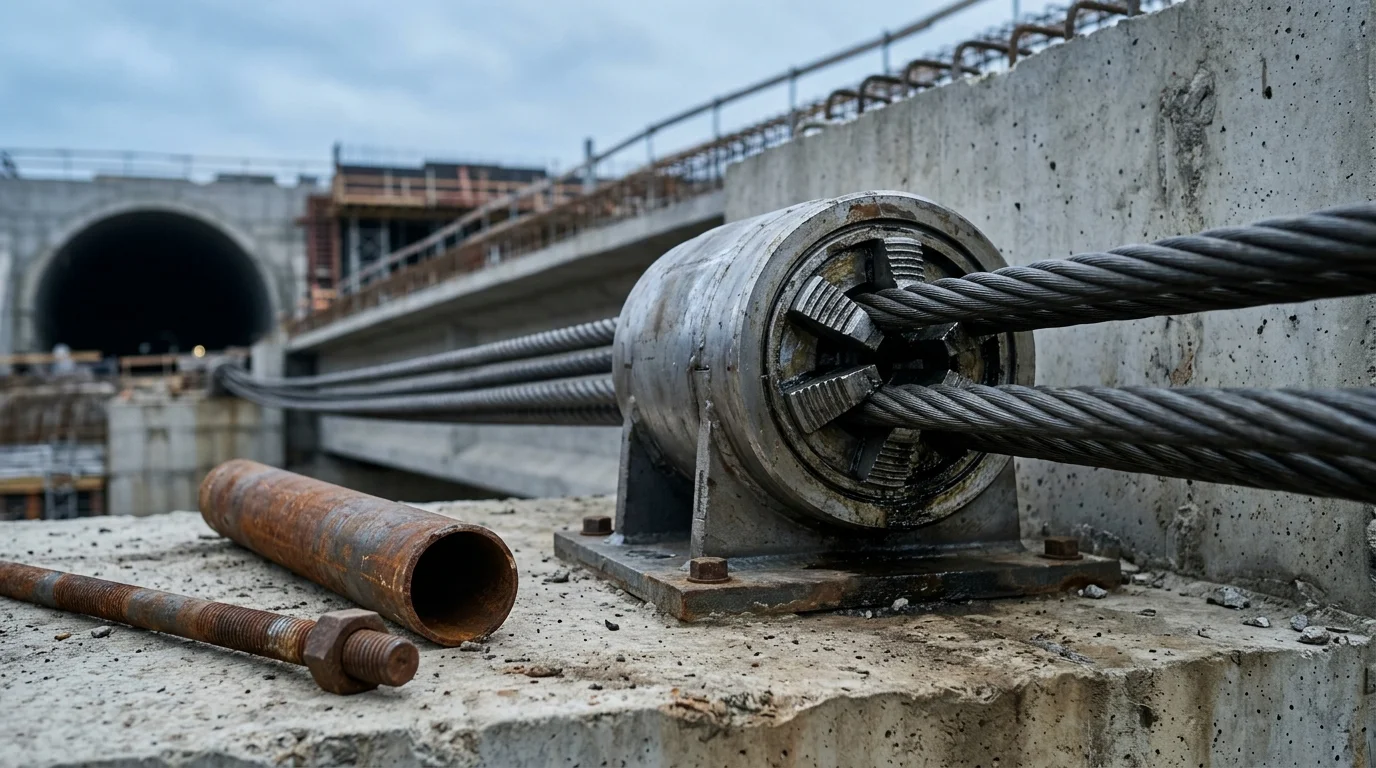
A sea-crossing bridge project suffered a prestress loss exceeding the limit due to insufficient hardness of anchor wedges (measured HRC48, design requirement HRC55-60), resulting in direct losses of over 20 million RMB. This is not an isolated case: a significant proportion of prestress failure accidents originate from misjudgment of working conditions or incorrect material selection during the selection phase. For a side-by-side material comparison across bridge span classes, see our prestressed anchorage comparison for bridge span conditions page.
Core Issue: Anchor selection is not about “choosing the expensive one” or “choosing the cheap one,” but a vertical decision chain from working conditions → standards → materials → suppliers → acceptance. Missing any step can shorten the structural lifespan by more than 20 years.
By the end you will know how to assess working conditions, verify standards, confirm materials, audit suppliers, and inspect incoming anchors, and be able to build a complete selection checklist for your project.
Step 1: Working Condition Assessment: Don’t Let “Looks About Right” Ruin the Design
Checkpoints: Tension force level, environmental corrosion level, structural fatigue frequency
-
Tension force ≤ 10000kN + Medium/small span bridges (25-40 year design life)
Applicable Standard: GB/T 14370-2015 Anchorage, Grip and Coupler for Prestressing Tendons
Typical Scenarios: Urban overpasses, ordinary highway bridges
Risk Point: If a high-strength solution is mistakenly selected, costs increase unnecessarily; if an under-specified solution is chosen, insufficient wedge hardness (e.g., using 45# steel instead of 40Cr) will directly lead to anchorage failure. -
Tension force 10000-30000kN + Large span bridges (40-60 year design life)
Applicable Standard: JT/T 329-2010 Anchorage, Grip and Coupler for Steel Strand of Highway Bridge
Typical Scenarios: Cable-stayed bridge anchorages, suspension bridge anchor blocks
Key Parameter: Anchorages require 42CrMo forgings, wedge hardness HRC40-44 (e.g., 42CrMo wedges in Option B), otherwise the wedges will “fail to grip” the steel strand under high stress. -
Tension force > 30000kN + Marine environment (60-100 year design life)
Applicable Standards: GB/T 20878-2007 Stainless and Heat-Resisting Steels - Designation and Chemical Composition + Marine engineering specifications
Typical Scenarios: Sea-crossing bridges, offshore wind turbine foundations
Fatal Trap: Ordinary 40Cr exhibits stress corrosion cracking within a few years in a chloride ion environment; 17-4PH martensitic stainless steel (Option C) must be used.
Data Support: A coastal bridge, due to misjudging the corrosion level (C5-M), used Option B’s 42CrMo anchorages. After 5 years, micro-cracks appeared on the anchorage surface, and the final replacement cost was several times the original purchase price.
flowchart LR
    A["Improper Selection"] --> B["Premature Failure"]
    B --> C["Equipment Shutdown"]
    C --> D["Economic Loss"]

    style A fill:#fff3cd,stroke:#f39c12
    style D fill:#ffcdd2,stroke:#d32f2f,stroke-width:3px
Step 2: Standard Verification: “Complies with National Standard” Is Not Enough
Checkpoints: Standard number, version number, specific clauses
- General Standard: GB/T 14370-2015 (Static load anchorage efficiency coefficient ≥ 0.95, total strain under ultimate tensile force ≥ 2.0%)
- Industry Standard: JT/T 329-2010 (Adds requirement for anchorage efficiency coefficient ≥ 0.90 after 2 million fatigue load cycles)
- Specialized Standard: Marine engineering must meet the corrosion resistance requirements of NORSOK M-001 (Norwegian petroleum standardization organization)
Real Case: A project procured Option A anchorages. The supplier claimed “complies with national standard,” but actually only referenced the 2007 version (lacking the requirement for wedge hardness uniformity). Acceptance testing revealed a hardness fluctuation of HRC8 within the same batch (standard requires ≤ HRC3), leading to excessive dispersion in anchorage force.
Decision Logic:
- Medium/small span: GB/T 14370-2015 is sufficient
- Large span: Must add the fatigue clauses of JT/T 329-2010
- Marine environment: Additionally add the C5-M level requirement from ISO 9223 (Corrosivity of atmospheres)
Step 3: Material Confirmation: Chemical Composition and Heat Treatment Determine Everything
Checkpoints: Material grade, heat treatment process, hardness test report
| Option | Anchorage Material | Wedge Material | Hardness Requirement | Applicable Scenario |
|---|---|---|---|---|
| A | 45# steel forging + quenching and tempering | 40Cr quenched and tempered | HRC55-60 | Medium/small span, tension force ≤ 10000kN |
| B | 42CrMo forging | 42CrMo quenched and tempered | HRC40-44 | Large span, tension force ≤ 12000kN |
| C | 40CrNiMo forging | 40CrNiMo precision grinding | HRC42-46 | Ultra-large span + marine environment |
Key Details:
- Option A’s 45# steel anchorage: If the supplier substitutes Q235B, the tensile strength drops from 600MPa to 375MPa, rendering it scrap.
- Option B’s 42CrMo wedge: Must undergo quenching and tempering (quenching + high-temperature tempering), otherwise the hardness cannot reach HRC40-44.
- Option C’s 17-4PH: Requires solution treatment + aging treatment, otherwise corrosion resistance drops significantly.
Supplier Factory Audit Check: Request third-party material test reports (including C, Si, Mn, Cr, Ni, Mo content) and inspect on-site heat treatment furnace temperature curve records (tempering temperature ≥ 850°C).
Step 4: Supplier Verification: Don’t Just Look at Price and Delivery Time
Checkpoints: Production equipment, testing capability, past performance
-
Equipment Requirements:
- Forging: Must have die forging press (≥ 2000 tons), not free forging
- Heat treatment: Continuous quenching and tempering furnace (temperature uniformity ±5°C)
- Machining: CNC lathe + grinding machine (wedge inner hole tolerance ≤ 0.02mm)
-
Testing Capability:
- Hardness tester: Rockwell hardness tester (HRC) needs regular calibration
- Ultrasonic flaw detection: 100% inspection of internal cracks in anchorages (GB/T 4162-2008 Grade B)
- Static load test: Need 20000kN testing machine (to verify anchorage efficiency coefficient)
-
Performance Verification: Require 3 contracts + acceptance reports from projects of the same level (e.g., tension force ≥ 10000kN)
Pitfall Case: A project chose the supplier with the lowest quotation, but the supplier had no die forging capability and used free forging + welding instead. The anchorage weld cracked during tensioning, causing the steel strand to fly out.
Step 5: Incoming Inspection: Don’t Let the “Certificate of Conformity” Fool You
Checkpoints: Appearance, dimensions, hardness, static load test
-
Appearance Inspection:
- Anchor surface free of cracks, folds, oxide scale
- Wedge teeth complete, no chipping or burrs
- Anchor bearing plate flatness ≤ 0.5mm (use feeler gauge)
-
Dimension Measurement:
- Anchor inner hole diameter tolerance ±0.1mm (use inside micrometer)
- Wedge taper angle error ≤ 0.5° (use angle gauge)
- Anchor bearing plate thickness deviation ≤ 1mm (Option A requires 40mm, Option B 50mm, Option C 60mm)
-
Hardness Sampling:
- Sample 3% per batch, measure 3 points per anchor (edge, center, edge)
- Option A wedge: HRC55-60; Option B wedge: HRC40-44; Option C wedge: HRC42-46
- If one point fails, reject the entire batch
-
Static Load Test (Critical):
- Per GB/T 14370-2015, sample 3% per batch
- Anchorage efficiency coefficient ≥ 0.95, total strain under ultimate tensile force ≥ 2.0%
- If failed, double retest; if still failed, scrap the entire batch
Decision Summary: Checklist from Working Conditions to Acceptance
| Step | Core Question | Checkpoints | Standard Basis |
|---|---|---|---|
| Working Condition Assessment | Tension force, environment, lifespan | Design drawings + geological report | GB/T 14370-2015 |
| Standard Verification | Standard version + special clauses | Contract technical annex | JT/T 329-2010 |
| Material Confirmation | Grade + heat treatment + hardness | Third-party material report + furnace temperature records | GB/T 3077-2015 |
| Supplier Verification | Equipment + testing + performance | On-site audit + contract cases | ISO 9001:2015 |
| Incoming Inspection | Appearance + dimensions + hardness + test | Sampling report + static load records | GB/T 14370-2015 |
Two key takeaways: For high-frequency fatigue or marine environments, always upgrade to the appropriate material and standard; never accept a supplier’s claim of “compliant” without verifying the specific standard version and test reports.
Next Steps
To apply this guide to your project, prepare the following:
- [ ] Design documents specifying tension force, design life, and environmental corrosion class (e.g., ISO 9223 C5-M)
- [ ] List of candidate anchor options with material grades and heat treatment requirements
- [ ] Supplier qualification documents including equipment list, testing capabilities, and past project references
- [ ] Incoming inspection plan with sampling rates, measurement tools, and acceptance criteria per GB/T 14370-2015
For further assistance, explore our capabilities or contact us to discuss your specific anchor requirements.
Deep Reading
More systematic selection, procurement, or inspection guides.
- Prestressed Anchorage for Bridges: Failure Mechanisms and Site-Based Condition Gradingwhitepaper
A more systematic guide on a related selection or inspection topic.
- Fastener Selection for Agricultural Processing Equipment: From Failure Mechanisms to Acceptance Decisionwhitepaper
A more systematic guide on a related selection or inspection topic.
- How to Select Fasteners for T&D Systems in Southeast Asia: An Engineering Application & Procurement Decision Guidewhitepaper
A more systematic guide on a related selection or inspection topic.
This article helps with selection and application. But in real projects, specifying the right part is only step one, finding the right factory, controlling quality, and delivering on time is the real challenge. We cover fasteners, rubber, plastics, and industrial textiles across four categories, from Zhejiang industrial clusters to your project site, one team, end to end.
See Our Supply Chain Capabilities →