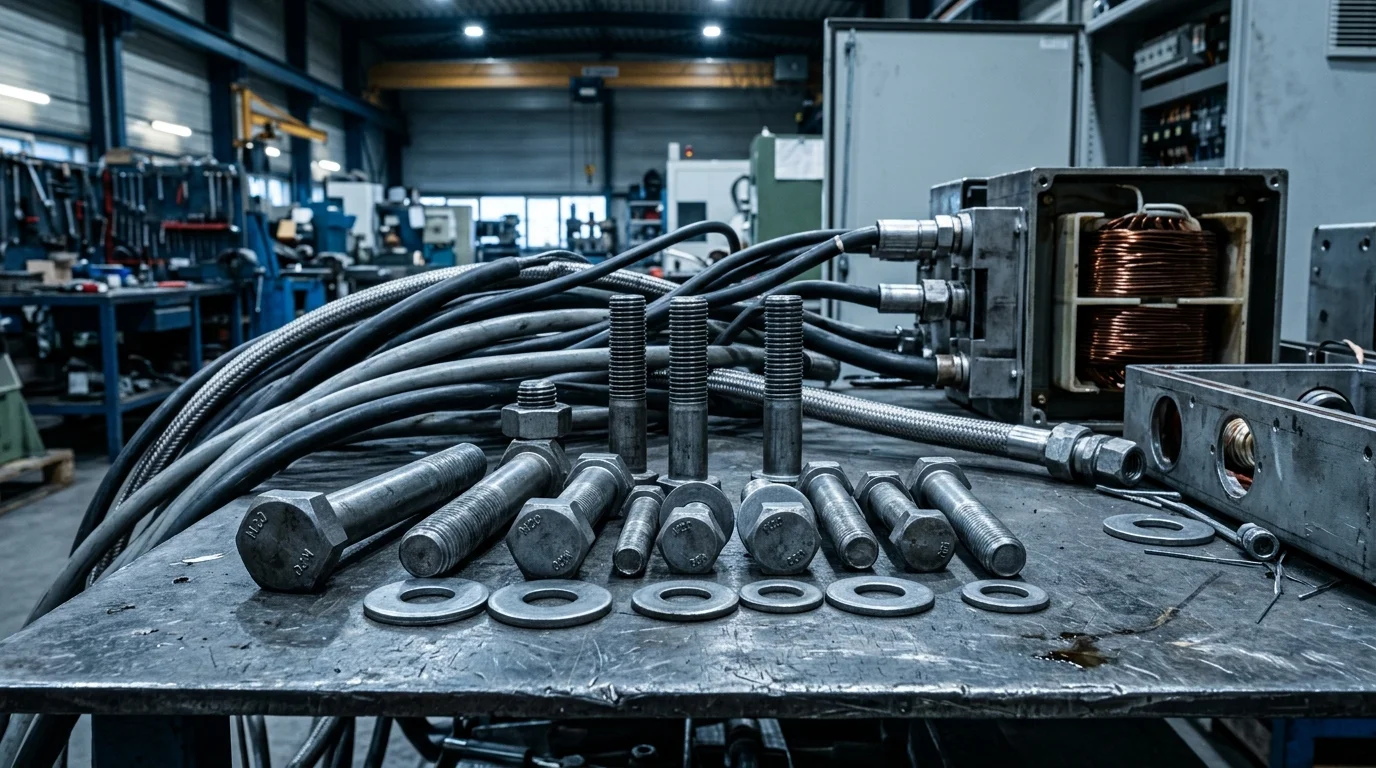
Power Engineering Hardware Selection Guide — Fasteners, Connectors, Grounding Materials
We systematically organize hardware standards, materials, and corrosion protection grades required for photovoltaic, wind power, transmission and distribution projects. Based on international standards such as GB, ISO, and IEC, we provide comparable selection data and factory resources.
Power Hardware Selection: Corrosivity First
Choosing hardware for a power project is closer to following an environment-driven decision map than reading a parts list. Start with corrosivity. In dry C1-C3 atmospheres, hot-dip galvanized parts are the workhorse—≥85 µm coating and ≥720 h salt-spray on the current bracket line; move into C4-C5 coastal, high-humidity or polluted service and galvanized steel can corrode badly within five years, so switch to zinc-aluminium coated or stainless grades. Wind-turbine tower flanges run a different rule set: IEC 61400 drives preload and a design fatigue life of ≥20 years, a single flange takes 200+ M10.9 high-strength bolts, and scatter in the torque coefficient is the classic trigger for delayed fracture; Q355D cold-weather anchor bolts hold ≥34 J impact energy at −20 °C under GB/T 1591-2018. For submerged and splash zones—hydropower seals and wetted or buried fittings—chlorides decide the grade: 316L carries 2-3% molybdenum for pitting resistance and 2205 duplex adds strength. At copper-to-aluminium transitions, galvanic corrosion is the hidden killer in lines; friction-welded joints remove contact resistance and copper-clad steel keeps ≥30% IACS earthing conductivity. Match your environment below and jump straight into the scenario that fits.
You can compress the same logic into three questions before you send an RFQ. First, what atmosphere does the site see? Dry C1-C3 sites stay with hot-dip galvanizing (≥85 µm coating, ≥720 h salt-spray); coastal, humid or polluted C4-C5 sites move to zinc-aluminium coating or stainless steel. Second, is any part submerged or buried? If yes, chlorides pick the grade—316L for pitting resistance, 2205 duplex when strength matters—and check seals separately for crevice-corrosion risk. Third, do copper-to-aluminium or copper-to-steel transitions exist? In transmission and substation work, friction-welded connectors remove contact resistance and copper-clad steel earthing (≥30% IACS) avoids galvanic acceleration. Once those three answers are in, the scenario blocks below take over: tower flanges are a preload-scatter problem, PV projects a foundation-and-clamp problem, substations an earthing-and-lug problem. For buried electrodes, copper-clad steel is the steadier choice—it avoids galvanic acceleration at copper-to-steel junctions.
HOW WE WORK
How We Assist You in Procurement?
01
In-Depth Study of Standards
We continuously study GB, ISO, IEC and other standards to ensure recommended products meet international requirements.
02
Screen Reliable Factories
We only cooperate with factories certified to ISO 9001 and regularly verify their qualifications.
03
Provide Complete Parameters
For each product, we provide material certificates, dimensional drawings, and test reports (if available).
04
Coordinate Small-Batch Orders
We support sample orders, allowing you to test quality before bulk procurement.
APPLICATION SCENARIOS
Browse Solutions by Project Scenario
Select your project type to view corresponding product packages, selection recommendations, and technical parameters.
01
Ground-Mounted Solar Farm
8.8 Grade Hot-Dip Galvanized Bolts · Salt Spray ≥720h · 25-Year Life Reference
- Bracket Connectors · Ground Screws · MC4 Connectors · Grounding System
- One-stop hardware package from bracket foundation to electrical connections. Provides hot-dip galvanized/stainless steel fasteners, ensuring coating thickness per ISO 1461 standard.
- Material/coating: hot-dip galvanizing ≥85 µm, ≥720 h salt-spray
- Service: C1-C3; upgrade to zinc-aluminium/stainless at C4-C5 or corrodes within 5 years
- Standard: ISO 1461 (galvanizing)
Ground-Mounted Solar FarmSolutions →
02
Distributed Rooftop Solar
6063-T5 Aluminum Alloy · Anodizing ≥15μm · Lightweight
- Roof Clamps · Lightweight Clamps · Waterproof Seals · Cable Trays
- Suitable for color steel tiles, standing seam roofs, glazed tiles, etc. Aluminum parts are anodized for corrosion protection.
- Material/coating: 6063-T5 aluminium alloy · anodizing ≥15 µm
- Applications: roof clamps · lightweight clamps · waterproof seals · cable trays
- Pain points: roof leaks / aluminium-steel galvanic corrosion / loosening clamps
Distributed Rooftop SolarSolutions →
03
Wind Turbine Tower and Foundation
10.9S Grade · EN 14399 · Third-Party Testing Assistance Available
- Flange Bolts · Anchor Bolt Cages · Lock Washers · Nacelle Fasteners
- Large hexagon high-strength bolts, designed with preload reference to EN 14399. Suitable for onshore and offshore wind power projects.
- Grade/standard: 10.9S · EN 14399
- Preload & fatigue: ≥20-year design fatigue (IEC 61400) · 200+ high-strength bolts per flange
- Cold service: Q355D anchor bolts ≥34 J at −20 °C (GB/T 1591-2018)
Wind Turbine Tower and FoundationSolutions →
04
Transmission and Distribution & Substations
Friction-Welded Copper-Aluminum Transition · IEC 62305 · Grounding Resistance ≤1Ω Reference
- Suspension Clamps · Copper-Aluminum Connectors · Copper-Clad Steel Grounding Rods · Cable Trays
- Copper-aluminum transition uses friction welding to prevent galvanic corrosion. Grounding system meets substation lightning protection acceptance requirements.
- Process: friction-welded copper-aluminium transition · no contact resistance
- Earthing: copper-clad steel ≥30% IACS · IEC 62305
- Applications: suspension clamps · copper-aluminium connectors · grounding rods · cable trays
Transmission and Distribution & SubstationsSolutions →
05
Energy Storage Systems
Insulating Washers ≥2kV · Tin-Plated Copper Busbars · Stainless Steel Connectors
- Battery Rack Fasteners · Tin-Plated Copper Busbars · Liquid Cooling Pipe Connectors · Insulating Washers
- Energy storage cabinet fasteners are insulated to prevent creepage. Copper busbars are tin-plated for oxidation resistance, and liquid cooling pipes use 304 stainless steel connectors.
- Insulation/coating: insulating washers ≥2 kV · tin-plated copper busbars
- Materials: 304 stainless steel liquid-cooling connectors
- Applications: battery rack fasteners · busbars · insulating washers
Energy Storage SystemsSolutions →
06
Hydropower
316L Stainless Steel · Underwater Sealing · Crevice Corrosion Protection
- Pressure Pipe Bolts · Turbine Fasteners · Underwater Seals · Manhole Door Seals
- 316L stainless steel recommended for underwater fasteners; 35CrMoA double-end studs for high-pressure flanges.
- Materials: 316L (2-3% Mo, pitting-resistant) · 2205 duplex (higher strength)
- Service: submerged/splash zones · crevice corrosion protection
- Applications: penstock bolts · turbine fasteners · underwater seals
HydropowerSolutions →
STANDARDS
Technical Basis and Reference Standards
GB/T 1231-2024
High strength bolts with large hexagon head assemblies for steel structures
GB/T 3098.1
Mechanical properties of fasteners - bolts, screws and studs
GB 50009
Load code for the design of building structures
GB 50169
Code for construction and acceptance of grounding devices
GB/T 21762-2008
Cable management - Cable tray systems and cable ladder systems
IEC 61400 series
Wind turbine standards
RESOURCES
Technical Resources and Selection Guides
5 Common Mistakes in Ground-Mounted Solar Fastener Selection
8.8 Grade/10.9 Grade/Galvanizing Thickness — With Real Cases
5 Common Mistakes in Ground-Mounted Solar Fastener Selection →
Comparison of Corrosion Protection Processes for Power Engineering Fasteners
White Paper: How to Choose Between Hot-Dip Galvanizing, Dacromet, and Sherardizing?
Comparison of Corrosion Protection Processes for Power Engineering Fasteners →
Quick Reference for 8.8 vs 10.9 Grade Bolt Selection
Load Calculation and Selection Quick Reference Table
Quick Reference for 8.8 vs 10.9 Grade Bolt Selection →
FAQ
Frequently Asked Questions
Explore Our Supply Chain Capabilities
From factory QC to global logistics, one team, end to end
Explore Capabilities →