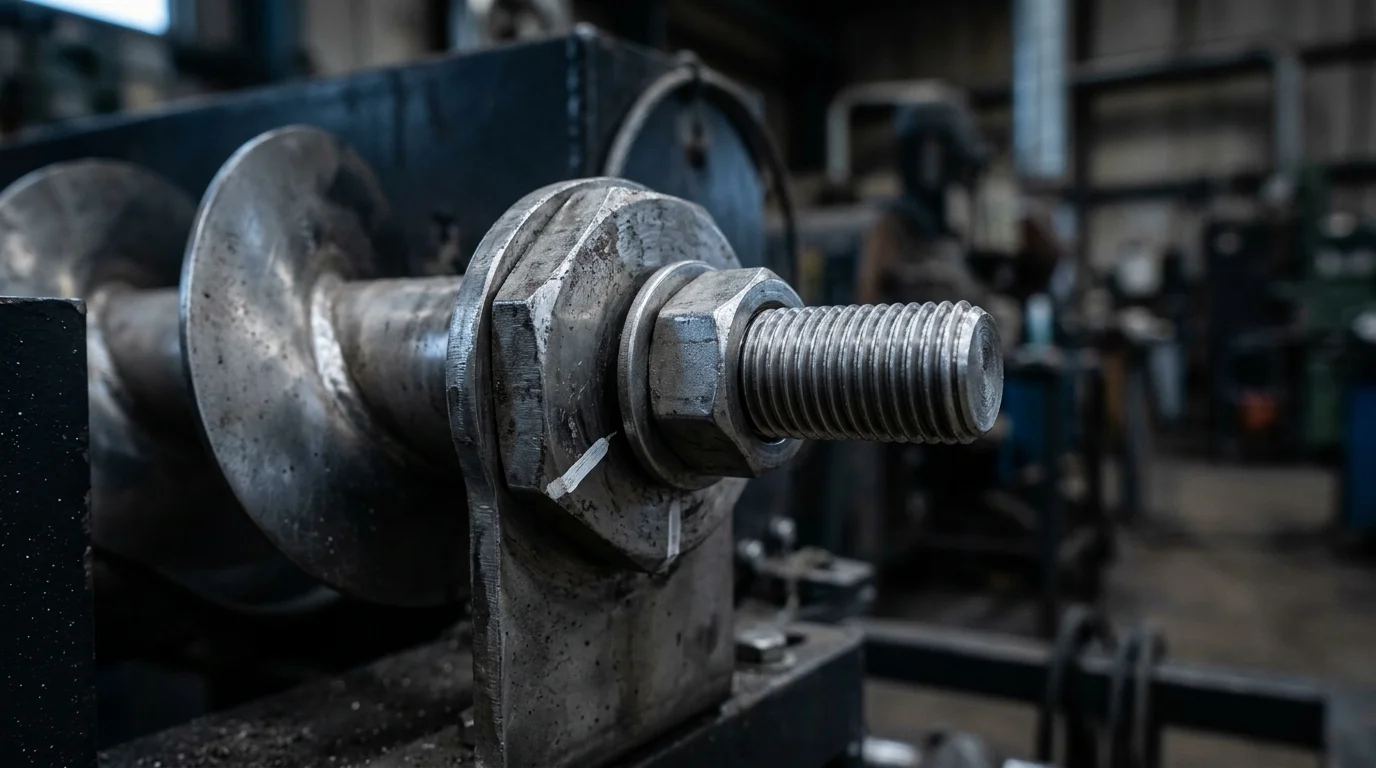
Grain Auger Bolt Shear: A Real-World Failure
During the 2023 autumn harvest, a combine harvester at a cooperative in Hebei was idled for three days after a bolt fractured, not due to a defective part, but because no one had verified the agricultural machinery-specific standards during selection. The bolt was part of a grain auger (grain auger bolt shear prevention), a critical component for moving harvested grain. Such failures are not rare: bolt shear fractures in grain augers account for a significant portion of all failures, often triggered by foreign object jamming, overload operation, or improper materials. In one case, a grain trailer overturned during harvest season because a hitch bolt failed due to incorrect torque. For procurement engineers and EPC contractors, the specification sheet you rely on could be the difference between a safe harvest and a costly accident.
By the end you will know how to select the right bolt grade, verify thread positioning, and apply the correct torque to prevent shear failures in grain augers, and be able to create a procurement checklist that covers all critical parameters.
1. Bolt Shear Failure: Beyond Tightening
In agricultural grain augers, bolt shear fractures are a leading failure mode, primarily caused by foreign object jamming, overload operation, or improper materials. These failures are not accidental but reflect design flaws. For example, a grain trailer hitch bolt failed because threads were exposed in the shear zone, causing the vehicle to overturn. If a longer shoulder bolt had been used, it would not have fractured under the same load. The shear strength of a bolt depends on the shank diameter and material, not the thread length. The thread root is a stress concentration point; when threads lie in the shear plane, shear strength is reduced by 30-50%. Therefore, during procurement, confirm that the bolt’s shank length covers the total thickness of the connected parts.
2. Torque Golden Rule: 70% Tensile Strength
Minimum preload standard: bolt preload should reach 70% of tensile strength (based on stress area). Torque calculation: Torque = Coefficient K × Bolt Diameter × Preload. The K value is affected by lubrication and thread type. For dry friction, K is approximately 0.2; for oil lubrication, it can drop to 0.15, leading to a potential 30% difference in preload under the same torque. Procurement tip: require suppliers to provide K values based on actual materials, not generic tables. Generic tables may ignore lubrication conditions and surface treatments, rendering torque specifications ineffective.
3. Materials and Grades: Shear Bolt as Safety Valve
Shear bolts are intentionally designed weak points: they fracture under overload to protect expensive components like the main shaft and gears. This design is analogous to a fuse in an electrical circuit. Grade selection: lower grades (e.g., Grade 2) are more prone to fracturing under shear, while higher grades (e.g., Grade 8) may transfer the failure point. For instance, the tensile strength of a Grade 2 bolt is approximately 74 ksi, while a Grade 8 bolt can reach 150 ksi. Procurement strategy: match the bolt grade with the preload according to the equipment manufacturer’s torque table (e.g., John Deere) to avoid over-strengthening, which may prevent the shear bolt from fracturing under overload and damage the main shaft or gears.
4. Thread Position: Life or Death in Shear Zone
The thread root is a stress concentration point: when threads are located in the shear plane, shear strength is reduced by 30-50%. Correct design: use bolts with a shank length exceeding the shear plane, or use fully threaded bolts with reduced torque. Shoulder bolts have higher shear strength due to their smooth surface and lack of stress concentration points. Procurement check: confirm the bolt’s shank length covers the total thickness of the connected parts. For example, if the total thickness is 50 mm, the shank length should be at least 55 mm to ensure the shear plane is in the shank area.
5. Overload Protection: Torque Is Not the Only Defense
Foreign object jamming (e.g., stones, metal fragments) is the most common overload source in grain augers. These objects can cause the bolt to instantly experience shear forces far exceeding the design load. Solution: use shear bolts as mechanical fuses, or install torque-limiting clutches. Shear bolts fracture under overload, absorbing energy and protecting the main shaft and gears. Procurement suggestion: clearly specify the overload protection design (e.g., fracture torque value of the shear bolt) in the contract, rather than relying solely on installation torque. For example, manufacturers like Farm King explicitly reserve the right to modify design specifications; request the latest torque table during procurement.
6. Fatigue Failure: The Overlooked Chronic Killer
Bolt fatigue accounts for a notable portion of failures: crack initiation → propagation → sudden fracture, a hidden process. Fatigue occurs under cyclic loading, such as continuous auger operation. Low preload leads to loosening, fretting wear, and fatigue cracks; high preload causes yielding. Procurement data: require suppliers to provide fatigue test reports, especially S-N curves under cyclic loading. S-N curves show bolt fatigue life at different stress levels, key for assessing long-term reliability.
7. Torque Table Traps: Lubrication and Surface Treatment
Lubrication conditions change the torque-preload relationship: under the same torque, dry friction and oil lubrication can result in a preload difference of about one-third (K drops from 0.2 to 0.15, F=T/(K·d) inversely amplifies).
Manufacturer notes: Farm King and other manufacturers explicitly reserve the right to modify design specifications—request the latest torque table during procurement. Torque tables may be adjusted due to lubrication conditions, surface treatments, or material batches.
Practical advice: specify lubrication conditions in the purchase order (e.g., “dry installation” or “MoS2 coating”) and attach the corresponding torque values. For example, the torque value for dry installation may be 100 Nm, while for MoS2 coating it may be 80 Nm.
Key Parameters Quick Reference
| Parameter | Standard/Recommended Value | Notes |
|---|---|---|
| Material Grade | Select based on working conditions | Refer to corresponding industry standards |
| Surface Treatment | hot-dip galvanized / Dacromet / Stainless steel | Determined by corrosion class C1-C5 |
| Inspection Interval | Quarterly or semi-annually | More frequent for critical locations |
| Replacement Criteria | Replace when wear/corrosion exceeds limits | Not based solely on age |
| Standard References | See standard clauses in text | Use as technical attachment in procurement |
8. Procurement Decision Checklist: From Specification to Verification
Must-check items:
- Bolt grade (Grade/Class) matches manufacturer’s torque table
- Shank length covers the shear plane
- Lubrication conditions are clearly specified
- Overload protection design included (shear bolt or clutch)
Verification methods: require suppliers to provide batch torque test reports, or conduct preload spot checks (using ultrasonic bolt stress meters). Ultrasonic bolt stress meters can precisely measure bolt preload to ensure compliance with specifications.
Ultimate warning: Do not replace equipment manufacturer-specific specifications (e.g., John Deere, Farm King) with “generic torque tables”—one misuse can equal one rollover. Generic torque tables ignore equipment-specific conditions and may lead to bolt failure and serious accidents.
Key standards cited in this article: NY/T 1640-2021 (Safety requirements for agricultural machinery), JB/T 8544-2015 (General technical conditions for agricultural machinery §4.3 Fastener requirements).
Bolt shear failure is not accidental but a chain reaction of design, procurement, and installation. From torque specifications to material grades, from thread position to overload protection, every detail determines equipment safety and lifespan. As a procurement decision-maker, the specification sheet in your hand is a technical document and a responsibility statement. Choosing the right bolt protects both equipment and people on site.
Next Steps
Prepare the following parameters/materials and contact Yaxiio technical team for selection advice and quotation:
- Working condition parameters: type of conveyed material (e.g., grain, feed), maximum load (kN or kg), working environment (temperature, humidity, corrosion class).
- Connection dimensions: total thickness of connected parts (mm), bolt hole diameter (mm), required bolt length (mm).
- Equipment manufacturer information: equipment brand and model (e.g., John Deere S790, Farm King 8700) to match the original torque table.
- Lubrication conditions: specify the lubrication state during installation (dry, oil lubrication, MoS2 coating, etc.).
Deep Reading
More systematic selection, procurement, or inspection guides.
- Farm Machinery Bolt Failures: From Root Causes to Reliable Selection and Maintenancewhitepaper
A more systematic guide on a related selection or inspection topic.
- Fastener Selection for Agricultural Processing Equipment: From Failure Mechanisms to Acceptance Decisionwhitepaper
A more systematic guide on a related selection or inspection topic.
- Energy Storage System Busbar Bolt Torque and Contact Resistance Controlwhitepaper
A more systematic guide on a related selection or inspection topic.
This article helps with selection and application. But in real projects, specifying the right part is only step one, finding the right factory, controlling quality, and delivering on time is the real challenge. We cover fasteners, rubber, plastics, and industrial textiles across four categories, from Zhejiang industrial clusters to your project site, one team, end to end.
See Our Supply Chain Capabilities →