Hot Dip Galvanizing: Durable Zinc Coating for Fasteners
Hot dip galvanizing process for steel fasteners, delivering thick, metallurgically bonded zinc coatings per ISO 10684 and GB/T 13912. Ideal for outdoor, coastal, and corrosive environments. Partner galvanizing plant with resident QC on every batch.
Send Drawings for a Quote →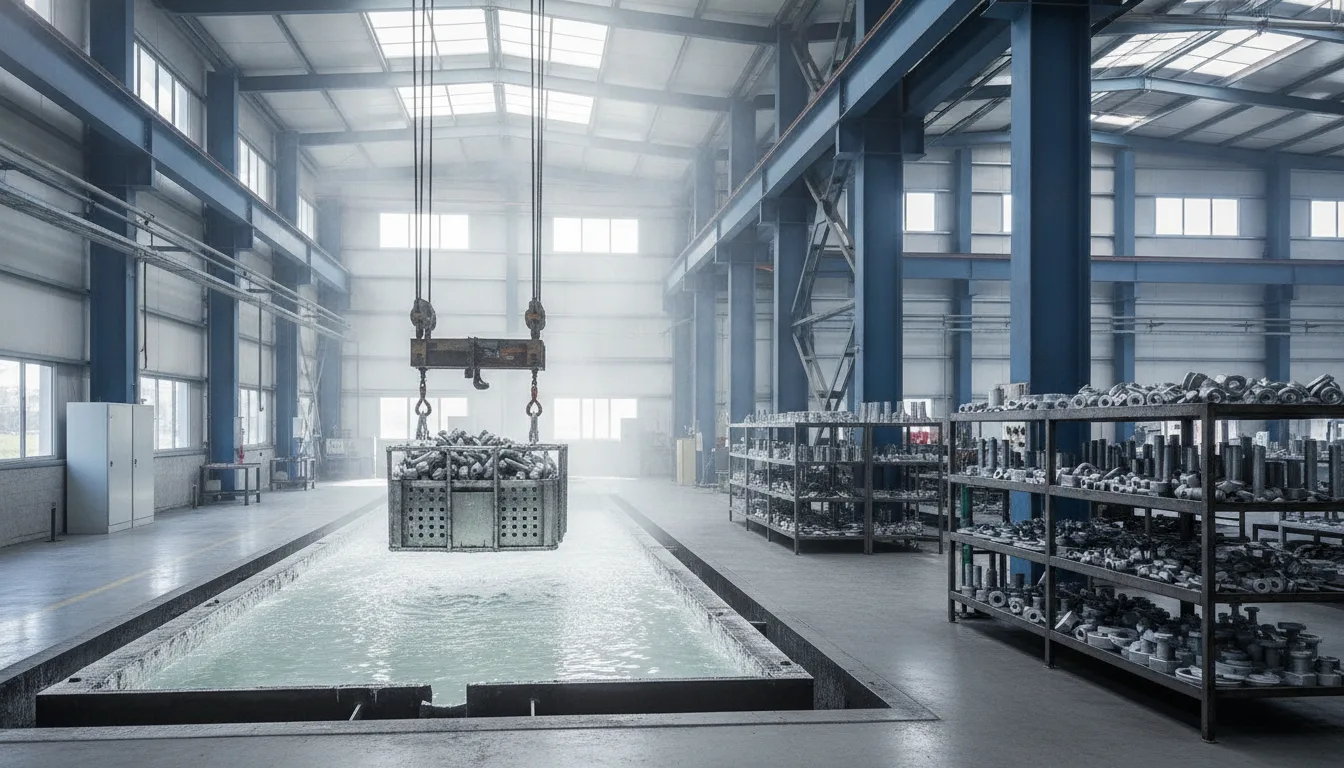
Process Overview
How It Works
Hot dip galvanizing is a process where steel fasteners are immersed in a bath of molten zinc, forming a metallurgically bonded zinc-iron alloy coating. The sequence includes surface cleaning, fluxing, immersion, withdrawal, quenching, and inspection. This coating provides sacrificial protection, making it ideal for long-term outdoor service. For fasteners, the coating thickness always exceeds per standard class, so threads require special manufacturing limits to ensure fit (ISO 10684:2004 clause 6.2).
Key Advantages
- ✓Thick, durable zinc coating: local minimum 40 µm, batch average 50 µm per ISO 10684 for fasteners
- ✓Sacrificial protection: zinc corrodes preferentially, protecting steel even at scratches and cut edges
- ✓Metallurgical bond: zinc-iron alloy layers formed by diffusion, not just a surface deposit
- ✓Proven in harsh environments: suitable for C2 to C5 corrosivity categories per ISO 9223
- ✓Cost-effective long-term protection: lower maintenance compared to paint systems
Typical Applications
Hot dip galvanized fasteners are used in outdoor structures, power transmission, substations, solar mounting, agriculture, marine environments, and infrastructure projects where long-term corrosion resistance is critical.
Capability Envelope
| Applicable standards | ISO 10684:2004, GB/T 13912-2020, GB/T 5267.3-2008, ASTM A123/A153 |
| Thread size range | M8 to M64 (coarse thread) |
| Property class | Up to 10.9 for bolts/screws/studs; up to 12 for nuts |
| Coating thickness (fasteners) | Local ≥per standard class, batch average ≥per standard class (ISO 10684) |
| Coating thickness (general steel) | Per ISO 1461 / GB/T 13912 tiers (local 35–per standard class, average 45–per standard class by steel thickness) |
| Production model | Partner hot-dip galvanizing plant with resident QC on site |
| Catalog SKUs | 381 active hot-dip galvanized fastener SKUs |
| Quality reports | Coating thickness reports, material certificates, salt spray test reports (on request) |
We operate a partner hot-dip galvanizing plant model: for every batch, our resident QC is stationed at the external galvanizer to verify coating thickness, thread fit, and surface quality. This ensures compliance with ISO 10684 and GB/T 13912 without maintaining our own plant. For hot dip galvanizing services, hot dip galvanizing companies, or hot dip galvanizing machine inquiries, we focus on fasteners—contact us for hot dip galvanized bolts and fasteners.
Per ISO 10684:2004 / ISO 1461:2022 / GB/T 13912-2020 / GB/T 5267.3-2008 / ASTM A123/A123M-24 / ASTM A153/A153M-23 / ISO 9223:2012 / ISO 14713-1:2017 / ISO 14713-2:2019 / ISO 14713-3:2017 (drawing callouts take precedence)
Design & Cost Tips (DFM)
Leave tool radius on inside corners
Sharp internal corners are not machinable: R ≥ tool radius (R1.5–R3 typical). Smaller radii mean more tool changes and higher cost.
Thin walls and deep cavities
Wall thickness ≥per specification for aluminum and ≥per specification for steel is recommended. Cavities deeper than ~5× tool diameter need a drawing review first.
Tolerate only critical features
Tight tolerances everywhere means expensive everywhere. Put per drawing on mating features and leave the rest to ISO 2768-mK.
Rethink small threads
Deep blind tapped holes need runout allowance. Below M2, evaluate rivet nuts or wire thread inserts for better cost and consistency.
Finishing changes dimensions
Anodizing and plating add microns to surfaces. Mask precision fits or leave allowance — and state it on the drawing.
Cost structure and volume breaks
Material, machine time, finishing and inspection are quoted separately. Unit price breaks clearly at batch-dependent — tell us the target volume.
Selection Boundaries: When to Use, When Not
Good fit
- ✓Outdoor structures and infrastructure: bridges, guardrails, transmission towers, substations
- ✓Coastal and industrial atmospheres with corrosivity categories C3 to C5 (ISO 9223)
- ✓Fasteners requiring thick, durable zinc coating: bolts, nuts, washers, studs
- ✓Applications where long-term maintenance is costly or difficult
Not recommended
- ✗Indoor, dry environments where thinner electro-galvanizing is sufficient and more cost-effective
- ✗High-strength fasteners above property class 10.9 (risk of hydrogen embrittlement)
- ✗Parts with fine threads below M8 (coating thickness may affect fit)
- ✗Applications requiring precise dimensional tolerances that thick coating would compromise
Process Flow
Surface cleaning: degreasing and acid pickling to remove oil, rust, and mill scale
Fluxing: application of flux solution to prevent oxidation before immersion
Drying: preheating to remove moisture and activate the flux
Immersion in molten zinc bath: zinc-iron alloy layers form by diffusion
Withdrawal and draining: excess zinc is removed, coating solidifies
Quenching and passivation: cooling and optional chromate treatment
Inspection: coating thickness measurement, thread fit check, visual inspection
Quality & Inspection
Inspection Capability
- •Quality & Inspection equipment per standard requirements
- •Coating thickness gauge (magnetic method, per ISO 1461 / ISO 10684)
- •Visual inspection of coating continuity and surface condition
- •Salt spray chamber (ISO 9227, project-case validation)
Available Reports
- •Coating thickness measurement report (per ISO 1461 / ISO 10684)
- •Material test certificate (MTC, lot traceable)
- •Resident QC batch inspection records (partner plant)
- •Third-party testing (SGS/BV on request)
Industries & Typical Parts
Power & Energy
- -Substation structures and busbar supports
- -Solar mounting systems
- -Wind turbine tower bolts
Agriculture
- -Greenhouse frames and fasteners
- -Fencing and livestock equipment
- -Irrigation systems
Industrial
- -Conveyor systems and supports
- -Storage racks and platforms
- -Chemical plant structures
Municipal & Infrastructure
- -Highway guardrails and signage
- -Bridges and walkways
- -Water treatment facilities
Mining
- -Conveyor structures
- -Screening equipment
- -Ventilation systems
FAQ
Need Hot Dip Galvanized Fasteners?
Get a quote for hot dip galvanized bolts, nuts, and washers per ISO 10684. Our team will review your drawings and provide a fast, competitive quote with full quality documentation.
Send Drawings for a Quote →Related Processes
Electro Galvanizing
Thinner electroplated zinc for indoor and mild environments — see the comparison
Related Whitepaper
Coating thickness vs salt spray hours — data for specification decisions
Coating Thickness Inspection
How to check galvanizing thickness on site — practical field methods
Fastener Catalog
Hot-dip galvanized fastener SKUs across diameter and property class options