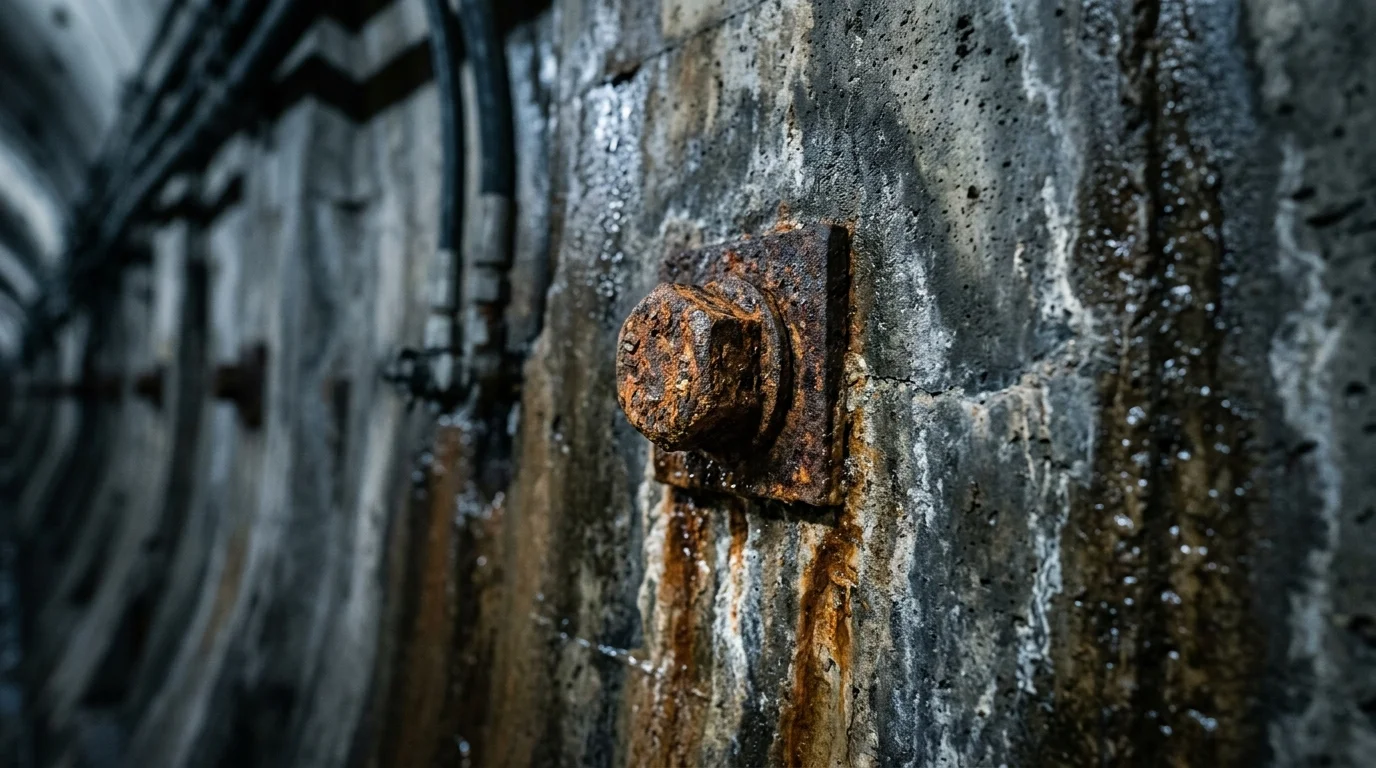
Case: Shanghai Metro Tunnel Bolt Corrosion
In March 2025, during a routine inspection at a Shanghai metro maintenance section, a tunnel segment that had been in operation for only 7 years showed obvious water seepage at segment joints. The galvanized coating on bolt surfaces had partially peeled off, and preload had decreased by more than 40%. This is not an isolated case; among tunnel leakage cases handled annually, a large portion are directly related to preload loss caused by bolt corrosion. For a grade-by-grade comparison of segment bolt materials, see our shield segment bolt comparison for tunnel conditions page.
By the end you will know how to select shield tunnel segment bolt materials based on burial depth, water pressure, and water quality, and be able to judge whether to upgrade the anti-corrosion scheme.
Core Issue: Corrosion of shield tunnel segment bolts in tunnel seepage water accelerates preload decay. Corrosion directly weakens the bolt cross-section. More critically, corrosion products (rust) expand in volume, creating fretting wear in the thread pair, causing preload to decay at a rate of 0.5% to 1.5% per day. When preload falls below 70% of the design value, segment joint opening exceeds standards, leakage intensifies, forming a vicious cycle of corrosion → leakage → more severe corrosion.
Matching Rules for Corrosion Environment and Bolt Selection
Tunnel seepage water is not simply uniform corrosion. Different burial depths, water pressures, and water qualities can result in corrosion rates for bolts differing by more than a factor of 10. Based on standards GB/T 1591-2018 and ISO 898-1, three selection red lines are summarized:
| Operating Condition Parameters | Corrosion Risk Level | Recommended Bolt Material | Corresponding Standard |
|---|---|---|---|
| Burial depth ≤ 20m, conventional metro | Low to Medium | Q235B Hot-dip Galvanized | GB/T 700-2006 |
| Burial depth 20-40m, high water pressure | Medium to High | 40Cr Quenched & Tempered + Phosphated | GB/T 3077-2015 |
| Burial depth > 40m, cross-sea / ultra-high water pressure | Extremely High | 40CrNiMoA Vacuum Degassed | GB/T 3077-2015 |
Key Parameter: In tunnel seepage water with pH 6.5 to 8.5, the corrosion rate of Q235B is approximately 0.1 to 0.3 mm/year, while that of 40Cr under the same conditions is only 0.05 to 0.15 mm/year. However, the truly fatal factors are not uniform corrosion, but crevice corrosion and stress corrosion—these are the Achilles’ heel of high preload bolts.
Bolt Selection Schemes for Three Operating Conditions
Scheme A: Q235B Standard Segment Bolt: Economical Choice for Conventional Metro Tunnels
Suitable for conventional metro sections with burial depth ≤ 20m and groundwater pressure ≤ 0.3MPa. Q235B hot-dip galvanized bolts, paired with Grade 8 Dacromet coated nuts, can meet a maintenance-free period of 8 to 10 years in moderately corrosive environments.
Core Parameters:
- Circumferential Bolt: M24×200, Grade 8.8, hot-dip galvanized coating thickness spec ≥ 50μm
- Longitudinal Bolt: M20×150, Grade 8.8, hot-dip galvanized coating thickness ≥ 50μm
- Nut: M24/M20, Grade 8, Dacromet coating
Note: When seepage water pH is < 6.5 (acidic) or Cl⁻ concentration > 500 mg/L, the service life of the hot-dip galvanized coating shortens to 3 to 5 years. In such cases, upgrading to Scheme B is recommended.
Scheme B: 40Cr High-Strength Segment Bolt: Standard for Heavy-Duty Traffic / High Water Pressure Tunnels
For heavy-duty traffic tunnels with burial depth 20-40m and water pressure 0.3-0.8MPa, or metro sections with complex geological conditions (e.g., crossing fault fracture zones), 40Cr quenched and tempered bolts are the mainstream industry choice.
Core Parameters:
- High-Strength Circumferential Bolt: M30×250, Grade 10.9, phosphated
- High-Strength Longitudinal Bolt: M27×200, Grade 10.9, phosphated
- High-Strength Nut: M30/M27, Grade 10, phosphated
Technical Advantages: After quenching and tempering, 40Cr has tensile strength ≥ 1000MPa and yield strength ≥ 900MPa, approximately 40% higher than Q235B. The phosphate coating (thickness 10-20μm) provides additional protection in humid environments and does not pose the risk of hydrogen embrittlement like galvanized coatings.
Data Support: In accelerated corrosion tests simulating tunnel seepage water (pH=7.2, Cl⁻=200mg/L), the preload retention rate of 40Cr phosphated bolts was still 92% after 180 days, while that of Q235B hot-dip galvanized bolts was only 78%.
Scheme C: 40CrNiMoA Extreme Segment Bolt: Ultimate Solution for Cross-Sea / Ultra-Deep Tunnels
When burial depth > 40m, water pressure > 1.0MPa, or the tunnel passes through seawater / high-salinity-alkali strata, ordinary alloy steel can no longer meet requirements. 40CrNiMoA vacuum degassed bolts, paired with Grade 12 cadmium-plated nuts, are the only choice to address the triple challenge of ultra-high water pressure + strong corrosion + ultra-long service life.
Core Parameters:
- Special Alloy Circumferential Bolt: M36×300, Grade 12.9, vacuum degassed
- Special Alloy Longitudinal Bolt: M30×250, Grade 12.9, vacuum degassed
- Special Alloy Nut: M36/M30, Grade 12, cadmium-plated
Why 40CrNiMoA? While maintaining ultra-high strength (tensile ≥ 1200MPa), this material possesses excellent resistance to stress corrosion cracking. The vacuum degassing process reduces hydrogen content to ≤ 2ppm, eliminating hydrogen embrittlement risk. Cadmium plating (thickness 8-15μm) offers corrosion resistance in seawater environments several times higher than galvanized coatings, with stable friction coefficient (0.12-0.15) ensuring preload control accuracy.
Real Case: The Hong Kong-Zhuhai-Macao Bridge immersed tube tunnel (burial depth about 45m, water pressure 1.2MPa) uses similar grade bolts, with a design life of 120 years and zero corrosion failure records in 7 years of operation.
Selection Decision Table: Quick Matching from Operating Conditions to Bolts
| Operating Conditions | Recommended Scheme | Key Reason | Preload Decay Control Target |
|---|---|---|---|
| Burial depth ≤20m, pH=7~8, Cl⁻<200mg/L | Scheme A | Economy priority, 8-year maintenance-free | ≤15%/10 years |
| Burial depth 20-40m, pH=6.5~8.5, Cl⁻<500mg/L | Scheme B | Strength + corrosion resistance balance, 15-year maintenance-free | ≤10%/15 years |
| Burial depth >40m, seawater/high salinity, pH<6.5 | Scheme C | Extreme corrosion resistance + stress corrosion resistance, 30-year maintenance-free | ≤5%/30 years |
| Heavy-duty traffic + high-frequency vibration | Scheme B or C | High fatigue strength (Grade 10.9 and above) | ≤8%/20 years |
Installation and Maintenance “Anti-Corrosion” Details
- Torque Control: Use a digital torque wrench with accuracy ±3%. Recommended preload for 40Cr bolts is 70%~80% of yield strength, and for 40CrNiMoA is 60%~70% (to avoid stress corrosion sensitive zone).
- Sealing Treatment: Inject polyurethane sealant into bolt holes to prevent seepage water from penetrating along the thread pair. Schemes B and C are recommended to be used with O-ring seals.
- Regular Inspection: During operation, sample 5% of bolts every 2 years for preload inspection; if decay >20%, replace immediately.
Next Steps
To obtain a customized bolt selection scheme, please prepare the following parameters and contact our engineers:
- Tunnel burial depth and groundwater pressure
- Seepage water quality analysis report (pH, Cl⁻, SO₄²⁻, etc.)
- Design life and maintenance-free period requirements
- Existing bolt specifications and materials (if any)
Our engineers will provide a detailed selection report and quotation based on your specific working conditions. Visit our contact page or capabilities page for more information.
Deep Reading
More systematic selection, procurement, or inspection guides.
- Fastener Selection for Agricultural Processing Equipment: From Failure Mechanisms to Acceptance Decisionwhitepaper
A more systematic guide on a related selection or inspection topic.
- How to Select Fasteners for T&D Systems in Southeast Asia: An Engineering Application & Procurement Decision Guidewhitepaper
A more systematic guide on a related selection or inspection topic.
- Livestock Facility Fastener Selection: Corrosion Zones, Materials, and Inspectionwhitepaper
A more systematic guide on a related selection or inspection topic.
This article helps with selection and application. But in real projects, specifying the right part is only step one, finding the right factory, controlling quality, and delivering on time is the real challenge. We cover fasteners, rubber, plastics, and industrial textiles across four categories, from Zhejiang industrial clusters to your project site, one team, end to end.
See Our Supply Chain Capabilities →