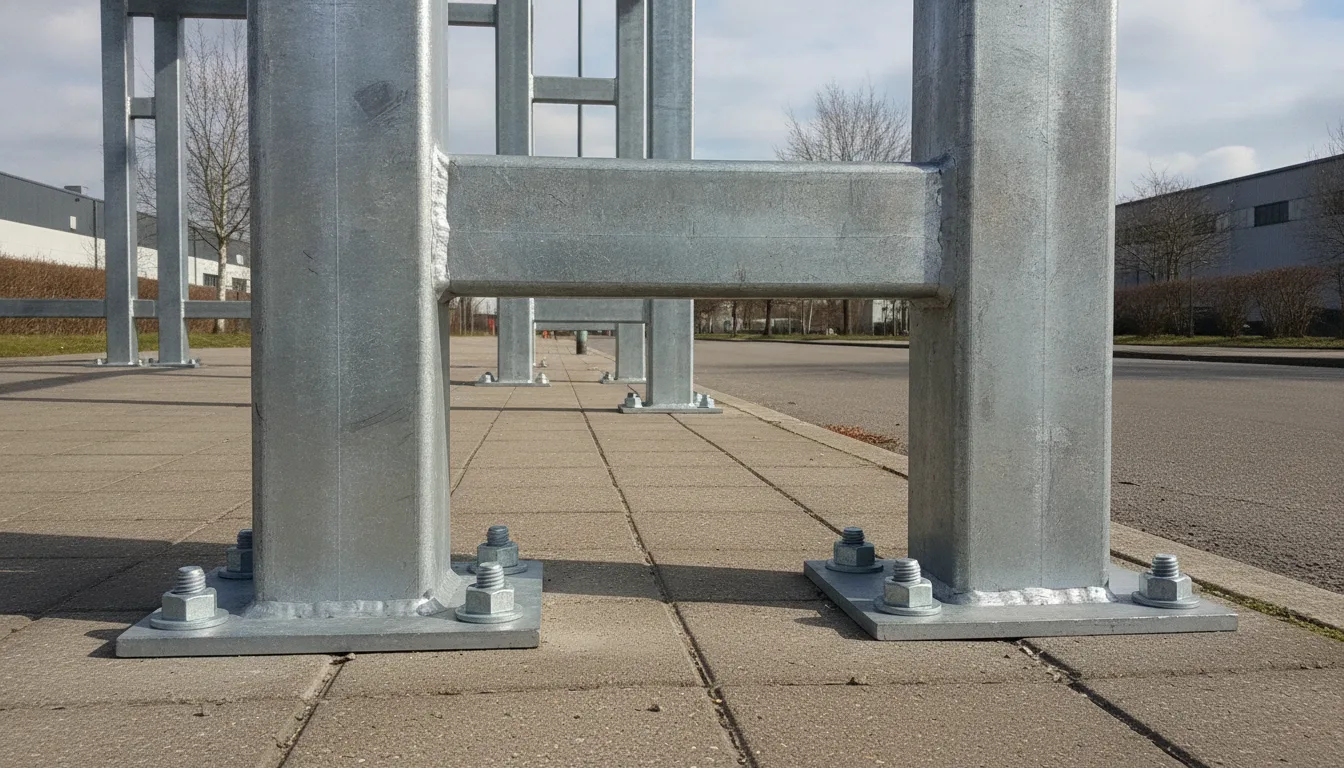
A bus shelter looks like a few pillars holding up a roof, but it is actually a typical cantilevered steel structure. With rear columns and a front cantilever, the entire weight of the roof and wind load are concentrated on the anchor bolts of the front columns. During the same typhoon, the roofs of ordinary buildings remained intact, while the bus shelter was ripped out by its roots, because the overturning moment of a cantilevered structure is several times that of an ordinary column. By the end you will know how to calculate wind load on a bus shelter, identify why anchor bolts loosen, and apply a construction inspection checklist to prevent failures.
Wind Load Calculation and Selection
A standard bus shelter roof area is approximately 8-12m². Calculated according to GB 50009 with a basic wind pressure of 0.45kN/m²:
| Parameter | Value | Formula |
|---|---|---|
| Wind Load | 3.6-5.4 kN | Area x Basic Wind Pressure x Shape Coefficient 1.3 |
| Cantilever Arm | 2.5m | Roof center to foundation top surface |
| Overturning Moment | 9-13.5 kNm | Wind Load x Arm |
| Front Column Spacing | 1.5m | Double column spacing |
| Single Column Uplift Force | 6-9 kN | Overturning Moment / Column Spacing |
The tensile capacity of an M16 Grade 8.8 bolt is approximately 60kN, from a static perspective, the wind load is far less than the bolt strength. However, the problem is repeated alternation: the wind direction changes every few minutes, creating a tension-compression cycle. Under alternating loads, bolt preload decays by 20% in the first year and another 10% in the second year (typical values based on engineering experience). After three years, the actual preload is only 55% of the design value.
Why Anchor Bolts are Ripped Out by the Roots
| Failure Mode | Cause | Proportion |
|---|---|---|
| Concrete Foundation Crushing | Insufficient bolt edge distance, concrete cone failure | 45% |
| Bolt Tensile Fracture | Fatigue fracture, crack propagation from thread root | 30% |
| Bolt Pullout | Insufficient anchorage depth or chemical anchor aging | 15% |
| Nut Loosening and Falling Off | No anti-loosening measures, vibration loosening | 10% |
Note: The proportions above are typical failure distribution based on field observations, not from a specific standard.
Three Key Selection Factors
| Factor | Requirement | Standard |
|---|---|---|
| Bolt Specification | Minimum M16x300, Grade 8.8 Hot-Dip Galvanized | GB/T 5782-2016 (Hexagon Head Bolts) |
| Anchorage Depth | 10d (160mm), pre-embedment preferred | GB 50367 |
| Anti-Loosening Measures | Double nut + spring washer, or Spiralock lock nut | GB/T 10433-2002 (Cylindrical Head Studs for Arc Stud Welding) |
Construction Inspection Checklist
| Step | Inspection Item | Tool |
|---|---|---|
| 1 | Foundation Concrete Strength C30 | Rebound Hammer |
| 2 | Anchor Bolt Verticality 2mm/m | Spirit Level |
| 3 | Tightening Torque M16: 210-250 Nm | Torque Wrench |
| 4 | Re-tightening per OEM maintenance manual | Torque Wrench |
📐 Key standards referenced in this article: GB 50017-2017 §7.2 (High-strength bolt connections for steel structures), GB 50205-2020 §6.3 (Acceptance of high-strength bolt construction quality).
TCO Calculation: 5-Year Cost Comparison
Taking 500 M16 bolts as an example:
| Cost Item | Carbon Steel + Hot-Dip Galvanizing | 304 Stainless Steel | 316L Stainless Steel |
|---|---|---|---|
| Procurement | 1,750 RMB | 6,000 RMB | 12,000 RMB |
| 5-Year Maintenance | 7,500 RMB | 0 RMB | 0 RMB |
| Replacement | 1,750 RMB | 0 RMB | 0 RMB |
| 5-Year TCO | ~11,000 RMB | ~6,000 RMB | ~12,000 RMB |
304 stainless steel is recommended for municipal engineering. The TCO figures are based on typical project estimates; actual costs may vary.
Decision Guide: Choosing the Right Bolt and Maintenance Strategy
Summary
- For high-frequency vibration or wind-induced alternating loads, use wedge lock washers or Spiralock nuts; spring washers are nearly ineffective in Junker tests.
- For coastal or corrosive environments, 304 stainless steel offers lower 5-year TCO than carbon steel with hot-dip galvanizing coating, despite higher initial cost.
Next Steps: What to Prepare
Before contacting a supplier, prepare the following parameters to get accurate recommendations:
- [ ] Site wind load data: Basic wind pressure (kN/m²) from local building code or meteorological data.
- [ ] Shelter dimensions: Roof area, cantilever length, column spacing, and height.
- [ ] Bolt specification: Current bolt size, grade, material, and coating (if any).
- [ ] Maintenance schedule: Frequency of inspection and re-tightening, if available.
For further assistance, you can contact us or explore our capabilities.
Deep Reading
More systematic selection, procurement, or inspection guides.
- Farm Machinery Bolt Failures: From Root Causes to Reliable Selection and Maintenancewhitepaper
A more systematic guide on a related selection or inspection topic.
- Undercarriage Fastener Failures: Why Bolts Loosen and Pins Wear, and How to Make the Right Maintenance and Procurement Decisionswhitepaper
A more systematic guide on a related selection or inspection topic.
- Bolted Connection Engineering for Agricultural Facilities: Failure Mechanisms, Selection, and Maintenancewhitepaper
A more systematic guide on a related selection or inspection topic.
This article helps with selection and application. But in real projects, specifying the right part is only step one, finding the right factory, controlling quality, and delivering on time is the real challenge. We cover fasteners, rubber, plastics, and industrial textiles across four categories, from Zhejiang industrial clusters to your project site, one team, end to end.
See Our Supply Chain Capabilities →