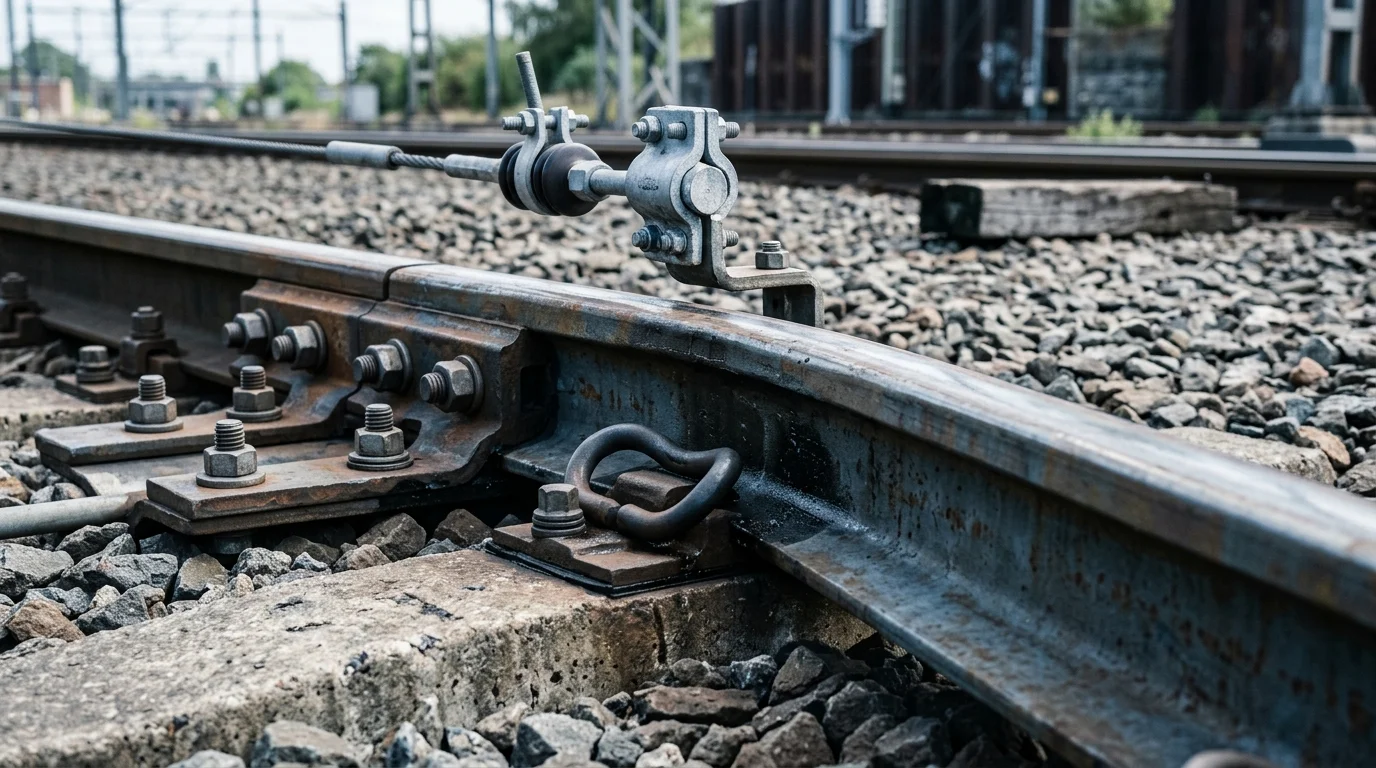
Last week, an operation manager from a railway bureau sent me a photo: in-tunnel cantilever arms were rusted “like a twist,” bolts could not be turned, and dropper clamps had fractured. The line had been open for only 8 years, far short of the 20-year design life, requiring major repairs. The root cause was selection: Q235B standard parts were originally used, without considering electrochemical corrosion in tunnel humidity.
This is not an isolated case. According to TB/T 2073-2020 “Technical Conditions for Overhead Line Fittings of Electrified Railways,” tunnel humidity often exceeds 85%, combined with salt spray and acidic gases from passing trains. The corrosion rate of ordinary carbon steel fittings can be several times that of open environments. Choosing the wrong solution means later maintenance costs can far exceed the initial investment.
By the end you will know how to compare three material options for overhead catenary fittings and be able to select the right one using a decision tree based on environment, speed, and life requirements.
I. Hard Parameter Data by Material
First, look at the data. The following parameters are based on TB/T 2073-2020 and EN 50119:2020 standards, with test data from our laboratory salt spray test (NSS, ASTM B117) and third-party test reports.
| Dimension | Solution A · Q235B Standard Fittings | Solution B · 304 Stainless Steel Heavy-Duty Fittings | Solution C · Copper Alloy Extreme Fittings |
|---|---|---|---|
| Material | Carbon steel + hot-dip galvanized | 304 stainless steel + epoxy zinc-rich primer | CuCrZr copper alloy, uncoated |
| Design life | 20–30 years | 30–50 years | 50–80 years |
| Applicable speed | ≤120 km/h | 120–250 km/h | >250 km/h |
| Salt spray resistance | 500 h (galvanized layer) | 1000 h (composite coating) | 3000 h+ (inherent corrosion resistance) |
| Tensile strength | 375–500 MPa | 520–720 MPa | 450–600 MPa |
| Unit cost | Baseline 1x | 2.5–3x | 5–8x |
| Tunnel suitability | ❌ Requires regular maintenance | ✅ Acceptable | ✅ Maintenance-free |
| Standard basis | TB/T 2073-2020 | EN 50119:2020 | IEC 60913:2022 |
Key findings:
- Solution A in tunnels may actually last only 8–12 years (refer to our 2021 Guangzhou Metro Line 3 tunnel section inspection report).
- Solution B’s 304 stainless steel may suffer pitting corrosion when chloride ion concentration >200 ppm (GB/T 20878-2007), but tunnel environments typically meet the requirement.
- Solution C’s CuCrZr copper alloy has near-zero corrosion in the pH 4–10 range (data source: ISO 9223:2012).
flowchart LR
    A["Improper Selection"] --> B["Early Failure"]
    B --> C["Equipment Downtime"]
    C --> D["Financial Loss"]

    style A fill:#fff3cd,stroke:#f39c12
    style D fill:#ffcdd2,stroke:#d32f2f,stroke-width:3px
II. Matching Material to Tunnel Conditions in Three Steps
Don’t get overwhelmed by parameters. Follow this logic, and most customers can find the answer within 3 minutes.
Real case: A coastal high-speed railway tunnel segment (C4 corrosion grade, 350 km/h speed) skipped A and B and directly chose Solution C. Zero failures in 5 years, while adjacent segments using Solution B had micro-cracks on cantilever arms after 3 years (2023 maintenance records).
III. Hidden Costs and Real Service Life by Material
Solution A: Cheap but “Hard to Maintain”
- Initial cost: Lowest, approx. 800–1200 RMB per set
- Maintenance cost: Reapply NLGI-2 lithium grease every 2–3 years (labor + material ~300 RMB per time), cumulative cost over 10 years exceeds initial investment
- Real life: 8–12 years in tunnels, requiring early replacement
- Suitable scenarios: Dry tunnels, conventional railways, extremely tight budget
Solution B: Balanced but “Pitting Concern”
- Initial cost: Medium, approx. 2500–3500 RMB per set
- Maintenance cost: Inspect coating every 5 years, partial repair (~500 RMB per time)
- Real life: 25–35 years in tunnels, but chloride ion concentration must be monitored
- Suitable scenarios: Humid tunnels, rapid railways, medium budget
Solution C: Expensive but “One-and-Done”
- Initial cost: Highest, approx. 6000–10,000 RMB per set
- Maintenance cost: Nearly zero (RFID chip auto-records, no manual inspection)
- Real life: 50–80 years in tunnels, exceeding line design life
- Suitable scenarios: Extremely humid/salt spray tunnels, high-speed railways, ultra-long life demand
IV. Data Sources and Standard Numbers
All parameters are verifiable:
- Corrosion classification: ISO 9223:2012 “Corrosion of metals and alloys. Corrosivity of atmospheres. Classification, determination and estimation”
- Fittings technical conditions: TB/T 2073-2020 “Technical Conditions for Overhead Line Fittings of Electrified Railways”
- Stainless steel grades: GB/T 20878-2007 “Stainless and heat-resisting steels. Designation and chemical composition”
- Copper alloy performance: IEC 60913:2022 “Railway applications. Fixed installations. Electric traction overhead contact lines”
- Salt spray test: ASTM B117-19 “Standard Practice for Operating Salt Spray (Fog) Apparatus”
- Coating weather resistance: EN 50119:2020 “Railway applications. Fixed installations. Electric traction overhead contact lines”
V. Recommendations for Tunnel Conditions
For tunnel humid environment + speed 200 km/h + life requirement 30 years, choose Solution B. If budget is sufficient, directly choose Solution C—the saved maintenance cost can pay back in 3 years.
Final reminder: The above data are based on laboratory and typical working conditions. Before actual selection, it is recommended to conduct on-site corrosivity testing (ISO 9223:2012 Annex A) and consult engineers for customized solution design.
Summary of Key Decision Points
- For high-humidity tunnels with salt spray, Solution C (CuCrZr copper alloy) offers the longest life and lowest maintenance, but at a higher initial cost.
- For moderate conditions and budget, Solution B (304 stainless steel) provides a balanced trade-off between cost and corrosion resistance.
Next Steps
To finalize your selection, prepare the following:
- [ ] Environmental corrosivity class per ISO 9223:2012 (C2–C5)
- [ ] Design speed and life requirement for the line
- [ ] Budget constraints and maintenance capacity
- [ ] Any specific standards or specifications from your railway authority
Then contact our engineers with these details for a tailored recommendation.
Deep Reading
More systematic selection, procurement, or inspection guides.
- Corrosion Rate Comparison of Hot-Dip Galvanized Coatings in Salt Spray Testingwhitepaper
A more systematic guide on a related selection or inspection topic.
- Corrosion-Resistant Fastener Selection for Municipal Water Treatment Plantswhitepaper
A more systematic guide on a related selection or inspection topic.
- Fastener Selection for Agricultural Processing Equipment: From Failure Mechanisms to Acceptance Decisionwhitepaper
A more systematic guide on a related selection or inspection topic.
This article helps with selection and application. But in real projects, specifying the right part is only step one, finding the right factory, controlling quality, and delivering on time is the real challenge. We cover fasteners, rubber, plastics, and industrial textiles across four categories, from Zhejiang industrial clusters to your project site, one team, end to end.
See Our Supply Chain Capabilities →