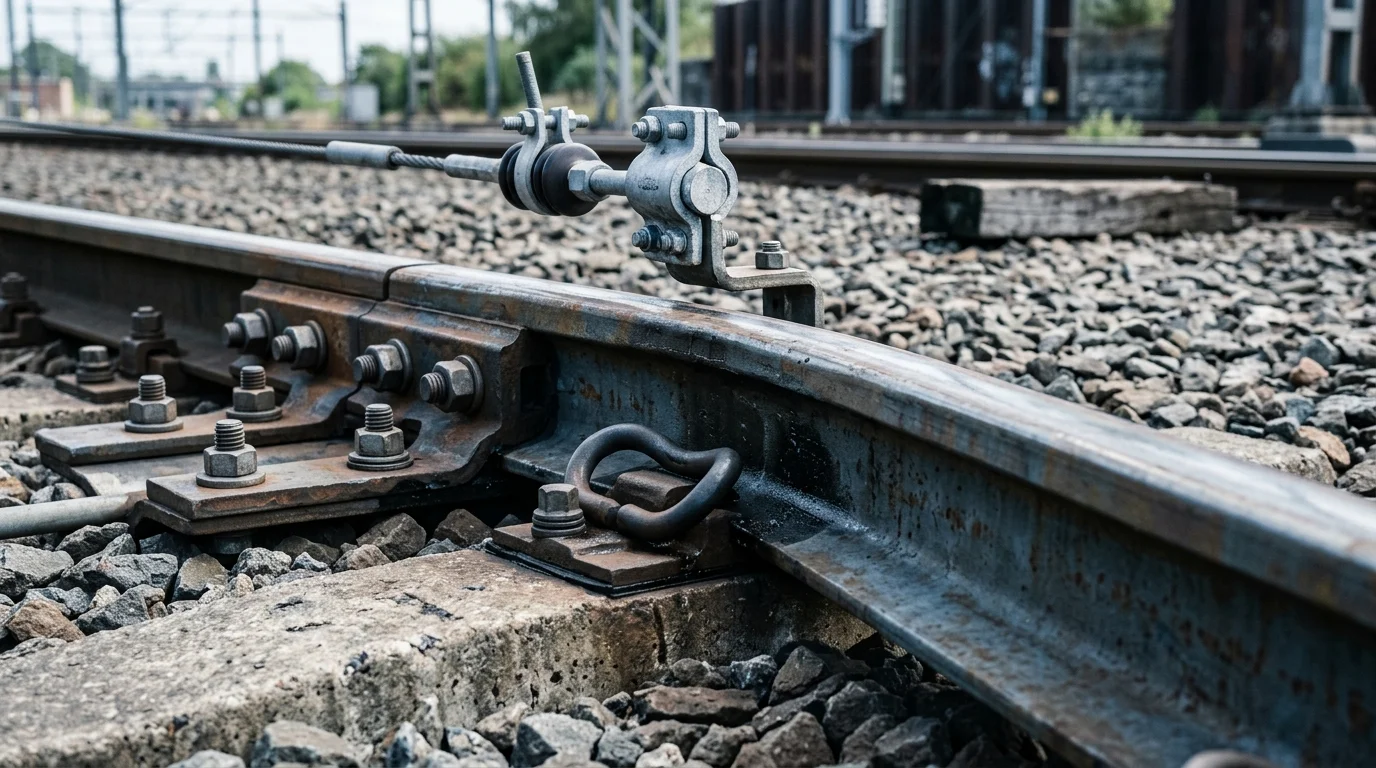
Selecting catenary fittings (catenary hardware) for subway or rail tunnels is not a hunt for the most expensive alloy. It is a methodical exercise in matching four dimensions: the environmental corrosion severity, the relevant international standards, the metallurgical and process capability of the material, and the quality assurance behind its manufacturing. In a tunnel, ordinary structural choices can fail within a few years when humidity, stray current, and airborne contaminants combine into an aggressive electrochemical attack. The following five-step logic unpacks the decision chain from first site assessment through to final acceptance testing, with an emphasis on verifying compatibility across the entire cantilever assembly, positioners, dropper clamps, cantilever arms, and fasteners.
By the end you will know how to assess tunnel corrosion severity, compare material standards, verify material authenticity, and inspect incoming hardware—and be able to apply this logic to your own procurement decisions.
Step 1 – Condition Assessment: Determine the Corrosion Environment First
Before any material grade appears on a specification sheet, the environmental stressors inside the tunnel must be characterised. Three parameters matter most.
Humidity and condensation frequency – In many tunnels relative humidity exceeds 85 % throughout the year, often with condensation forming during temperature swings between night and day operation. Where condensation persists more than a few hours per day, direct metallic contact between dissimilar materials becomes an almost permanent wet circuit for galvanic action.
Stray current intensity – DC traction systems can leak current into the track structure and from there into metallic components. Standards such as EN 50122‑2 provide calculation and measurement frameworks for stray current; the acceptable levels depend on the track return circuit design and the presence of stray current collection mats. Even if the average current density appears low, local hotspots at isolated joints can drive pitting corrosion rates well above the general background level.
Chloride and sulphur compound concentrations – Coastal urban tunnels may see chloride deposition from aerosol ingress, ventilation shafts, or even de‑icing salts carried into the tunnel by trains. Sulphides often originate from brake shoe dust or diesel exhaust where hybrid traction is used. ISO 9223 provides a corrosivity classification (C1 to CX) based on the combined effect of humidity, temperature, and airborne pollutants. A tunnel classed as C3 (medium) with no measurable stray current could permit hot-dip galvanized carbon steel with an appropriate service‑life reserve. Once conditions move into C4 or C5 territory, or when stray currents are confirmed, carbon steel with only a zinc coating is no longer a defensible baseline; stainless steel, copper alloys, or nickel‑base materials must enter the evaluation.
Decision logic – Start by assigning a corrosivity category per ISO 9223 using actual hygrothermal and pollution measurements. Add the stray‑current dimension from EN 50122‑2 assessments. Where the combination suggests a “high” corrosion risk, eliminate material plans that rely solely on barrier coatings. This prevents the common misjudgment of applying an atmospheric‑only classification to a system that is in reality wet, current‑carrying, and chemically loaded.
Step 2 – Standards Cross-Reference: Set Material Minimums with Exact References
A generic material name such as “stainless steel” or “galvanised steel” is meaningless without the corresponding standard number and edition. Tunnel fittings require not only structural standards but also corrosion protection and fastener standards.
Material substrate standards – If a carbon steel tube is to be used for cantilevers, a structural seamless tube standard such as EN 10210 or ASTM A501 is appropriate; welded tube standards may carry different tolerances and weld‑zone properties that can weaken the part under cyclic catenary loads. For stainless steels, grades must be specified by reference to flat‑product or long‑product standards (e.g. ISO 15510 for chemical composition ranges, EN 10088‑3 for bars). Requiring a specific grade, 304 (UNS S30400), for instance, should be accompanied by a chemical composition certificate showing Cr 18.0–20.0 %, Ni 8.0–10.5 %, C ≤ 0.08 %, and Mn not exceeding 2.0 %; otherwise, a substitution with a lower‑cost austenitic‑manganese grade remains undetected.
Galvanising and coating standards – When hot‑dip galvanising is permitted, the minimum coating thickness should be referenced to a standard such as EN ISO 1461 or ASTM A123. For structural steel thicker than 6 mm, EN ISO 1461 requires an average coating thickness of at least 85 µm, but in a permanently damp tunnel environment it is common practice to specify ≥120 µm for extended service intervals. Paint systems applied over zinc (duplex systems) must refer to ISO 12944 parts 5 and 6 for the selection and performance of protective paint systems in corrosivity category C4 or higher. For electroplated zinc‑alloy coatings or zinc‑flake coatings on fasteners, ISO 10683 or the relevant product standard defines salt‑spray resistance requirements; typical practice calls for at least 720 hours to red rust under ISO 9227 for components exposed to condensation.
Fastener performance grades – Bolts, nuts, and washers must be marked with property classes per ISO 898-1 (carbon and alloy steel) or ISO 3506‑1 (stainless steel). For example, “8.8” indicates that the part must meet all mechanical requirements of that standard, including tensile strength, yield ratio, and hardness. For stainless fasteners, grades such as A2‑70 or A4‑80 indicate material and strength level; verify supplier certificates match the specified grade.
Decision logic – Build a list of required standards for each component (substrate, coating, fastener). Reject any quotation that does not cite exact standard numbers and editions. This step alone filters out many non‑conforming products.
Step 3 – Material Verification: Confirm Composition and Process
Even when the documentation cites the correct standards, the actual material must be verified. This step involves both chemical and mechanical checks.
Chemical composition – For stainless steel, a portable X‑ray fluorescence (XRF) spectrometer can quickly confirm the presence of key elements: chromium, nickel, manganese, and carbon. If manganese is high and nickel is low, the material may be a lower‑grade austenitic manganese steel with poorer corrosion resistance. For copper alloys, verify the main alloying elements (e.g., copper, chromium, zirconium in CuCrZr alloys) to ensure compliance with the specified grade.
Mechanical properties – Hardness testing is a quick screening method. For example, per ISO 898‑1, an 8.8‑grade bolt should have a hardness range of HRC 22–32. For forged carbon steel parts, the forging temperature range (e.g., 850–950 °C) is critical for achieving fine grain structure and toughness; request process records from the supplier for confirmation.
Electrochemical compatibility – In humid environments, galvanic corrosion can occur when dissimilar metals are in contact. The galvanic series (e.g., ASTM G82) can be used to estimate potential differences. A potential difference below about 0.3 V is generally considered low risk; carbon steel and copper have a large potential difference, so insulation or compatible alloy pairs are needed. Copper alloys and stainless steel are relatively close in the galvanic series, making them a safer combination in most tunnel environments.
Decision logic – Verify in this order: chemical composition → mechanical properties → galvanic compatibility. The last item is often overlooked but is critical in humid, stray‑current‑prone tunnels.
Step 4 – Supplier Process Control: Demand Traceability
Material certificates alone are not enough; you need evidence that the supplier has effective control over their processes.
Heat treatment records – Request continuous temperature‑time curves for each batch. Uniformity and control range directly affect microstructure and properties. A final mechanical test report alone is insufficient to rule out process deviations.
Testing equipment – Key instruments such as coating thickness gauges, adhesion testers, and spectrometers must be within calibration validity. During audits, request demonstration measurements using standard samples to confirm capability.
Batch traceability – Each fitting should have a permanent marking (e.g., laser engraving) that can be linked to the material heat number, heat treatment batch, and test report number. This ensures that if a defect is found, the affected batch can be precisely identified.
Decision logic – Prefer suppliers with relevant certifications (e.g., EN 15085 for railway welding) and quality management systems that allow open access to process records. Reject those that provide only final material certificates without any intermediate process control data.
Step 5 – Incoming Inspection: Verify Dimensions, Coatings, and Fastening
Even with a reliable supplier, incoming inspection is the last line of defense. The following checks should be performed on every delivery.
Dimensional checks – Use calibrated gauges to verify critical dimensions such as hole diameters, thread pitch, and overall lengths. For cantilever arms, check straightness and wall thickness at multiple points. Any deviation beyond the specified tolerance (e.g., ±0.5 mm for hole positions) should trigger rejection.
Coating thickness and adhesion – For galvanised parts, use a magnetic induction or eddy current thickness gauge to measure coating thickness at several points. The average should meet the specified minimum (e.g., ≥120 µm for tunnel environments). Adhesion can be tested by cross‑cut or pull‑off methods per relevant standards.
Fastener torque test – For critical bolted connections, perform a torque‑tension test on a sample basis to ensure that the specified torque achieves the required preload without thread stripping. This is especially important for stainless steel fasteners, which are prone to galling.
Documentation review – Verify that the delivery includes all required certificates: material test reports, coating thickness records, heat treatment charts, and calibration certificates for testing equipment. Cross‑check the batch numbers on the parts with the documents.
Decision logic – Establish a clear incoming inspection procedure with defined acceptance criteria. Record all measurements and retain samples for future reference. If any check fails, quarantine the entire batch and notify the supplier immediately.
Summary of Key Decision Points
- In high‑humidity tunnels with stray current, carbon steel with only a zinc coating is not a defensible baseline; stainless steel or copper alloys should be considered.
- Always require exact standard references (e.g., ISO 898‑1, EN ISO 1461) and verify material composition with XRF before accepting any batch.
Next Steps
To apply this five‑step logic to your next OCS hardware procurement, prepare the following:
- [ ] Tunnel environmental data: relative humidity, condensation frequency, stray current measurements, and chloride/sulphur deposition rates.
- [ ] A list of all components with required standards (substrate, coating, fastener) and acceptance criteria.
- [ ] A supplier audit checklist covering heat treatment records, testing equipment calibration, and batch traceability.
- [ ] An incoming inspection plan with dimensional, coating, and torque test procedures.
For further assistance in selecting or verifying OCS hardware, explore our capabilities or contact us to discuss your specific tunnel environment.
Material Matrix for Tunnel Environments
| Environment | Corrosivity Class (ISO 9223) | Stray Current | Recommended Material | Coating/Protection |
|---|---|---|---|---|
| Dry tunnel, low humidity | C1–C2 | None | Carbon steel | Hot-dip galvanised (≥85 µm) |
| Humid tunnel, occasional condensation | C3 | Low | Carbon steel or stainless steel | Hot-dip galvanised (≥120 µm) or duplex system |
| Coastal tunnel, high chloride | C4–C5 | Possible | Stainless steel (304/316) or copper alloy | None required for stainless; consider insulation for copper |
| Stray current present | Any | Confirmed | Stainless steel or copper alloy with insulation | Dielectric coatings or isolation kits |
Deep Reading
More systematic selection, procurement, or inspection guides.
- Corrosion Rate Comparison of Hot-Dip Galvanized Coatings in Salt Spray Testingwhitepaper
A more systematic guide on a related selection or inspection topic.
- Corrosion-Resistant Fastener Selection for Municipal Water Treatment Plantswhitepaper
A more systematic guide on a related selection or inspection topic.
- Livestock Facility Fastener Selection: Corrosion Zones, Materials, and Inspectionwhitepaper
A more systematic guide on a related selection or inspection topic.
This article helps with selection and application. But in real projects, specifying the right part is only step one, finding the right factory, controlling quality, and delivering on time is the real challenge. We cover fasteners, rubber, plastics, and industrial textiles across four categories, from Zhejiang industrial clusters to your project site, one team, end to end.
See Our Supply Chain Capabilities →