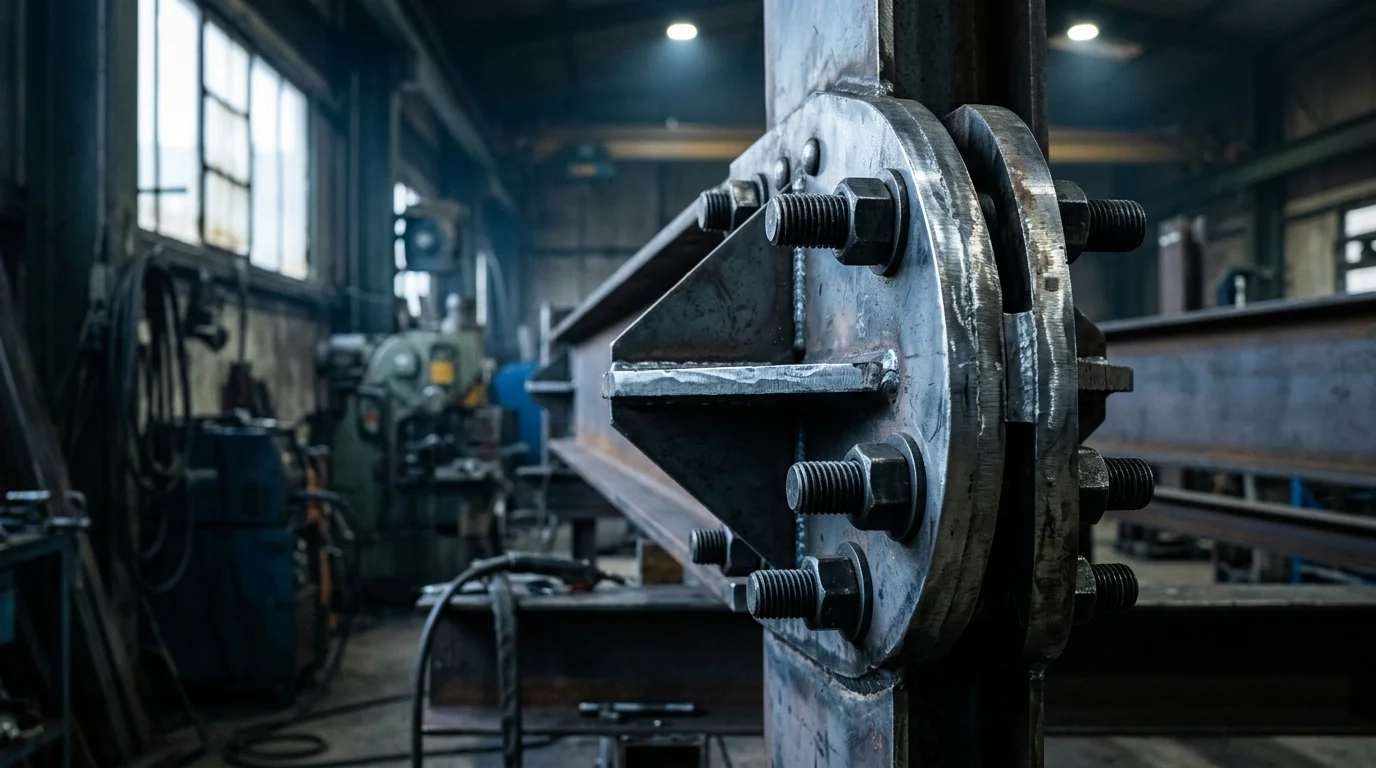
The Real Cost of Bolt Failure
A steel frame structure under construction partially collapsed during a storm. Investigation conclusion: connection node bolt failure, not a design issue. From 1970 to 2013, among numerous steel structure failure (steel structure fasteners) cases, a significant proportion were directly related to fasteners. During the 2023 harvest season, a farm in northern China lost three days of operation due to a single fastener failure.
A supplier-provided “compliant with standards” certificate is not the same as “suitable for working conditions.” Bolts that pass general laboratory tests may not withstand the environmental stresses of a specific project, differences in coating or washer combinations can lead to connection failure, rework, or safety incidents. Some failure cases were not made public, causing similar issues to recur in subsequent projects. The Pittsburgh Convention Center case, handled non-publicly, resulted in repeated safety oversights.
By the end of this guide, you will know how to distinguish between bearing-type and friction-type connections, specify the right bolts for critical and agricultural applications, and audit suppliers to avoid costly fastener failures.
Differences Between Bearing-Type and Friction-Type Connections
Steel structure connections are divided into two types: bearing-type and friction-type. Bearing-type connections transfer force through contact between the bolt shank and the hole wall; friction-type connections transfer force through friction between the plate components.
In bearing-type connections, bolts must be designed according to strength to bear loads. When procuring, the bolt load-bearing capacity grade must be specified, such as Grade 8.8 or Grade 10.9. Grade 8.8 indicates a tensile strength of 800 MPa and a yield strength of 640 MPa.
Friction-type connections have special requirements for contact surfaces, which must be treated to ensure the friction coefficient. When procuring, both the bolts themselves and the treatment process of the connecting plates must be included in the specifications. If the supplier cannot provide a contact surface treatment plan, the friction-type connection may be ineffective.
Key Requirements of the RCSC Standard
The American Institute of Steel Construction and its subordinate RCSC have developed the most authoritative bolt connection specifications globally. The RCSC specification governs the design, installation, and inspection procedures for bolts.
High-strength bolts must achieve the specified pretension to ensure connection performance. When procuring, the supplier must be required to provide a torque coefficient or pretension test report. The torque coefficient reflects the friction force during bolt tightening and directly affects the accuracy of pretension.
The specification requires torque inspection of installed bolts. Do the procured bolts support this type of inspection? Does the supplier provide matching inspection tools or data? Prioritize manufacturers that comply with RCSC or equivalent international standards, such as ISO 898, ASTM A325, etc.
Procurement Strategy for Critical Fasteners
NASA guidelines stipulate that “critical fasteners” and “special fasteners” used in primary load paths or secondary load paths must be procured from approved manufacturers. The primary load path is the force transmission route bearing the main loads, such as beam-column connection nodes; the secondary load path is the auxiliary force transmission route, such as bracing connections.
Which nodes in the project are “critical”? Beam-column connections, bracing nodes, crane beam connections, etc. Once these nodes fail, structural collapse may occur. Classify fasteners into three levels, “critical,” “important,” and “ordinary”, and adopt different procurement strategies for each.
For critical parts, the supplier must be required to provide original manufacturer certificates, batch traceability, and third-party inspection reports. The original manufacturer certificate confirms that the bolts come from a legitimate factory; batch traceability allows the production time and raw material source of each batch of bolts to be traced. Special parts such as high-strength bolts, tension-control bolts, and locking bolts must be sourced from designated brands or certified channels.
Fastener Requirements for Agricultural Steel Structures
Agricultural buildings include equipment sheds, livestock barns, grain silos, etc., which are exposed to humid, corrosive, and animal activity environments for extended periods. Ordinary galvanized bolts cannot meet the requirements.
Galvanized coating thickness, bolt material, and washer locking design are all critical. Hot-dip galvanizing coating is thicker than zinc plated and provides better corrosion protection. Require the supplier to provide hot-dip galvanized bolts and specify the coating thickness standard, such as at least 85 microns.
Agricultural equipment has high vibration levels; locking washers or nylon insert lock nuts must be procured. Locking washers use special tooth profiles to prevent bolt loosening; nylon insert lock nuts have a built-in nylon ring that increases friction. Reference agricultural building guidelines, emphasizing reduced maintenance costs.
Supplier Audit Key Points
Supplier audit is a critical step in ensuring bolt quality. First, check qualifications: whether the supplier is certified to ISO 9001, AISC. ISO 9001 is a quality management system certification, AISC is the American Institute of Steel Construction certification.
Second, examine testing capabilities: does the supplier have a laboratory? Can they provide tensile test, hardness test, and torque coefficient test reports? Tensile test measures tensile strength, hardness test measures wear resistance, and torque coefficient test reflects installation performance.
Finally, check the traceability system: does each batch have a unique number that can be traced to raw materials, production date, and inspection records? Batch traceability is the last line of defense for quality assurance, allowing quick location and recall if problems occur. Reference NASA’s manufacturer approval requirements for “critical fasteners” to establish a “qualified supplier list.”
Procurement Checklist
Step 1: Clarify connection type—bearing-type or friction-type. Step 2: Determine bolt grade—such as ASTM A325, A490, or ISO 8.8, 10.9. ASTM A325 is the American standard high-strength bolt, equivalent to ISO 8.8; A490 is equivalent to ISO 10.9.
Step 3: Specify coating and locking—hot-dip galvanizing, Dacromet, locking washers. Dacromet is a chromium-free environmentally friendly coating with better corrosion resistance than galvanizing. Step 4: Require key data—torque coefficient, pretension, batch traceability.
Step 5: Audit supplier qualifications—factory, testing, certification. Step 6: Sign quality agreement—clarify non-conforming product handling and compensation clauses. If any item is not met, reassess the supplier.
Long-Term Cost Considerations
Assume a project uses 1000 bolts, each 0.5 yuan cheaper, saving 500 yuan. If 10 bolts fail and cause rework, the rework cost may exceed 50,000 yuan. If bolt failure leads to structural collapse, the loss may be millions or even tens of millions.
High-quality bolts typically last several times longer than cheap bolts. In agricultural buildings, hot-dip galvanized bolts can remain rust-free for 20 years, while electro-galvanized bolts may start rusting after 5 years. Considering the full life cycle cost, high-quality bolts offer better value.
Key Clauses in Procurement Agreements
Procurement agreements must specify: quality standards, inspection methods, acceptance criteria, non-conforming product handling, and traceability requirements. Quality standards should cite specific standard numbers, such as ASTM A325 or ISO 898-1. Inspection methods should specify the qualification requirements for third-party testing agencies.
Acceptance criteria should specify key parameters such as torque coefficient range and pretension deviation. Non-conforming product handling should specify specific procedures for return, replacement, or compensation. Traceability requirements should specify batch number format and record retention period.
Key Parameter Quick Reference
| Parameter | Standard/Recommended Value | Remarks |
|---|---|---|
| Material Grade | Select based on working conditions | Refer to relevant industry standards |
| Surface Treatment | hot-dip galvanized/Dacromet/stainless steel | Determined by corrosion class C1-C5 |
| Inspection Cycle | Quarterly or semi-annually | More frequent for critical parts |
| Replacement Criteria | Replace when wear/corrosion exceeds limits | Not based solely on age |
| Standard Reference | See standard clauses in text | Use as technical attachment in procurement |
High-Strength Bolt Torque Coefficient Re-inspection
Grade 10.9 high-strength bolts are used for main beam-column connections in steel structures. The torque coefficient K value directly affects preload. If K is too large, the same torque produces insufficient preload; if K is too small, over-tightening may cause bolt fracture.
Acceptance criteria:
| Item | Requirement |
|---|---|
| Sampling quantity | Randomly select 8 sets per batch (same batch, same specification) |
| K value range | 0.11–0.15 (depending on design requirements) |
| Standard deviation | ≤0.010 |
| Test method | GB/T 1231-2024 or ASTM A325 |
If a torque coefficient tester is not available, at least perform appearance and hardness checks:
- Thread surface must be free of cracks, folds, and rust
- Use a hardness tester to spot-check head and tail hardness; Grade 10.9 hardness should be HRC 33–39
- Check for mixed batches—bolts from different heats may have significantly different torque coefficients
📎 How to choose between torque method and turn-of-nut method? See this comparison of high-strength bolt tightening methods.
Summary: Two Key Decision Points
- For high-vibration conditions, specify wedge-lock washers or nylon insert lock nuts; spring lock washers are largely ineffective in Junker tests.
- For friction-type connections, always require the supplier to provide a contact surface treatment plan and friction coefficient test data.
Next Steps: Prepare These Before You Procure
- [ ] List all connection nodes and classify them as critical, important, or ordinary.
- [ ] Determine the required bolt grade and surface treatment based on the environment (corrosion class, vibration).
- [ ] Prepare a supplier audit checklist covering certifications, testing capabilities, and traceability.
- [ ] Draft procurement agreement clauses for quality standards, inspection, and non-conforming product handling.
Deep Reading
More systematic selection, procurement, or inspection guides.
- Installation and Acceptance of High-Strength Bolts for Steel Structureswhitepaper
Systematic guide on high-strength bolt installation and acceptance.
- Corrosion Rate Comparison of Hot-Dip Galvanized Coatings in Salt Spray Testingwhitepaper
Whitepaper comparing corrosion rates for different coating thicknesses.
- Energy Storage System Busbar Bolt Torque and Contact Resistance Controlwhitepaper
Technical whitepaper on bolt torque and contact resistance.
Related Solutions
Pages for specification checks and procurement discussion.
- Frame Connectorsl2_l3
Commercial page for agricultural steel structure frame connectors.
This article helps with selection and application. But in real projects, specifying the right part is only step one, finding the right factory, controlling quality, and delivering on time is the real challenge. We cover fasteners, rubber, plastics, and industrial textiles across four categories, from Zhejiang industrial clusters to your project site, one team, end to end.
See Our Supply Chain Capabilities →