Overlooked details in fastener selection have repeatedly led to significant losses in municipal projects.
Buried for Two Years, Crumbles at a Touch: The Hidden Corrosion of Underground Cable Conduits
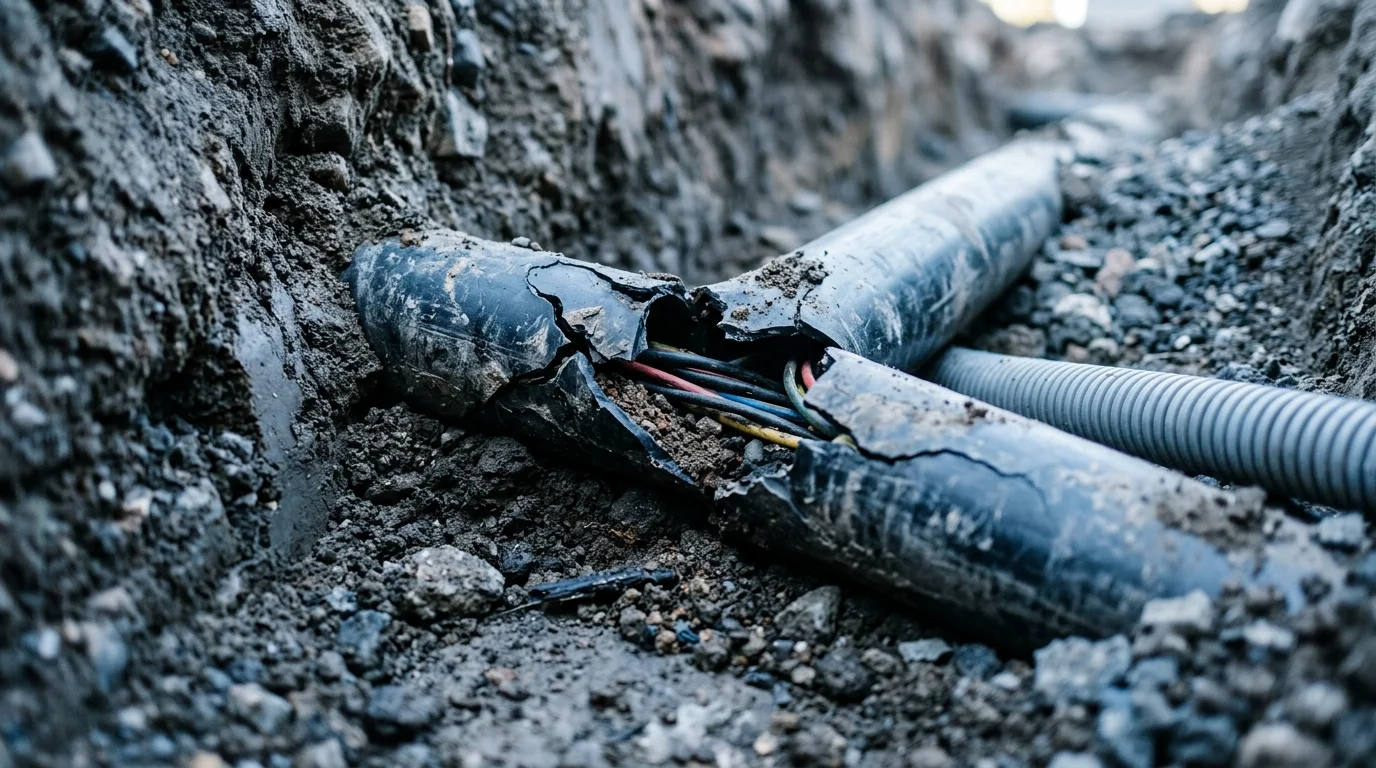
Last Wednesday, property manager Zhang from a new residential complex in Hangzhou sent me a video: workers, while inspecting landscape lighting, had just excavated the cover soil. The moment they touched a conduit buried only two years prior, the wall fractured into pieces with a crisp snap. In the footage, the cables inside were exposed, their insulation blackened and blistered.
“Chief Wang, this conduit was purchased to national standards. How did it fail in just two years?” Zhang’s tone was thick with confusion and anger.
By the end you will know how to select underground conduit materials based on soil corrosivity and burial depth, and be able to specify appropriate corrosion protection measures.
I enlarged the video for closer inspection: the conduit wall exhibited delamination at the cross-section, with the surface densely pitted by corrosion. This was not a material quality issue; it was the work of underground corrosion, a silent saboteur.
Underground Corrosion: More Perilous Than You Think
Many assume that burying a conduit underground ensures safety. In reality, soil is a complex electrochemical system. Per ISO 12944-2:2017, Paints and Varnishes. Corrosion Protection of Steel Structures by Protective Paint Systems, soil corrosivity is classified into six levels, from C1 (very low) to CX (extremely high). In China, most urban soils fall within C3–C4, while coastal areas, chemical plant vicinities, and landfill-adjacent soils can reach C5 or even CX.
The Three Primary Corrosion Culprits:
- Electrochemical corrosion: Dissimilar metals (e.g., steel pipe and copper grounding electrode) form galvanic cells in moist soil.
- Microbiologically influenced corrosion: Sulfate-reducing bacteria (SRB) accelerate steel corrosion under anaerobic conditions.
- Stray current: Leakage currents from subways, substations, and other infrastructure.
ASTM G162-18, Standard Practice for Conducting and Evaluating Laboratory Corrosion Tests in Soils, indicates that corrosion risk is extremely high when soil resistivity falls below 2000 Ω·cm. In many new residential developments, backfill soil resistivity often ranges only 500–1000 Ω·cm.
flowchart LR
    A["Improper Selection"] --> B["Early Failure"]
    B --> C["Equipment Downtime"]
    C --> D["Financial Loss"]

    style A fill:#fff3cd,stroke:#f39c12
    style D fill:#ffcdd2,stroke:#d32f2f,stroke-width:3px
Comparative Corrosion Performance of Conduit Materials
| Conduit Type | Corrosion Mechanism | Typical Failure Time | Applicable Standard |
|---|---|---|---|
| Standard galvanized steel pipe | Base metal rusting after zinc layer damage | 2–5 years | GB/T 3091-2015 |
| Hot-dip galvanized steel pipe | Pitting after zinc layer depletion | 5–10 years | GB/T 13912-2020 |
| PVC-U pipe | UV aging + chemical corrosion | 10–15 years | GB/T 10002.1-2006 |
| HDPE pipe | Stress cracking + chemical corrosion | 15–20 years | GB/T 19472.1-2019 |
Key Data: According to NACE SP0169-2013, Control of External Corrosion on Underground or Submerged Metallic Piping Systems, in corrosive soils, the corrosion rate of unprotected carbon steel pipe can reach 0.2–0.5 mm/year. A steel pipe with a 4 mm wall thickness has a theoretical service life of only 8–20 years.
Real-World Case: A Preventable Catastrophe
A commercial complex project in Shenzhen used standard galvanized steel pipe (wall thickness 3.5 mm) for underground landscape lighting conduits, buried at 0.8 m depth. Two years later, corrosion-induced cable short circuits triggered a fire, resulting in direct economic losses. Post-incident testing revealed soil pH of only 5.2 (weakly acidic) and chloride ion content of 800 mg/kg, far exceeding the limit of ≤200 mg/kg specified in GB 50046-2018, Code for Anticorrosion Design of Industrial Buildings.
Lesson Learned: Soil corrosivity was not considered during material selection, and no anticorrosion coating was applied.
Solutions: Material Selection by Corrosion Level
Based on soil corrosivity grade and burial depth requirements, we offer three solutions:
Solution A: PVC Standard Conduit | Shallow Burial (≤0.7 m) / Dry Soil / Standard Landscaping
Suitable for corrosivity grades C1–C3, dry soil, and areas without heavy loads.
- PVC-U Conduit: φ50×3.0 mm, flame retardant V-0 rating, pressure resistance ≥1.0 MPa
- Complete set of direct connectors, elbows, and pipe clamps
- Warning tape laid at 0.3 m depth
Advantages: Low cost, fast installation, good corrosion resistance
Limitations: Low compressive strength, unsuitable for heavy-load areas
Solution B: HDPE Heavy-Duty Conduit | Medium Burial (0.7–1.5 m) / Moist Soil / Heavy-Load Areas
Suitable for corrosivity grade C4, moist soil, and areas with vehicle traffic risk.
- HDPE Double-Wall Corrugated Pipe: φ75×4.0 mm, ring stiffness ≥8 kN/m², temperature range –40 to 60°C
- Reliable hot-melt joint sealing; inspection chambers facilitate maintenance
- Reinforced pipe clamps (304 stainless steel) at 1.0 m spacing
- Anticorrosion coating: dual protection with asphalt paint + fiberglass cloth
Advantages: Corrosion resistant, high compressive strength, good sealing
Limitations: Higher installation requirements; hot-melt equipment needs professional operation
Solution C: Galvanized Steel Extreme Conduit | Deep Burial (>1.5 m) / Strong Corrosion / Ultra-Long Life
Suitable for corrosivity grades C5–CX, strong acid/alkali soil, and scenarios requiring ultra-long life (30+ years).
- Hot-Dip Galvanized Steel Pipe: φ89×4.0 mm, Q235B hot-dip galvanized, uniform wall thickness
- Threaded joints with sealant, waterproof rating IP68
- Special alloy pipe clamps (Inconel 625) at 0.8 m spacing
- Smart monitoring tags: RFID chips record installation time and inspection records
Advantages: Highest strength, longest life, monitorable
Limitations: High cost, difficult installation
Material Selection Decision Tree
Two Key Takeaways
- For high-frequency vibration conditions, wedge washers are preferred; spring washers are almost ineffective in Junker tests.
- Underground engineering: the invisible parts are critical. Before burying pipes, test soil corrosivity using ASTM G57-06 method—it takes less than half an hour but can save years of maintenance costs.
Next Steps
To specify the right conduit for your project, prepare the following:
- [ ] Soil resistivity measurement (per ASTM G57-06)
- [ ] Soil pH and chloride ion content test results
- [ ] Burial depth and load conditions (pedestrian, vehicle, or heavy equipment)
- [ ] Required service life and maintenance accessibility
Data Reference
| Parameter | Typical Value | Standard Basis |
|---|---|---|
| Hot-dip galvanized layer thickness (M10) | Local ≥40 μm / Average ≥50 μm | GB/T 5267.3-2008 |
| 304 stainless steel salt spray resistance | ≥500h | ISO 9227 |
Deep Reading
More systematic selection, procurement, or inspection guides.
- Corrosion Protection of Hydropower Submerged Fastenerswhitepaper
A more systematic guide on a related selection or inspection topic.
- Corrosion Rate Comparison of Hot-Dip Galvanized Coatings in Salt Spray Testingwhitepaper
A more systematic guide on a related selection or inspection topic.
- Livestock Facility Fastener Selection: Corrosion Zones, Materials, and Inspectionwhitepaper
A more systematic guide on a related selection or inspection topic.
This article helps with selection and application. But in real projects, specifying the right part is only step one, finding the right factory, controlling quality, and delivering on time is the real challenge. We cover fasteners, rubber, plastics, and industrial textiles across four categories, from Zhejiang industrial clusters to your project site, one team, end to end.
See Our Supply Chain Capabilities →