Roof Sealing Washer Failure and Prevention
Each self-tapping screw through a roof panel is a potential leak point. EPDM washer aging and installation defects like screw spinning can lead to purlin corrosion and costly repairs. This page failure mechanisms and procurement checks for roof sealing hardware
RISK AUDIT // ENGINEERING DIAGNOSIS
Procurement Pitfall Guide
"Roof sealing failures often start with a washer that hardens or a screw that spins—here's how to spot and prevent them."
QC-AUDIT // REV.5
SCALE 1:1 · 03 ITEMS
RISK-01
EPDM waterproof gasket hardens and fails under high roof panel temperatures
Corrective Measures
RISK-02
Self-drilling screw spinning prevents waterproof gasket from being compressed
Corrective Measures
RISK-03
Self-drilling screw strips threads in thin purlin — preload is zero
Corrective Measures
FIELD-SPECIFIC INSIGHT
Roof Sealing Washer Failure Checklist
The most overlooked engineering difference in roof sealing is the compression set of the EPDM washer under sustained high temperature. A washer that passes initial leak tests may fail after 5-8 years due to hardening, leading to capillary seepage along screw threads
WHAT TO CHECK
- 1Check EPDM washer hardness annually: if Shore A exceeds 80 or does not spring back under fingernail press, replace immediately
- 2Verify installation torque: screw spinning (threads spinning in purlin) reduces washer compression from 30% to 10%, causing immediate leaks
- 3For purlin wall thickness less than 1
| Check | Why it matters | What to specify |
|---|---|---|
| Washer compression set | Hardened washer loses sealing pressure, allowing capillary seepage | — |
| Screw installation torque | Spinning reduces washer compression from 30% to 10%, causing leaks | Use torque-controlled electric wrench; verify screw head is flush with washer |
| Purlin wall thickness | Thin purlin gives insufficient thread engagement, risk of pull-out | For purlin less than 1 |
| Washer material temperature rating | Silicone for extreme temperatures | — |
Data based on typical roof conditions. Actual service life depends on local UV index and temperature extremes
Evidence level: standard-backed
INDUSTRY TECH REFERENCE
Washer Compression Is a One-Shot Preload: Once the Installation Window Passes, the Loss Is Not Recoverable
High-strength bolts in the frame and self-tapping screws through the roof panel share one lifetime logic: the preload — or the washer compression — is fixed once at installation, and no re-tightening clause exists in service. Understand this logic and it is clear why washer acceptance has to happen on installation day.
High-strength bolt preload does not sit still after final tightening: most of the loss lands within the first hour, it stabilizes within a day or two, and it stops after a month — which is why final-tightening acceptance is locked to the 1 h to 48 h window after tightening (explanatory note to GB 50205-2020 §6.3.3). The erection preload is taken as Pc = 1.1P, compensating the roughly 10% preload loss once, on site; nothing is recovered by re-tightening in service (explanatory note to JGJ 82-2011 §6.4.13). The whole code system carries no in-service re-tightening clause: selling "maintenance-free" is correct; selling "re-tightenable" is wrong. A roof washer follows the same logic: sealing comes from the compression set at installation, that moment is the washer's hardest working state for the rest of its life, and no "re-tightening" in service can rescue a wrongly set compression. The difference is the compensation mechanism: the structure codes the loss into the equation (Pc = 1.1P), while a washer has no 1.1P — installation torque discipline is its only compensation. The conclusion is direct: washer acceptance must happen on installation day — verify the compression state right after fixing, because once that window passes, the seal state of that node can never be checked again. An ordinary plant is designed for a 50-year working life (Table 3.1.16 of GB 55001-2021); frame nodes are maintenance-free after final tightening, but a roof washer's "lifetime" is written on the day it is installed.
The claim that a washer has no equivalent 1.1P and that torque discipline is its only compensation is an industry inference for the roof scenario. No order-of-magnitude estimates are used in this slot.
INDUSTRY TECH REFERENCE
Fastener Division of Labor on the Roof: Self-Tapping Screws, Grade-C Bolts, and Anchors Each Carry One Job
A roof has three fastener layers from top to bottom: panel to purlin, purlin to frame, and roof accessories to the deck. The layers differ in duty and in how they fail — write the specs separately when ordering.
| Layer | Fasteners | Load path and key parameters | What to watch |
|---|---|---|---|
| Roof panel → purlin | Self-tapping screw + waterproof washer | Non-friction bearing load path: sealing from washer compression, wind resistance from thread engagement | Thin purlins with too few engaged threads pull out under wind uplift; under-compressed washer seeps |
| Purlin / girt → frame | Grade-C ordinary bolts (4.6/4.8) | Hole diameter d+1.0~1.5 mm, bearing load transfer (Table 11.5.1 hole sizes of GB 50017-2017) | Non-friction type — recheck by bearing; oversized holes cut the bearing area |
| Gutter / parapet / equipment base → roof deck | Anchor bolt or chemical anchor | Corrosion margin allowed for the environment on exposed parts (note to GB 50017-2017 §12.7.5) | Outdoor corrosion grade set too low → rust and a water path |
| Roof edge zone (near eaves) | Densified self-tapping screws | The highest wind-uplift zone, handled by denser fixing and deeper engagement (spacing per the drawing) | Pull-out risk under repeated wind uplift |
The Grade-C 4.6/4.8 ordinary bolts for purlins and girts (holes d+1.0~1.5 mm, bearing-type load path) and the environment-based corrosion margin for gutter/parapet/equipment-base anchors follow the relevant clauses of GB 50017-2017. No order-of-magnitude estimates are used in this slot.
INDUSTRY TECH REFERENCE
Structural Assemblies Get Incoming Re-Tests; Roof Washers Do Not: Three Steps Where the Quality Gate Moves
Structural bolting runs on lot-based verification — a failing lot is rejected in full. Self-tapping screws and roof washers have no equivalent incoming re-test, so the quality gate can only move forward to installation practice and post-install checks.
- Set the structural baseline first: incoming lot verification is a master-control item of GB 50205; large-hex high-strength assemblies are tested for torque coefficient (mean 0.110-0.150, standard deviation ≤0.0100, JGJ 82-2011 Table 6.3.1) plus other items, and a failing lot is rejected in full — self-tapping screws and roof washers have no such checklist, so their compression state is proven on site, not by a report
- Gate step 1: install with a torque-controlled wrench set to the recommended torque — torque-controlled tightening converts the wrench reading into clamping force as T_c = k·P_c·d; "spinning" from an uncontrolled speed is the roofing version of lost torque control, where the reading and the real compression part ways
- Gate step 2: verify the compression on installation day — feeler-gauge check around the washer edge and reverse-torque spot checks; compression is the roof fastener's "preload" and can only be proven on the spot
- Gate step 3: oil or dirt on the threads quietly changes the torque-conversion relationship — the structural side teaches the same lesson: field lubrication or contamination makes the clamping force delivered by the same wrench unknowable; thread condition matters just as much for a roof screw's reading
The torque coefficient 0.110-0.150 / standard deviation ≤0.0100 and T_c = k·P_c·d follow JGJ 82-2011 Table 6.3.1; field lubrication or contamination changing the torque conversion follows the JGJ 82-2011 commentary; lot-based verification with full-batch rejection is a GB 50205 master-control item. The claim that roof washers have no equivalent re-test and that the quality gate moves forward in three steps is an inference for this roof scenario. No order-of-magnitude estimates are used in this slot.
INDUSTRY TECH REFERENCE
One Spun Self-Tapping Screw: The Chain from Lost Torque Control to a Seeping Roof
Spinning is the most invisible roof-installation defect: the screw looks seated while the washer is under-compressed. Walk the chain and match every root cause with its interception point.
- 1The electric wrench runs too fast and the self-tapping screw spins inside the thin purlin — the threads rotate without feeding and the hex socket rounds out: the roofing version of lost torque control, after which the real clamping force can no longer be known (structural analogue: torque-controlled tightening converts the wrench reading into preload through the torque coefficient, and once k is uncontrolled the reading lies)
- 2Tightening stops early → washer compression falls far below design → sealing pressure is insufficient: compression is the roof fastener's "preload", and under-compression means a failed seal (structural analogue: an under-preloaded friction joint shifts to bearing-type working and deforms)
- 3The first rain arrives and water seeps along the threads and the washer edge → the purlin and panel edge stay damp and corrosion starts in the lap zone
- 4A spun screw already carries an abnormal load history: the structural rules set that no fastener may double as a temporary erection bolt, that load history changes the torque coefficient, and that the acceptance finding is void (note to JGJ 82-2011 §6.4.5) — a spun screw likewise cannot be accepted "as seated"; remove and replace it, do not re-tighten
- 5Interception points: cap the wrench torque to the recommended value; verify the compression around the washer edge on installation day; scrap any screw with a rounded hex socket and fit a fresh one
"Replace a spun screw, do not re-tighten" is an isomorphic inference transferring the structural rule to this roof scenario. No order-of-magnitude estimates are used in this slot.
PLAN COMPARISON
Three-Plan Core Parameter Comparison
Compare row by row. Click column headers to jump to plan details.
| A · A · General Industrial Plant | B · B · Coastal/High Corrosion Plant | C · Plan C · Coastal/Seismic Reinforced | |
|---|---|---|---|
| 1. EPDM | |||
| SPEC | M5.5/M6.3 self-tapping screw compatible | M5.5/M6.3 | M5.5/M6.3 |
| MATERIAL | EPDM + 304 stainless steel core | EPDM + 316 stainless steel core | EPDM + 316 stainless steel core |
| GRADE | Temperature range -40~120°C | C5 corrosion resistant | C5 corrosion resistant |
| FINISH | HDG >=55um per ISO 1461 | HDG >=55um per ISO 1461 | HDG >=55um per ISO 1461 |
| 2. SELF-TAPPING SCREW WATERPROOF CAP | |||
| SPEC | Compatible with screws | M5.5/M6.3×25-40mm | M5.5/M6.3×25-40mm |
| MATERIAL | PVC + UV stabilizer | 304/316 stainless steel | 304/316 stainless steel |
| GRADE | Black/Gray | A2-70/A4-70 | A2-70/A4-70 |
| FINISH | HDG >=55um per ISO 1461 | HDG >=55um per ISO 1461 | HDG >=55um per ISO 1461 |
| 3. INSULATION FIXING NAIL | |||
| SPEC | φ4.8mm, length 80-200mm | Compatible with screws | Compatible with screws |
| MATERIAL | Carbon steel, zinc-plated | Silicone rubber | Silicone rubber |
| GRADE | / | Temperature range -60~200°C | Temperature range -60~200°C |
| FINISH | HDG >=55um per ISO 1461 | HDG >=55um per ISO 1461 | HDG >=55um per ISO 1461 |
SELECTION GUIDE
How to Choose the Right Roof Sealing Hardware
| Operating condition | Recommended option | Key basis |
|---|---|---|
| General industrial plant, inland (C3 per ISO 12944-2) | Option A · EPDM + carbon steel self-tapping screw standard: EPDM waterproof washer with 304 stainless steel core (M5.5/M6.3 compatible, -40~120°C, double-layer gasket keeps compression at the optimal 30%) + PVC waterproof cap with UV stabilizer; replace gaskets that do not spring back under fingernail press during annual inspection | ASTM D395 (compression set <25% after 70°C×22h); stainless steel core limits excessive compression of EPDM to 30% |
| Coastal / high corrosion plant (C4 per ISO 12944-2) | Option B · Full 316 stainless steel + silicone rubber: waterproof washer M5.5/M6.3 (EPDM + 316 stainless steel core, C5 corrosion resistant) + self-tapping screw (M5.5/M6.3×25-40mm, 304/316 stainless steel, A2-70/A4-70) + silicone rubber waterproof cap (-60~200°C) | ISO 12944-2 C4; ISO 3506; silicone rubber rated -60~200°C for extreme temperature environments |
| Coastal / seismic extreme (C5-M per ISO 12944-2) | Plan C · Coastal/Seismic Reinforced: full-range Dacromet + 304/316 stainless steel (A2-70/A4-70) + wedge lock washer for anti-loosening — waterproof washer (EPDM + 316 stainless steel core) + self-tapping screw + silicone rubber cap (-60~200°C) | ISO 12944-2 C5-M extreme; GB 50896 |
| Screw spinning during installation (electric wrench speed too high) | Install with a torque-controlled electric wrench (torque set to 90% of the screw's recommended value, leaving room for manual adjustment); after installation a 0.1mm feeler gauge must not be insertable between the gasket and the roof panel; spot-check 1% of screws by reverse torquing (reverse torque ≥60% of installation torque) | Spinning compresses the gasket only 10% instead of 30% → insufficient sealing pressure → leaks on the first rain |
| Thin purlin wall (<1.5mm) / roof edge zones (greatest wind uplift) | Self-drilling screws only when purlin wall thickness ≥1.5mm; purlins <1.2mm must use M6 bolts with nuts (drill holes in the purlin web before installation); in roof edge zones tighten self-drilling screw spacing to two per corrugation | Effective thread engagement <3 pitches → screw pulled out of purlin under wind uplift → roof panel lifts → water leakage; GB 50896 |
A · General Industrial Plant
C3 (ISO 12944-2)
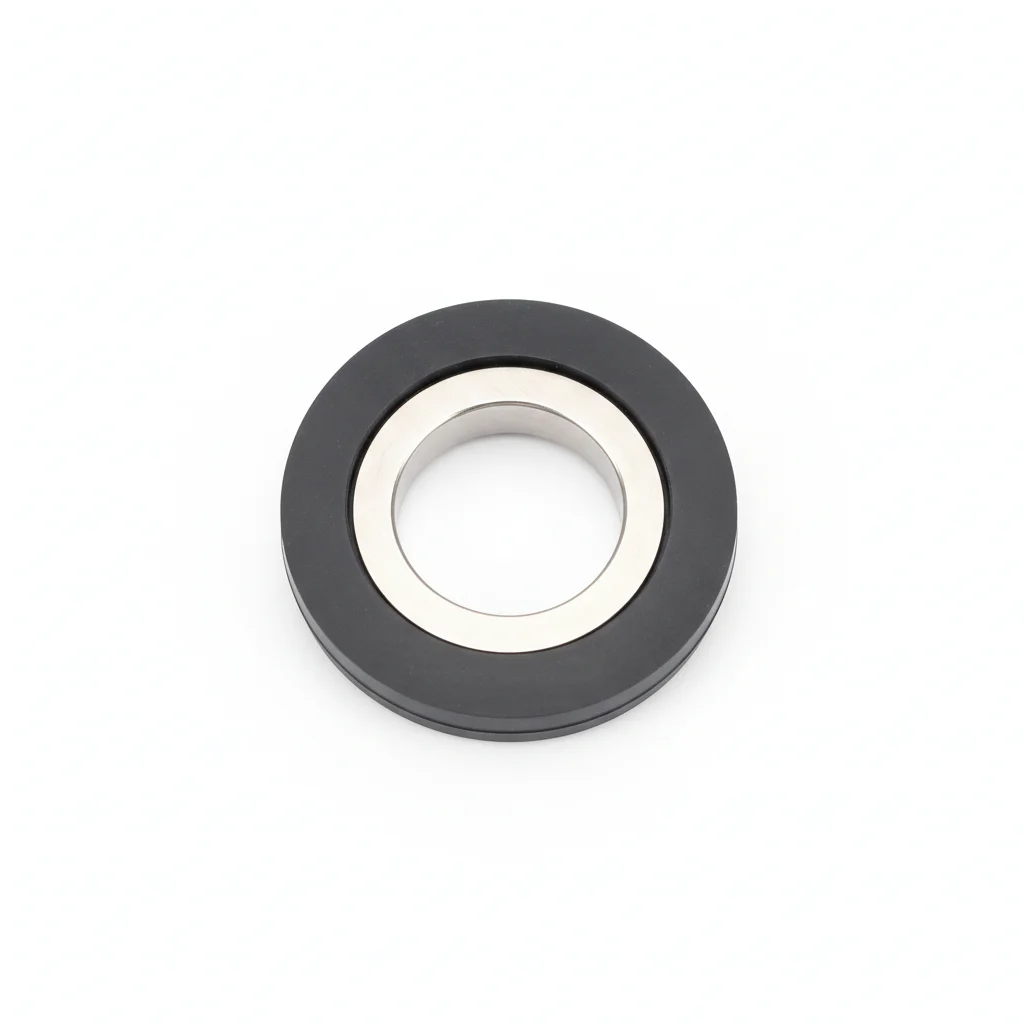
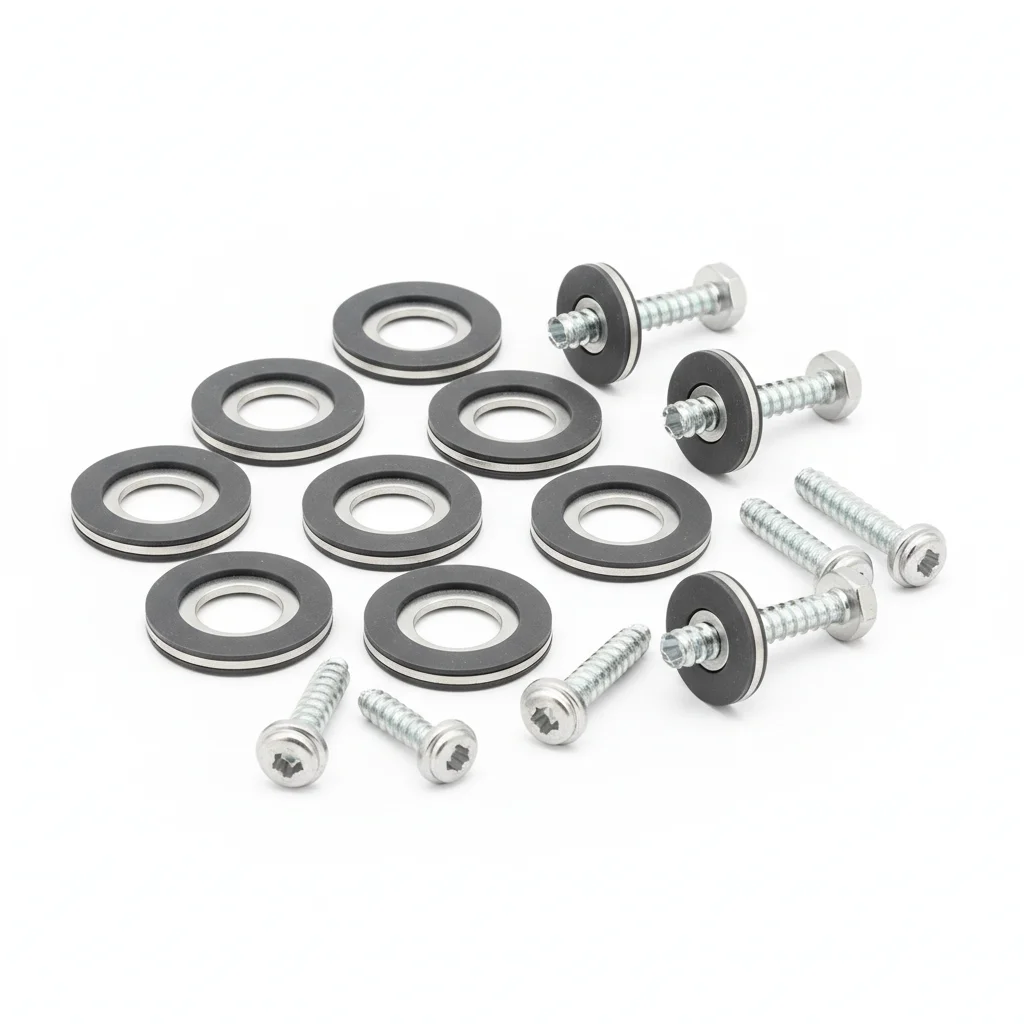
| EPDM | Self-Tapping Screw Waterproof Cap | Insulation Fixing Nail | |
|---|---|---|---|
| SPEC | M5.5/M6.3 self-tapping screw compatible | Compatible with screws | φ4.8mm, length 80-200mm |
| MATERIAL | EPDM + 304 stainless steel core | PVC + UV stabilizer | Carbon steel, zinc-plated |
| GRADE | Temperature range -40~120°C | Black/Gray | / |
| FINISH | HDG >=55um per ISO 1461 | HDG >=55um per ISO 1461 | HDG >=55um per ISO 1461 |
| CORROSION | C3 (ISO 12944-2) | C3 (ISO 12944-2) | C3 (ISO 12944-2) |
| TEMP | -20°C to +80°C | -20°C to +80°C | -20°C to +80°C |
| WEIGHT | ~0.5 kg/piece | ~0.5 kg/piece | ~0.5 kg/piece |
| MOQ | 100 pcs | 100 pcs | 100 pcs |
| PACK | VCI paper + carton | VCI paper + carton | VCI paper + carton |
| STD | ISO 898-1, GB/T 3098.1 | ISO 898-1, GB/T 3098.1 | ISO 898-1, GB/T 3098.1 |
| USE | Waterproofing for roof panel self-tapping screws | Secondary waterproof protection for screw heads | Securing insulation to purlins |
PROCEDURE
- Align the EPDM washer with the screw hole, ensuring the stainless steel core sits centered to achieve the designed 30% compression.
- Drive the self-tapping screw with a torque-controlled wrench set at 90% of the recommended installation torque, avoiding high-speed spinning.
- After seating, verify the screw head is flush with the washer and the washer edge is sealed against the roof panel.
- Use a 0.1mm feeler gauge around the washer perimeter; it must not penetrate between the washer and panel.
- Spot-check 1% of installed screws with a reverse torque test; the reverse torque must be at least 60% of the installation torque to confirm no spinning.
COMMON ERRORS
| ✕ WRONG | CONSEQUENCE | ✓ CORRECT |
|---|---|---|
| Using an electric wrench without torque control, causing the screw to spin in the purlin. | The washer compresses only 10% instead of 30%, sealing pressure drops to near zero, and leaks occur on the first rain. | Set the torque wrench to 90% of the recommended value and verify with a 0.1mm feeler gauge that the washer is fully seated. |
| Installing self-drilling screws into purlins with wall thickness less than 1.5mm. | Thread engagement is less than three pitches, so wind uplift pulls the screw out, lifting the roof panel and causing massive leakage. | For purlins under 1.2mm wall thickness, pre-drill and use M6 bolts with nuts; for 1.2–1.5mm, consult engineering for acceptable fastening methods. |
MAINTENANCE
Seasonally, press the EPDM washer with a fingernail—if it does not spring back or Shore hardness exceeds 80, replace it. At each overhaul window, verify that no washer is cracked or permanently deformed.
B · Coastal/High Corrosion Plant
C4 Harsh per ISO 12944-2
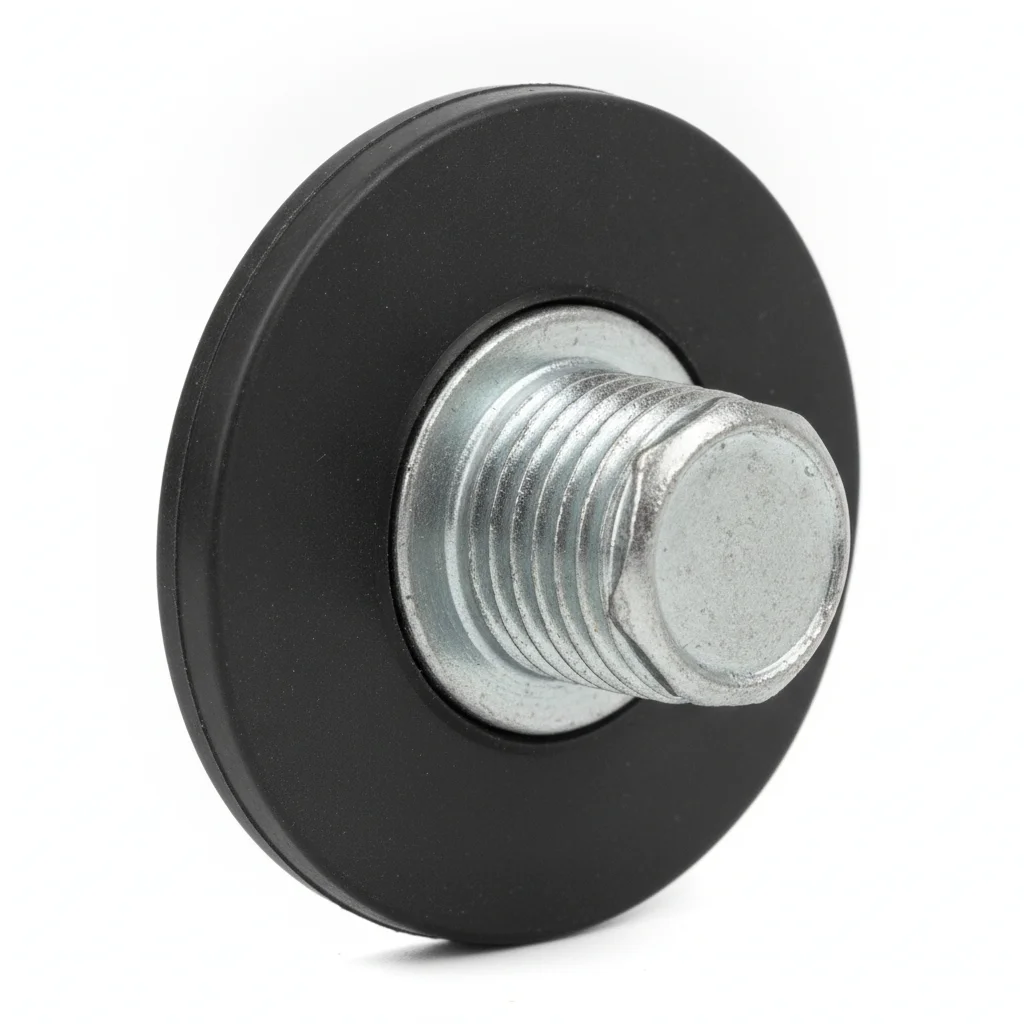
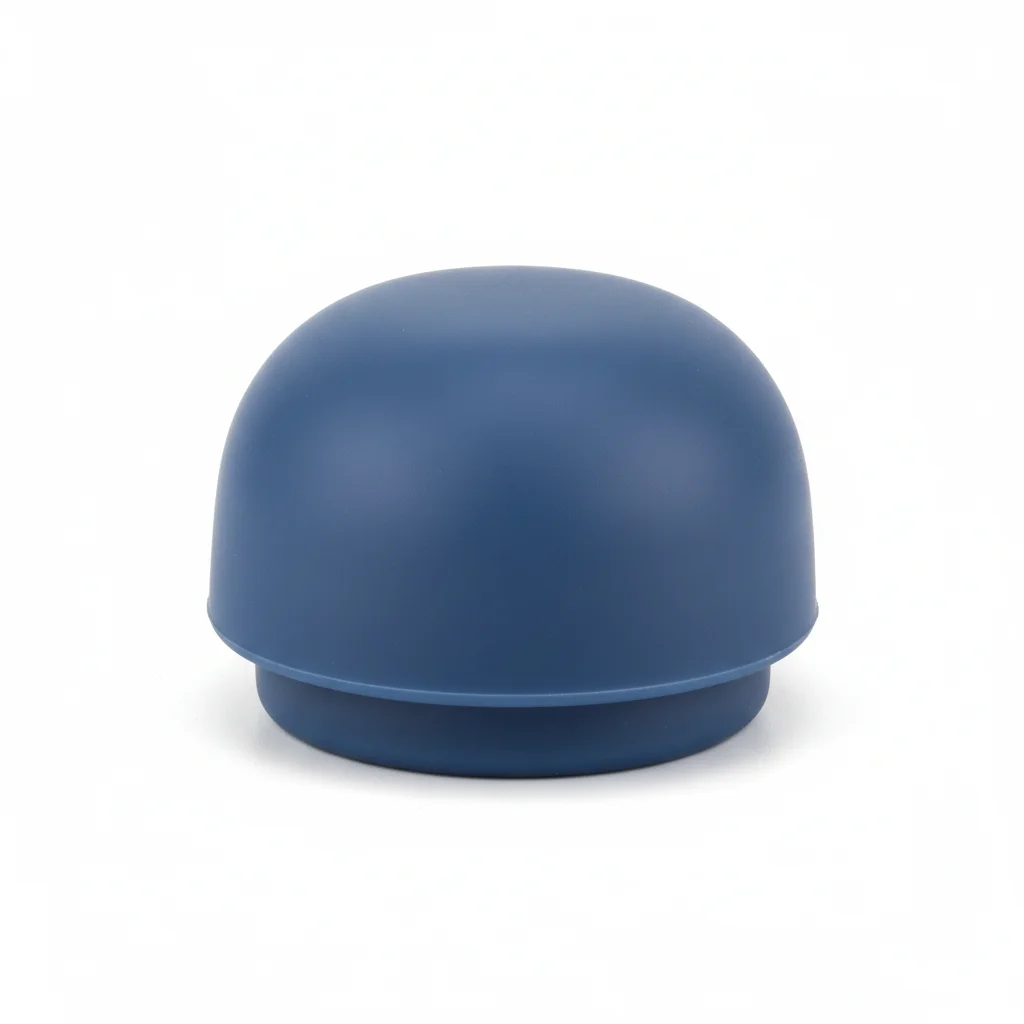
| Waterproof Washer | Self-Tapping Screw | Silicone Rubber Waterproof Cap | |
|---|---|---|---|
| SPEC | M5.5/M6.3 | M5.5/M6.3×25-40mm | Compatible with screws |
| MATERIAL | EPDM + 316 stainless steel core | 304/316 stainless steel | Silicone rubber |
| GRADE | C5 corrosion resistant | A2-70/A4-70 | Temperature range -60~200°C |
| FINISH | HDG >=55um per ISO 1461 | HDG >=55um per ISO 1461 | HDG >=55um per ISO 1461 |
| CORROSION | C3 (ISO 12944-2) | C3 (ISO 12944-2) | C3 (ISO 12944-2) |
| TEMP | -20°C to +80°C | -20°C to +80°C | -20°C to +80°C |
| WEIGHT | ~0.5 kg/piece | ~0.5 kg/piece | ~0.5 kg/piece |
| MOQ | 100 pcs | 100 pcs | 100 pcs |
| PACK | VCI paper + carton | VCI paper + carton | VCI paper + carton |
| STD | ISO 898-1, GB/T 3098.1 | ISO 898-1, GB/T 3098.1 | ISO 898-1, GB/T 3098.1 |
| USE | Coastal/chemical plant roofing | All stainless steel for C5 grade roofing | Extreme temperature environments |
PROCEDURE
- Clean the purlin and panel surfaces with a solvent to remove oils and debris, ensuring a dry substrate for the EPDM washer to seat.
- Pre-drill pilot holes when the purlin thickness is less than 1.5 mm to prevent thread stripping, or switch to bolted connections for walls under 1.2 mm.
- Position the EPDM + 316 stainless steel washer under the screw head, ensuring the conical washer is oriented to expand radially upon compression.
- Drive the 304/316 stainless steel self-tapping screw with a torque-controlled wrench set to 90% of the recommended value, avoiding over-speed spinning.
- Verify the washer compression reaches the designed 30% by checking that the screw head is flush and no gap exceeds 0.1 mm with a feeler gauge.
- Apply the silicone rubber waterproof cap over the screw head for secondary protection, pressing firmly to seal the edges.
COMMON ERRORS
| ✕ WRONG | CONSEQUENCE | ✓ CORRECT |
|---|---|---|
| Driving the screw at high speed without torque control, causing the threads to spin in the purlin. | The washer compresses only 10% instead of 30%, leading to immediate leaks and potential pull-out under wind uplift. | Use a torque-controlled wrench set to 90% of the recommended torque, and spot-check with a reverse torque test to confirm no spinning occurred. |
| Using screws on purlins with wall thickness less than 1.5 mm without pre-drilling or switching to bolted connections. | Insufficient thread engagement (less than 3 pitches) causes the screw to pull out under wind load, lifting the roof panel. | For purlins under 1.2 mm, use M6 bolts with nuts; for 1.2–1.5 mm, pre-drill pilot holes to ensure proper thread engagement. |
MAINTENANCE
Seasonally inspect the EPDM washers and silicone caps for hardening or cracking; press with a fingernail—if no spring-back, replace immediately. Check for any signs of corrosion on the 316 stainless steel screws, especially in coastal salt-laden air. Verify that the washer compression remains at the designed 30% by measuring the gap under the screw head with a 0.1 mm feeler gauge. Re-torque any screw that shows signs of loosening or spinning, and replace any with visible damage.
Plan C · Coastal/Seismic Reinforced
C5-M Extreme per ISO 12944-2
| Waterproof Washer | Self-Tapping Screw | Silicone Rubber Waterproof Cap | |
|---|---|---|---|
| SPEC | M5.5/M6.3 | M5.5/M6.3×25-40mm | Compatible with screws |
| MATERIAL | EPDM + 316 stainless steel core | 304/316 stainless steel | Silicone rubber |
| GRADE | C5 corrosion resistant | A2-70/A4-70 | Temperature range -60~200°C |
| FINISH | HDG >=55um per ISO 1461 | HDG >=55um per ISO 1461 | HDG >=55um per ISO 1461 |
| CORROSION | C3 (ISO 12944-2) | C3 (ISO 12944-2) | C3 (ISO 12944-2) |
| TEMP | -20°C to +80°C | -20°C to +80°C | -20°C to +80°C |
| WEIGHT | ~0.5 kg/piece | ~0.5 kg/piece | ~0.5 kg/piece |
| MOQ | 100 pcs | 100 pcs | 100 pcs |
| PACK | VCI paper + carton | VCI paper + carton | VCI paper + carton |
| STD | ISO 898-1, GB/T 3098.1 | ISO 898-1, GB/T 3098.1 | ISO 898-1, GB/T 3098.1 |
| USE | Extreme conditions / Maximum protection | Extreme conditions / Maximum protection | Extreme conditions / Maximum protection |
PROCEDURE
- Thoroughly degrease the purlin and panel with a marine-grade solvent, and confirm surface roughness is suitable for sealing.
- For seismic fortification intensity 8, pre-drill pilot holes in the purlin to ensure precise thread engagement, especially if wall thickness is below 1.5 mm.
- Assemble the EPDM + 316 stainless steel washer with the self-tapping screw, adding a wedge lock washer under the head for anti-loosening in seismic events.
- Drive the screw with a calibrated torque wrench to the specified torque (90% of recommended), avoiding spinning by controlling speed and pressure.
- Verify the washer is compressed to the target 30% using a feeler gauge; the gap must not exceed 0.1 mm.
- Seal the screw head with the silicone rubber cap, and apply a Dacromet-based protective coating to all exposed metal surfaces for C5 corrosion resistance.
COMMON ERRORS
| ✕ WRONG | CONSEQUENCE | ✓ CORRECT |
|---|---|---|
| Overtightening the screw without torque control, causing the EPDM washer to over-compress and lose its sealing ability. | The washer hardens prematurely under high compression, reducing sealing pressure and allowing water seepage along the threads. | Use a torque-controlled wrench set to 90% of the recommended value, and check the washer compression with a feeler gauge to ensure it does not exceed 30%. |
| Using stainless steel screws without a wedge lock washer in seismic zones, allowing loosening under vibration. | The screw backs out over time, reducing washer compression and causing leaks, especially during wind uplift or seismic events. | Install a wedge lock washer under the screw head to maintain preload and prevent loosening, as specified for seismic fortification intensity 8. |
MAINTENANCE
At each overhaul window or after a seismic event, inspect all screws for loosening or spinning; verify wedge lock washers are intact and the EPDM washers show no hardening (fingernail test). Check the silicone caps for cracks or UV degradation, and replace if any spring-back is lost. Confirm that the corrosion protection (Dacromet coating) remains intact, especially in coastal or chemical environments, and touch up any scratches to maintain C5-M performance.
REFERENCED STANDARDS
Referenced Standards
SUPPLIER CAPABILITY
Quality, Delivery & Customization
Quality Control
- ✓MTC material certificates with every batch
- ✓Key parts sampled for hardness/salt spray/torque coefficient
- ✓100% inspection or AQL sampling before shipment
Delivery
- ✓Standard parts made to order: 7-15 days
- ✓Custom parts: 25-45 days
- ✓FOB/CIF/DDP supported
Customization
- ✓Drawing review and material matching
- ✓Non-standard sizes/heads/threads
- ✓Small-batch prototyping supported
Certification
- ✓Material certificates (MTC)
- ✓Spectrographic analysis reports
- ✓Salt spray test reports (on request)
MOQ: No MOQ for standard parts; custom parts assessed by process complexity
FAQ
Frequently Asked Questions
RELATED READING
Keep Reading & Next Step
BEYOND TECHNICAL SPECS
Finding the right factory, controlling quality, delivering on time — that's the real challenge. We cover fasteners, rubber, plastics, industrial textiles. One team, end to end.
SEE CAPABILITIES →