Bucket Tooth Pins and Swing Bolts: Failure Diagnosis and Prevention
Bucket tooth pins endure bending and shear forces; a bent pin seizes in the adapter hole, preventing tooth replacement and reducing digging efficiency. Swing motor base bolts loosen under alternating shear, leading to spline wear and downtime. This page explains the failure chain and how two-piece pins and wedge lock washers mitigate these risks
RISK AUDIT // ENGINEERING DIAGNOSIS
Procurement Pitfall Guide
"Front-line failure patterns that shorten component life"
QC-AUDIT // REV.5
SCALE 1:1 · 03 ITEMS
RISK-01
Bucket Tooth Pin Seized in Adapter Hole After Eccentric Bending
Corrective Measures
RISK-02
Swing Motor Base Bolts Loosening During Emergency Stops and Starts
Corrective Measures
RISK-03
Tooth Adapter Wedge Backing Out Under Vibration Causing Tooth Loss
Corrective Measures
FIELD-SPECIFIC INSIGHT
Critical Inspection Points for Bucket Tooth Pins and Swing Bolts
The most overlooked failure mode is the progressive loosening of swing motor base bolts due to alternating shear from inertia torque, not just vibration. Similarly, bucket tooth pins fail by bending under single-angle loading, not by shear alone. These require specific design and maintenance checks
WHAT TO CHECK
- 1Bucket tooth pin: inspect for bending; two-piece pins resist bending better and allow single-side removal
- 2Swing motor bolts: check preload decay after many cycles; use wedge lock washers instead of spring washers to maintain tension
- 3High-frequency vibration accelerates loosening; use taper pin locking
- 4Corrosion: inspect for pitting depth or surface area affected; replace fasteners accordingly
| Check | Why it matters | What to specify |
|---|---|---|
| Bucket tooth pin bending | Bent pin seizes in adapter hole, preventing tooth replacement and causing adapter damage | Specify two-piece pin design; material 40CrMo or 42CrMo with HRC50-58; HDG per ISO 1461 |
| Swing motor bolt preload | Preload decay leads to displacement and spline wear | Use Grade 10.9 bolts with Dacromet coating; specify wedge lock washers; re-torque if below 80% of specified torque |
| Tooth adapter wedge back-out | Wedge back-out causes tooth loss and adapter damage | Use wedge lock washer with taper pin; replace if back-out exceeds specified limit |
| Corrosion damage | Corrosion reduces load capacity and accelerates fatigue failure | HDG per ISO 1461; replace if pitting depth or affected area exceeds limits |
Maintenance intervals and torque values should be verified against equipment manufacturer specifications. The data provided is based on typical heavy equipment operation
Evidence level: source-page-only
INDUSTRY TECH REFERENCE
Forged vs Cast Bucket Teeth: Material, Failure, and Acceptance
Teeth are the fastest-wearing parts on the attachment — line up the material route and the failure modes before ordering, and do not mix cast and forged parts in one query.
| Process | Material route | Dominant failure and trade-off | Wear mechanism / acceptance |
|---|---|---|---|
| Forged | 40Cr/42CrMo low-alloy steel, quenched and tempered | Hardness–toughness trade-off: too soft wears, too hard cracks | Quench-and-temper balance; accept per GB/T 25628-2023 |
| Cast | ZGMn13 Hadfield manganese steel | Early wear and tooth breakage (dominant failure modes) | Impact-hardened surface — tougher with every shock |
| Tooth pin (horizontal/vertical) | No public authoritative source (registered gap) | Material and hardness lack an independent source — do not accept made-up hardness figures | No dedicated standard — custom part, accept per OEM drawing/spec |
40Cr/42CrMo is the mainstream forged-tooth-body material; tooth-pin material and hardness have no independent basis and are not asserted here. GB/T 25628-2023 (issued 2023-09-07) is the current edition, replacing and voiding the 2010 edition. No order-of-magnitude estimates are used in this slot.
INDUSTRY TECH REFERENCE
Bucket Teeth and Tooth Pins: Which Standards Apply
The tooth has a product standard to check; the tooth pin does not — know which one carries a number and which one is drawing-defined.
The listed standard numbers (GB/T 25628-2023, GB/T 9139-2018, GB/T 7586-2018) are current public national standards, given for procurement navigation with their scope only; acceptance values follow the current standard texts. No order-of-magnitude estimates are used in this slot.
INDUSTRY TECH REFERENCE
Buying Tooth Pins as Consumables: Batch by Wear, Not as Overhaul Stock
In one RFQ, run consumables and overhaul-class parts on separate lines so the pricing logic stays straight.
Bucket teeth and tooth pins are fast-moving consumables: sold in batches against wear, in a fiercely competitive aftermarket where forged vs cast and material hardness are the selling points, and prices follow the market — quoting, stocking, and change cadence all differ from overhaul-class parts such as swing-joint bolts, two supply chains with two pricing logics, so keep them out of one line item. The buying anchors: there is no publicly authoritative replacement interval in hours, so run on wear checks and accept per OEM drawing; tooth pins have no dedicated standard, so do not quote them by thread size.
Tooth pins are accepted per OEM drawing/specification; no authoritative public value exists for replacement intervals in hours. No order-of-magnitude estimates are used in this slot.
PLAN COMPARISON
Three-Plan Core Parameter Comparison
Compare row by row. Click column headers to jump to plan details.
| A · A · Medium Duty | B · B · Large Mining | C · Plan C · Mining/Extreme Conditions | |
|---|---|---|---|
| 1. TWO-PIECE BUCKET TOOTH PIN | |||
| SPEC | Per Equipment Model | Enlarged per Model | Enlarged per Model |
| MATERIAL | 40CrMo Induction Hardened | 42CrMo | 42CrMo |
| GRADE | HRC50-55 | HRC52-58 | HRC52-58 |
| FINISH | HDG >=55um per ISO 1461 | HDG >=55um per ISO 1461 | HDG >=55um per ISO 1461 |
| 2. SWING MOTOR BOLT | |||
| SPEC | M16-M20 | NL16-20 + Taper Pin | NL16-20 + Taper Pin |
| MATERIAL | 42CrMo | Carbon Steel Hardened + Dacromet + 45# | Carbon Steel Hardened + Dacromet + 45# |
| GRADE | Grade 10.9 Dacromet | Dacromet | Dacromet |
| FINISH | HDG >=55um per ISO 1461 | HDG >=55um per ISO 1461 | HDG >=55um per ISO 1461 |
SELECTION GUIDE
Selecting the Right Bucket Tooth Pin and Swing Bolt Plan
| Operating condition | Recommended option | Key basis |
|---|---|---|
| Medium-duty excavator, C3 per ISO 12944-2 | Option A · 40CrMo + Grade 10.9: two-piece bucket tooth pin (40CrMo induction hardened, HRC50-55) + swing motor bolt M16-M20 (42CrMo, Grade 10.9, Dacromet) | ISO 7129 (earth-moving machinery bucket teeth); SAE J553 (bucket tooth pins) |
| Large mining excavator, C5-M extreme per ISO 12944-2 | Option B · 42CrMo + wedge lock washer + taper pin: two-piece bucket tooth pin (42CrMo, HRC52-58) + wedge lock washer NL16-20 + taper pin (carbon steel hardened + Dacromet + 45#) | ISO 12944-2 C5-M; GB/T 30818 (excavator bucket teeth) |
| Eccentric bending overloads the tooth pin (single-corner prying; bending of 0.5-1mm) | Use two-piece bucket tooth pins (two short pins inserted from both sides instead of one long through-pin, drivable out from one side); material 42CrMo + induction hardening (surface HRC50-55); check pin hole wear each time teeth are replaced — if >0.5mm, install a bushing repair | ISO 7129; bent pin seizes in the adapter hole → must be cut off with a torch → high-temperature annealing of the adapter hole → clearance grows → easier bending → adapter scrapped |
| Swing motor base under emergency stops/starts (alternating shear; after 10⁵ emergency stops ≈ 3 months) | Grade 10.9 bolts + wedge lock washers + thread locking adhesive; re-torque with a torque wrench every 500 operating hours; locate the base precisely with at least 2 taper dowel pins (bolt holes have 0.5-1mm clearance, so pure bolt positioning inevitably loosens under impact) | ISO 898-1; preload decays over 50% → 0.2-0.5mm displacement between motor and reducer → fretting wear on splines; every 0.1mm increase in spline clearance increases impact load by 15% |
| Tooth adapter wedge back-out under high-frequency vibration (10-50Hz) | Drive the wedge with a special punch to the mark line; inspect teeth and wedges every shift — if wedge back-out exceeds 3mm, immediately re-drive it tight; use wedges with locking pins (double locking) instead of pure friction-type wedges | Back-out over 5mm → tooth wobbles during digging → detaches from the adapter under full load → adapter exposed and wears from ore → replacement cost jumps from hundreds of yuan (tooth) to thousands of yuan (adapter) |
A · Medium Duty
C3 (ISO 12944-2)
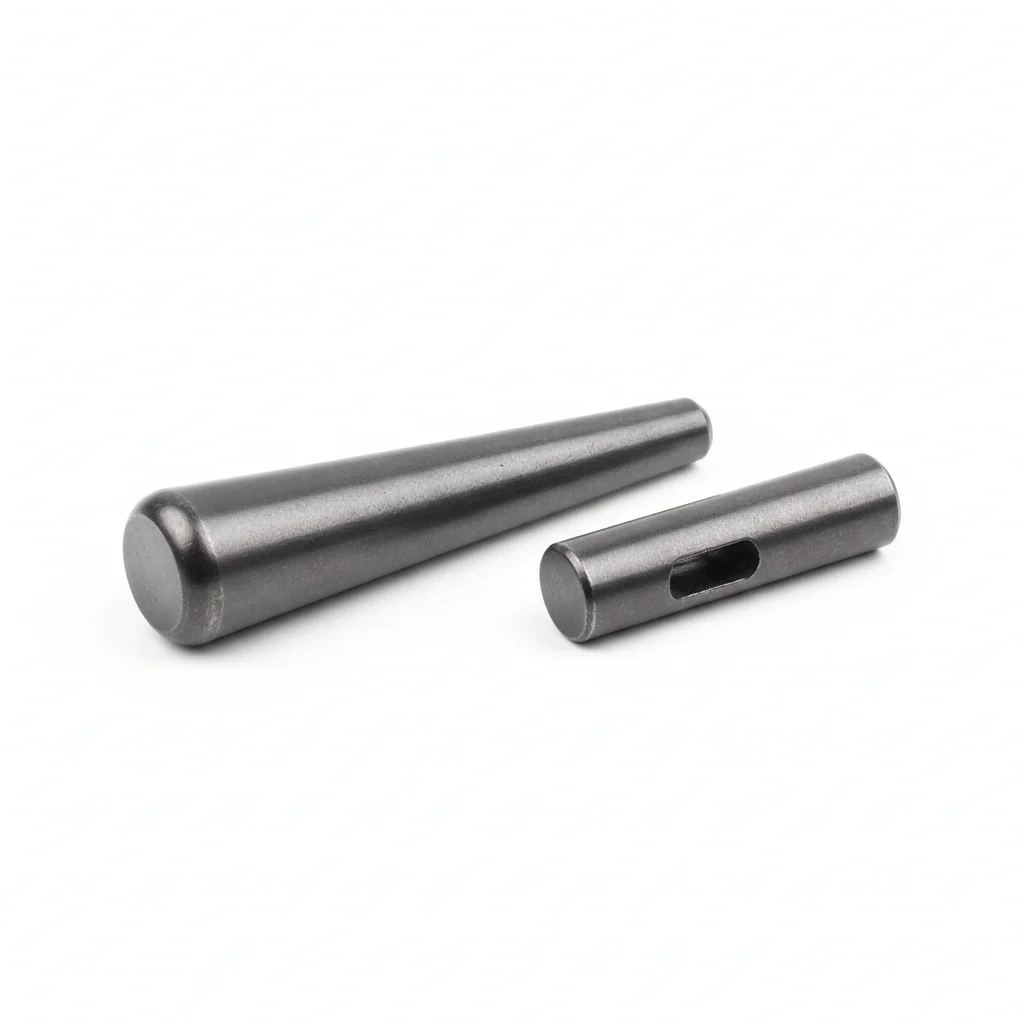
| Two-Piece Bucket Tooth Pin | Swing Motor Bolt | |
|---|---|---|
| SPEC | Per Equipment Model | M16-M20 |
| MATERIAL | 40CrMo Induction Hardened | 42CrMo |
| GRADE | HRC50-55 | Grade 10.9 Dacromet |
| FINISH | HDG >=55um per ISO 1461 | HDG >=55um per ISO 1461 |
| CORROSION | C3 (ISO 12944-2) | C3 (ISO 12944-2) |
| TEMP | -20°C to +80°C | -20°C to +80°C |
| WEIGHT | ~0.5 kg/piece | ~0.5 kg/piece |
| MOQ | 100 pcs | 100 pcs |
| PACK | VCI paper + carton | VCI paper + carton |
| STD | ISO 898-1, GB/T 3098.1 | ISO 898-1, GB/T 3098.1 |
| USE | Bucket Tooth | Swing Motor Base |
PROCEDURE
- Clean the adapter hole and pin bore with solvent to remove grease and debris; inspect for wear >0.5mm and if found, install a bushing repair.
- Insert the two-piece bucket tooth pin from each side, ensuring the short pin is driven flush with the adapter surface.
- For swing motor base bolts, align the motor and reducer using at least two dowel pins; insert grade 10.9 bolts with wedge lock washers.
- Tighten swing bolts in a cross pattern to the specified torque, then apply thread locking adhesive to the bolt threads.
- Verify that the wedge is driven to the mark line and that its back-out is less than 3mm; re-tighten if needed.
COMMON ERRORS
| ✕ WRONG | CONSEQUENCE | ✓ CORRECT |
|---|---|---|
| Using a single long through-pin instead of a two-piece pin | Under eccentric bending, the long pin bows and seizes in the adapter hole, preventing tooth removal and leading to torch cutting and adapter damage. | Use two-piece bucket tooth pins inserted from both sides; they resist bending better and can be driven out from one side. |
| Relying on spring washers alone for swing bolt locking | After repeated emergency stops, preload decays over 50%, allowing displacement and causing spline fretting wear and eventual failure. | Use grade 10.9 bolts with wedge lock washers and thread locking adhesive; ensure precise positioning with dowel pins. |
MAINTENANCE
At each tooth replacement, measure pin hole wear; if exceeding 0.5mm, install a bushing. For swing bolts, re-torque every 500 operating hours.
B · Large Mining
C5-M Extreme per ISO 12944-2
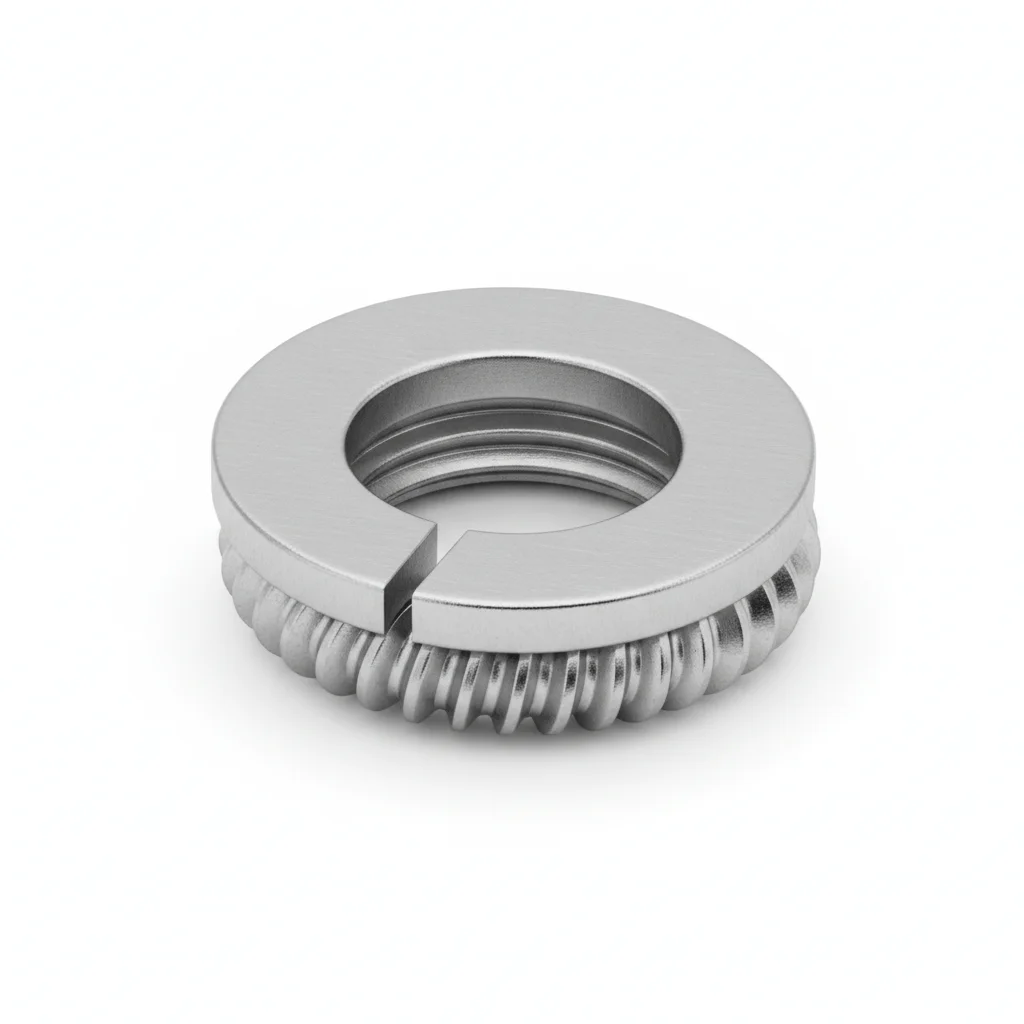
| Two-Piece Bucket Tooth Pin | Wedge Lock Washer | |
|---|---|---|
| SPEC | Enlarged per Model | NL16-20 + Taper Pin |
| MATERIAL | 42CrMo | Carbon Steel Hardened + Dacromet + 45# |
| GRADE | HRC52-58 | Dacromet |
| FINISH | HDG >=55um per ISO 1461 | HDG >=55um per ISO 1461 |
| CORROSION | C3 (ISO 12944-2) | C3 (ISO 12944-2) |
| TEMP | -20°C to +80°C | -20°C to +80°C |
| WEIGHT | ~0.5 kg/piece | ~0.5 kg/piece |
| MOQ | 100 pcs | 100 pcs |
| PACK | VCI paper + carton | VCI paper + carton |
| STD | ISO 898-1, GB/T 3098.1 | ISO 898-1, GB/T 3098.1 |
| USE | Mining Large Excavator Tooth | Swing Base Precise Positioning + Locking |
PROCEDURE
- Before inserting the two-piece pins, wire-brush the adapter bores to remove compacted fines; a clean bore lets the 42CrMo pin (HRC52-58) seat fully and avoids point loading that starts a bend.
- Drive each short pin from its own side until the head contacts the adapter face; never hammer from one side only, because that recreates the single‑side bending moment the two‑piece design is meant to eliminate.
- Set the wedge with a special punch to its marked line; if a locking‑pin wedge is used, drive the locking pin in until its head is flush—this double‑locking stops the 10–50 Hz vibration from backing the wedge out past the 3 mm alert threshold.
- Torque the M16–M20 swing‑motor bolts (Grade 10.9, Dacromet) in a cross pattern, then install the wedge lock washers (NL16–20) under each head; the cams lock by tension, not friction, so no spring washer is used.
- After the bolts are seated, insert at least two taper pins (ISO 8734) into the swing base to take the alternating shear load; the bolts then only clamp, and the taper pins hold position without clearance.
- Mark each bolt head and washer with a paint stripe after final torque, and record the torque value and operator ID in the shift log for traceability.
COMMON ERRORS
| ✕ WRONG | CONSEQUENCE | ✓ CORRECT |
|---|---|---|
| Reusing a bent two‑piece pin after straightening it with a hammer | The straightening creates micro‑cracks invisible to the eye; under the next scooping cycle the pin fractures inside the adapter, seizing the tooth and forcing a torch cut that anneals the adapter hole. | Always install new 42CrMo pins (HRC52–58); if a pin shows any bend, discard it—pins are wear items, not repairable. |
| Relying on the bolts alone to position the swing motor base, skipping the taper pins | Bolt holes have 0.5–1 mm clearance; under the inertia torque of emergency stops the motor shifts that amount, fretting the splines and accelerating wear to 'sharp teeth' within 2–3 months. | Install at least two taper pins (ISO 8734) to locate the base precisely; the bolts then only clamp and the taper pins absorb the shear. |
| Not checking wedge back‑out during the shift inspection | The wedge backs out past 5 mm under 10–50 Hz vibration, the tooth wobbles and detaches under load, exposing the adapter to ore wear—replacement cost jumps from a tooth to an adapter. | Each shift, measure wedge position; if back‑out exceeds 3 mm, re‑drive the wedge to its mark and verify the locking pin is seated. |
MAINTENANCE
Inspect tooth pins and wedges at every shift change, and re‑drive any wedge that has backed out more than 3 mm. For the swing‑motor bolts, check preload at each overhaul window (approximately every 500 operating hours) and re‑torque any bolt that has lost more than 20% of its specified torque. Replace pins showing bending or pitting deeper than 0.3 mm, and replace bolts with corrosion affecting more than 5% of the surface area. Document all findings in the equipment log.
Plan C · Mining/Extreme Conditions
C5-M Extreme per ISO 12944-2
| Two-Piece Bucket Tooth Pin | Wedge Lock Washer | |
|---|---|---|
| SPEC | Enlarged per Model | NL16-20 + Taper Pin |
| MATERIAL | 42CrMo | Carbon Steel Hardened + Dacromet + 45# |
| GRADE | HRC52-58 | Dacromet |
| FINISH | HDG >=55um per ISO 1461 | HDG >=55um per ISO 1461 |
| CORROSION | C3 (ISO 12944-2) | C3 (ISO 12944-2) |
| TEMP | -20°C to +80°C | -20°C to +80°C |
| WEIGHT | ~0.5 kg/piece | ~0.5 kg/piece |
| MOQ | 100 pcs | 100 pcs |
| PACK | VCI paper + carton | VCI paper + carton |
| STD | ISO 898-1, GB/T 3098.1 | ISO 898-1, GB/T 3098.1 |
| USE | Extreme Conditions / Maximum Protection | Extreme Conditions / Maximum Protection |
PROCEDURE
- Clean the adapter bores and pin surfaces with a solvent that leaves no residue; verify the bore is free of scale and that the 42CrMo pin (HRC52–58) slides in with a light press fit.
- Coat the pin shank with a molybdenum‑disulfide anti‑seize rated for the –40 °C to +80 °C range to prevent galling during the 15–20 year service life.
- Insert the two‑piece pins from opposite sides, seating each with a soft‑faced mallet until the retaining groove is fully exposed; then install the retaining rings or cotter pins to lock them against axial movement.
- For the swing base, first align the motor and reducer using the taper pins (ISO 8734) to guarantee zero‑clearance positioning; then hand‑tighten the Grade 10.9 Dacromet bolts with wedge lock washers (NL16–20).
- Tighten the bolts in a cross pattern to the specified torque, then perform a second pass to confirm no relaxation; the wedge lock washers maintain tension without spring washers.
- After final torque, apply a stripe of torque‑seal paint across each bolt head and the base, and record the installation date and torque values in the maintenance history.
COMMON ERRORS
| ✕ WRONG | CONSEQUENCE | ✓ CORRECT |
|---|---|---|
| Installing the wedge without a locking pin and not checking its position | Under high‑frequency vibration, the wedge backs out, the tooth detaches under load, and the adapter suffers ore wear—replacement cost escalates from a tooth to an adapter. | Use a wedge with a locking pin (double locking) and drive the wedge to its marked line; verify the locking pin is fully seated each shift. |
| Torquing the swing bolts without first installing the taper pins | Without taper pins, the bolt clearance (0.5–1 mm) allows the motor to shift under inertia torque, causing spline fretting and eventual 'sharp tooth' wear within months. | Always align the base with at least two taper pins (ISO 8734) before tightening the bolts. |
| Using a torch to remove a seized pin, which anneals the adapter hole | The high temperature softens the adapter, enlarging the hole clearance; the next pin bends more easily, creating a vicious cycle that ends in scrapping the adapter. | Prevent seizure by using two‑piece pins and anti‑seize; if a pin is stuck, drive it out from one side with a punch, never apply heat. |
MAINTENANCE
Inspect pins and wedges at every shift, and re‑drive any wedge backed out more than 3 mm. At each overhaul window (approximately every 500 operating hours), check swing‑bolt torque and re‑torque any bolt below the specified value. Replace pins if bending is detected or if surface pitting exceeds 0.3 mm depth. Replace bolts showing corrosion over 5% of the surface. For extreme conditions, perform a dye‑penetrant check on a 10% sample of the bolts every 3 years, and replace all critical fasteners at the 15‑year mark regardless of condition.
REFERENCED STANDARDS
References
SUPPLIER CAPABILITY
Quality, Delivery & Customization
Quality Control
- ✓MTC material certificates with every batch
- ✓Key parts sampled for hardness/salt spray/torque coefficient
- ✓100% inspection or AQL sampling before shipment
Delivery
- ✓Standard parts made to order: 7-15 days
- ✓Custom parts: 25-45 days
- ✓FOB/CIF/DDP supported
Customization
- ✓Drawing review and material matching
- ✓Non-standard sizes/heads/threads
- ✓Small-batch prototyping supported
Certification
- ✓Material certificates (MTC)
- ✓Spectrographic analysis reports
- ✓Salt spray test reports (on request)
MOQ: No MOQ for standard parts; custom parts assessed by process complexity
FAQ
Frequently Asked Questions
RELATED READING
Keep Reading & Next Step
BEYOND TECHNICAL SPECS
Finding the right factory, controlling quality, delivering on time — that's the real challenge. We cover fasteners, rubber, plastics, industrial textiles. One team, end to end.
SEE CAPABILITIES →