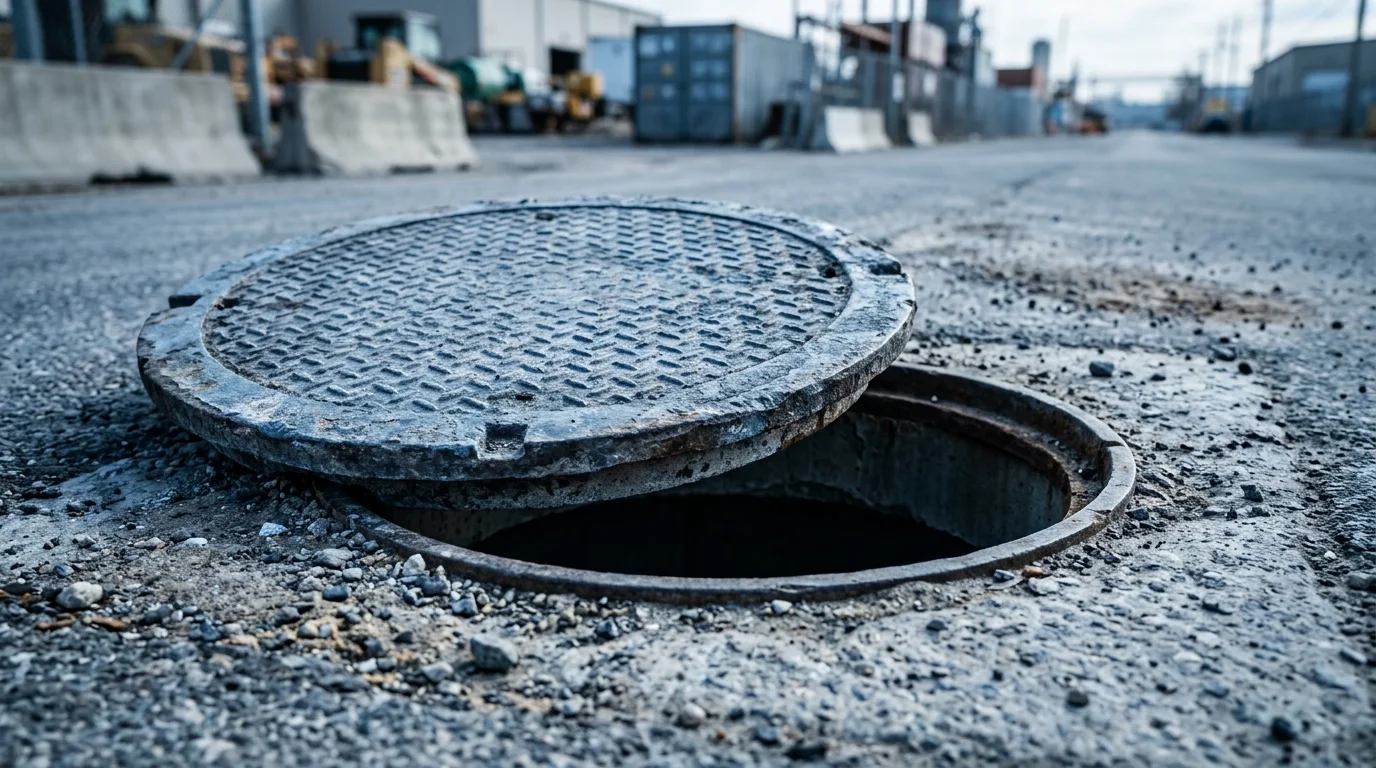
Manhole Cover Selection: 5-Step Guide to Avoid Pitfalls from Working Condition Misjudgment to Installation Acceptance
A municipal project in Hangzhou reported that manhole covers installed the previous year started rattling again. Inspection revealed the rubber pad in the manhole ring had aged and deformed, and the edges of the cast iron cover were worn—a classic case of selection not matching working conditions. According to GB/T 23858-2009 load-class selection practice, a large portion of manhole cover rattling failures originate from misjudgment of working conditions during the selection stage. For the aging and noise mechanism behind manhole cover rattling, see our manhole cover noise fix and prevention page.
Choosing a manhole cover is not like buying a screw; it requires systematic evaluation from underground to above ground. By the end you will know how to select a manhole cover based on working conditions and be able to verify installation acceptance to prevent rattling and premature failure.
Step 1: Working Condition Assessment – Don’t Let “Looks Like” Fool You
Core Question: Where will the manhole cover be installed? What kinds of vehicles pass over it? How does water drain?
Checklist:
- Traffic Load: Sidewalk/parking strip (A15–B125 class) vs. driveway (C250–D400 class) vs. airport/heavy-load (E600–F900 class), let data do the talking, not gut feeling. For example, a standard QT450-10 ductile iron manhole cover in Proposal A has a load capacity of ≥125 kN, suitable only for sidewalks or green belts; Proposal B uses an SMC composite heavy-duty cover with a capacity of ≥400 kN, necessary to withstand a parking lot.
- Environmental Corrosion: Near the sea or chemical plants? The 304 stainless steel extreme-condition cover in Proposal C (with Inconel 625 alloy seat) withstands 1,000 h salt spray, while the hot-dip galvanized version in Proposal A may fail within three years in an acid rain region.
- Drainage Requirements: Is the cover in a low-lying area? Proposal B’s SMC cover has anti-slip strips (friction coefficient ≥0.6), but if waterlogging is frequent, a hydraulic opening device (standard in Proposal B) must be added to prevent flooding.
Case: A logistics park installed Proposal A covers on a freight lane, and the edges cracked in three months. Actual measurement showed that a fully loaded forklift axle load exceeded 200 kN, far beyond the B125 class (125 kN). Selection Rule No. 1: The load class must be ≥ the actual maximum axle load × 1.5 safety factor.
Step 2: Standard Cross-Referencing – Parameters Have Standard Numbers, Don’t Trust Verbal Promises
Core Question: Does the manhole cover comply with national standards? Are the material parameters backed by references?
Checklist:
- National Standard Comparison: GB/T 23858-2009 Inspection Covers clearly defines load classes. The QT450-10 ductile iron cover in Proposal A (φ700×50 mm) must have a capacity of ≥125 kN (corresponding to A15–B125 class); the 304 stainless steel cover in Proposal C (φ900×80 mm) has a capacity of ≥900 kN (E600–F900 class).
- Material Standards: Ductile iron must comply with GB/T 1348-2019 (QT450-10); SMC composite materials must meet GB/T 15568-2008. The SMC cover in Proposal B (φ800×60 mm) incorporates a steel skeleton and reaches ≥400 kN capacity, but if the supplier substitutes the resin, the strength may be cut in half.
- Corrosion Protection Standards: Hot-dip galvanizing coating per GB/T 13912-2020 requires a thickness of ≥85 μm; Proposal C’s epoxy zinc-rich primer + polyurethane topcoat must withstand 1,000 h salt spray (ASTM B117).
Pitfall Avoidance: During acceptance of one project, manhole covers lacked stamped markings. The supplier claimed they “met national standards,” but after laboratory testing, the capacity reached only C250 class (250 kN), while the actual requirement was D400 class (400 kN). A standard number is the bottom line; parameters without a standard number are just empty promises.
Step 3: Material Confirmation – Ductile Iron vs. SMC vs. Stainless Steel, Which Is More Robust?
Core Question: Do the material properties match the working conditions? Is the service life long enough?
Checklist:
- Ductile Iron (Proposal A): QT450-10, tensile strength ≥450 MPa, elongation ≥10%. Suitable for sidewalks and green belts, service life 25–40 years. However, the rubber pad (10 mm) becomes brittle at -20 °C, so EPDM material must be used in northern regions.
- SMC Composite (Proposal B): Density 1.8–2.0 g/cm³, corrosion-resistant, insulating. Preferred for driveways, service life 30–50 years. Note: The emery anti-slip strips (30 mm wide) will wear under heavy loads and should be inspected every five years.
- 304 Stainless Steel (Proposal C): Integral forging, tensile strength ≥520 MPa. Suitable for airports and heavy-load traffic, service life 50–80 years. However, the Inconel 625 alloy seat (Proposal C) costs several times that of ordinary stainless steel and should not be used outside extreme environments.
Data Comparison:
| Parameter | Proposal A (Ductile Iron) | Proposal B (SMC) | Proposal C (304 Stainless Steel) |
|---|---|---|---|
| Load Class | A15–B125 | C250–D400 | E600–F900 |
| Service Life | 25–40 years | 30–50 years | 50–80 years |
| Typical Use | Sidewalk/green belt | Driveway/parking lot | Airport/heavy-load traffic |
| Anti-theft Design | Triangle lock core | Hydraulic opening device | RFID + displacement sensor |
Selection Logic: Proposal A’s anti-corrosion grease (lithium-based NLGI-2) needs reapplication every 2 years, while Proposal C’s smart monitoring system (RFID chip) can alarm in real time—the longer the service life, the lower the maintenance cost, but the higher the initial investment.
Step 4: Supplier Audit – Don’t Just Look at Samples, Look at the Production Line
Core Question: Does the supplier have the qualifications? Is the process stable?
Checklist:
- Production Qualifications: ISO 9001 certification, manhole cover production license (required in some provinces/cities). For Proposal A’s QT450-10 ductile iron cover, check the casting process—lost foam vs. sand casting, the former gives better surface finish.
- Equipment Capability: Proposal B’s SMC cover requires a hot press molding machine (pressure ≥2000 tons), and Proposal C’s 304 stainless steel cover requires a forging hydraulic press (≥5000 tons). Small factories use cold pressing, which reduces strength by about 30%.
- Test Reports: Third-party load capacity test reports (e.g., National Building Materials Testing Center). Proposal A’s anti-settlement rubber pad needs an aging test (70°C×168h, hardness change ≤10%).
Case: During a factory audit, it was found that the supplier had no hot-dip galvanizing line; the outsourced galvanizing thickness was only 60 μm (standard 85 μm), and the manhole seat rusted through after 3 months. A factory audit is not a formality; check equipment nameplates and quality inspection records.
Step 5: On-site Inspection and Installation Acceptance – The Last Line of Defense
Core Question: How to inspect the goods on site? How to test after installation?
Checklist:
- Appearance Inspection: No cracks, pores, or burrs on the cover surface. Proposal A’s anti-theft lock (triangle lock core) needs to be tried 3 times, and Proposal B’s hydraulic opening device (opening force ≤50 kg) needs to be measured.
- Dimensional Tolerance: Proposal C’s 304 stainless steel cover φ900±2 mm, manhole seat φ900±3 mm. Measure with calipers; reject if out of tolerance.
- Installation Acceptance: The height difference between the manhole seat and the road surface should be ≤5 mm (GB/T 23858-2009). Proposal C’s special installation tooling (hydraulic synchronous lifting system) has an accuracy of ±1 mm and must be calibrated on site.
- Functional Test: For heavy-load scenarios, roll with a road roller 10 times; no abnormal noise or settlement. Proposal B’s anti-slip strips (friction coefficient ≥0.6) need to be tested with a pendulum tester.
Pitfall Avoidance: In one project, the manhole cover tilted after installation because the manhole seat was not fixed with mortar (Proposal A requires rubber pad + mortar layer). Installation tooling is not a decoration; follow the manual step by step.
Summary of Key Decision Points
- For high-frequency traffic and heavy loads, choose a load class at least 1.5 times the actual maximum axle load; for corrosive environments, stainless steel or SMC is preferable to galvanized ductile iron.
- Always verify standard numbers and material certifications; a supplier’s verbal promise is not a substitute for stamped markings and third-party test reports.
Next Steps
Prepare the following parameters and documents to communicate with suppliers or engineers:
- Working condition parameters: Maximum axle load (kN), traffic frequency (daily vehicle count), environmental corrosion class (e.g., C3/C4), drainage slope.
- Standard requirements: Specify the required national standard (e.g., GB/T 23858-2009) and material standard (e.g., GB/T 1348-2019).
- Installation conditions: Height difference tolerance between manhole seat and road surface, mortar or rubber pad requirements.
- Acceptance checklist: Prepare an acceptance form including appearance, dimensions, load test, and functional test items.
Deep Reading
More systematic selection, procurement, or inspection guides.
- Corrosion-Resistant Fastener Selection for Municipal Water Treatment Plantswhitepaper
A more systematic guide on a related selection or inspection topic.
- Livestock Facility Fastener Selection: Corrosion Zones, Materials, and Inspectionwhitepaper
A more systematic guide on a related selection or inspection topic.
- Corrosion Protection of Hydropower Submerged Fastenerswhitepaper
A more systematic guide on a related selection or inspection topic.
This article helps with selection and application. But in real projects, specifying the right part is only step one, finding the right factory, controlling quality, and delivering on time is the real challenge. We cover fasteners, rubber, plastics, and industrial textiles across four categories, from Zhejiang industrial clusters to your project site, one team, end to end.
See Our Supply Chain Capabilities →