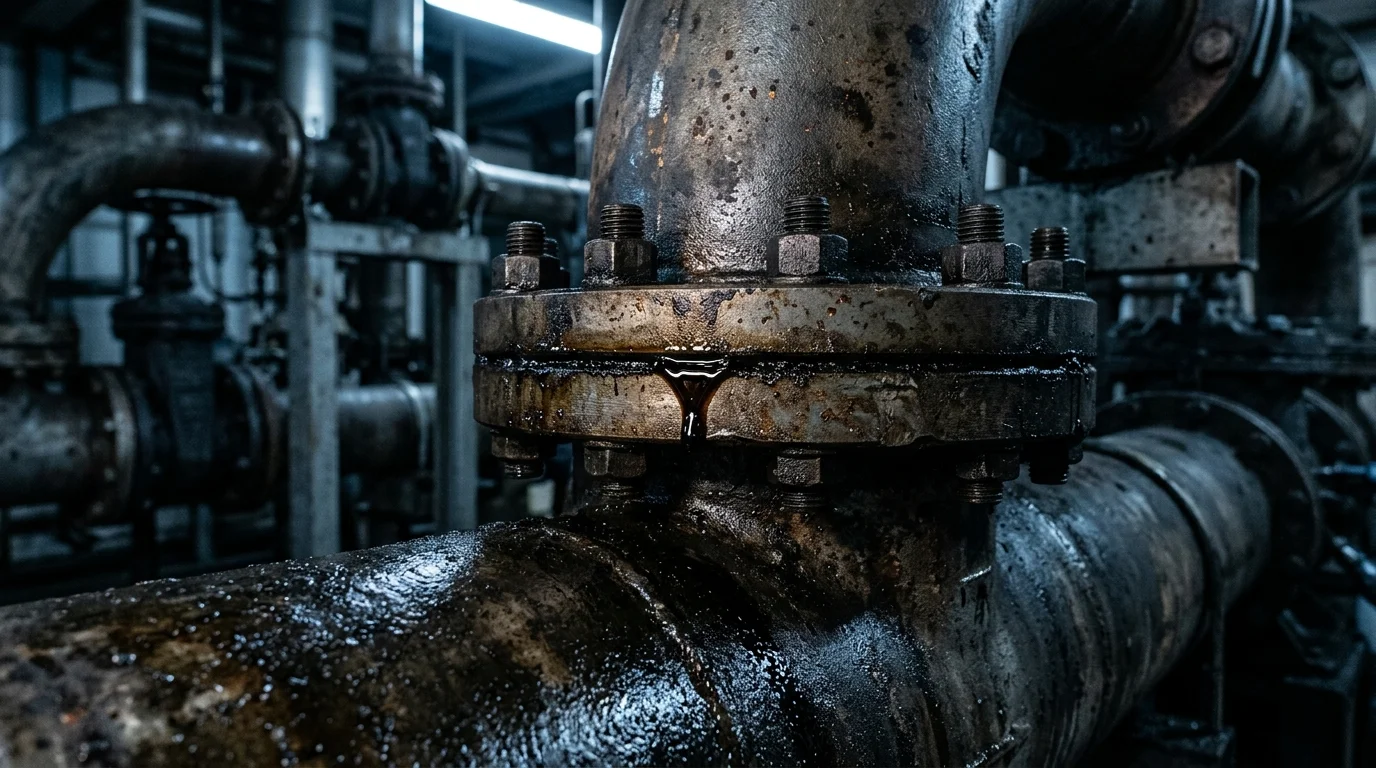
Industrial Piping Hardware — Don't Let a Flange Leak Become Your Downtime Report
A real thread on Reddit's r/pipefitter: a rubber gasket extruded and tore during installation, and the flange leaked on start-up — uneven torque was the root cause, the most common one in the trade. Flange sealing is a system: flange faces, gasket and bolts work together at design values, and any deviation shows up as a leak. ASME PCC-1 requires criss-cross, multi-pass tightening with verified torque — yet "one wrench, one pass" remains the number-one cause of leak rework on site. We supply a complete package: ASME B16.5 / HG/T 20592 flanges, spiral-wound and PTFE gaskets, and 8.8-grade galvanized bolts — upgraded to 316L + PTFE for corrosive media, matched by pressure class and service.
SOLUTION COMPARISON
Flange Connection Options Compared
Three flange families map to pressure class, temperature and maintenance rhythm.
| Option | Best for | Sealing performance | Installation / maintenance | Cost | Recommendation |
|---|---|---|---|---|---|
| Slip-on / plate flanges ⭐ Recommended (low pressure) | Low/medium-pressure water, air, oil lines | Medium: leak-free with correct gasket | Low Carbon steel galvanized has low cost, suitable for general conditions | Easy to weld and align; maintenance-friendly | The value choice for low-pressure lines |
| Weld-neck flanges TOP PICK | Medium/high-pressure steam, chemical service, thermal cycling | High: tapered hub resists bending and fatigue | Medium-high Stainless steel material and special gaskets increase cost | Demanding welds, NDT required | Mandatory for high temperature/pressure and cycling |
| Lap-joint flanges | Frequent dismantling, lined piping, dissimilar-metal joints | Medium: sealing face on the stub end | Medium High-pressure flange forgings have high cost, 100% non-destructive testing | Easiest bolt-hole alignment and dismantling | High-maintenance and rubber/PTFE-lined lines |
Gaskets and bolts must match the flange pressure class (ASME Class vs HG/T PN series). Mixing classes is the other big leak driver.
SELECTION DECISION
3-Step Selection Flow
1. Define media & P/T — corrosivity, design pressure, design temperature 2. Pick the standard system — GB/HG (domestic) or ASME/DIN (export and JV plants) 3. Match sealing & bolting — gasket type + bolt grade + torque procedure
01
Path A · Low-Pressure Water Lines
For: cooling water, fire water, plant utilities
- Slip-on flanges + EPDM rubber gaskets + 8.8-grade galvanized bolts. Per GB/T 9119 / HG/T 20592 PN10/16.
- Most economical for low-pressure, EPDM seals reliable, slip-on welds fast
Path A · Low-Pressure Water LinesSolutions →
02
Path B · Medium/High-Pressure Steam & Chemical
For: steam, hot oil, chemical media above 200°C
- Weld-neck flanges + spiral-wound gaskets (GB/T 4622 / ASME B16.20) + 10.9-grade alloy steel bolts. Cycling temperatures demand hot-torque verification.
- WN hub resists thermal fatigue, spiral-wound gaskets for high temp, 10.9 bolts stable at temperature
Path B · Medium/High-Pressure Steam & ChemicalSolutions →
03
Path C · Corrosive Media
For: acids, alkalis, seawater, chloride-bearing media
- 316L flanges/bolts (ISO 3506 A4) + PTFE gaskets + coated supports. 304 is not acceptable in chloride service — crevice corrosion risk.
- 316L resists chloride pitting, PTFE handles all media, safe for chloride-bearing service
Path C · Corrosive MediaSolutions →
ENGINEERING CASES
Typical Configuration Reference
Based on ASME B16.5, HG/T 20592, ASME PCC-1 and petrochemical practice. For reference only.
| Item | Typical Specs / Requirements | Design Basis / Source |
|---|---|---|
| Slip-on flanges | PN16, RF face, 20#/Q235 carbon steel | GB/T 9119, HG/T 20592 |
| Weld-neck flanges | Class 150–600, WN hub | ASME B16.5 |
| Spiral-wound gaskets | 304 + flexible graphite, inner/outer rings | GB/T 4622, ASME B16.20 |
| PTFE gaskets | Virgin or filled PTFE for corrosive media | ASME B16.21 |
| Flange bolts | 8.8 galvanized / 10.9 / 316L by P-T class | GB/T 3098.1, ISO 3506 |
| Tightening procedure | Criss-cross passes (30%-60%-100%), torque recorded | ASME PCC-1 |
Pressure piping must be designed and installed by licensed parties under the applicable piping code.
Final selection must be verified by a licensed piping engineer per applicable code.
Free BOM Service
Send the line list or isometrics — we'll organize a free piping-hardware BOM: flanges, gaskets and bolts paired by pressure class, with specifications and quantities.
Free BOM Preparation →Related Hardware
Combine in one RFQ for bundled pricing.
Can be included in the inquiry list to enjoy combined procurement discounts.
TECHNICAL BASIS
Standards & References
Parameters compiled from public standards; consult a professional engineer for project design.
Piping
- ASME B16.5-2020 — Pipe flanges & flanged fittings
Applicable Scope:Class ratings - HG/T 20592 / GB/T 9119 — Steel pipe flanges
Applicable Scope:PN series - ASME B16.20 / GB/T 4622 — Spiral-wound gaskets
Applicable Scope:Medium/high-pressure sealing - ASME PCC-1 — Bolted flange joint assembly
Applicable Scope:Torque & tightening sequence - ISO 7005 — Metallic flanges
Applicable Scope:International cross-reference
Fasteners & corrosion
- GB/T 3098.1 / ISO 898-1 — Fastener mechanical properties
Applicable Scope:8.8/10.9 grades - ISO 3506-1:2020 — Stainless steel fasteners
Applicable Scope:316L corrosive service
Parameters compiled from public standards; consult a professional engineer for project design.
FAQ
FAQ
Explore Our Supply Chain Capabilities
From factory QC to global logistics, one team, end to end
Explore Capabilities →About Yaxiio
Yaxiio is an industrial hardware sourcing company based in China. We help global buyers find technically compliant, cost-controlled hardware suppliers — from drawing review and material matching to factory audits and pre-shipment inspection. In industrial piping, we understand flange sealing systems, gasket matching and torque discipline. Our team works to ASME B16.5, HG/T 20592, ASME PCC-1 and ASME B16.20, and matches connection hardware to your media and pressure classes.