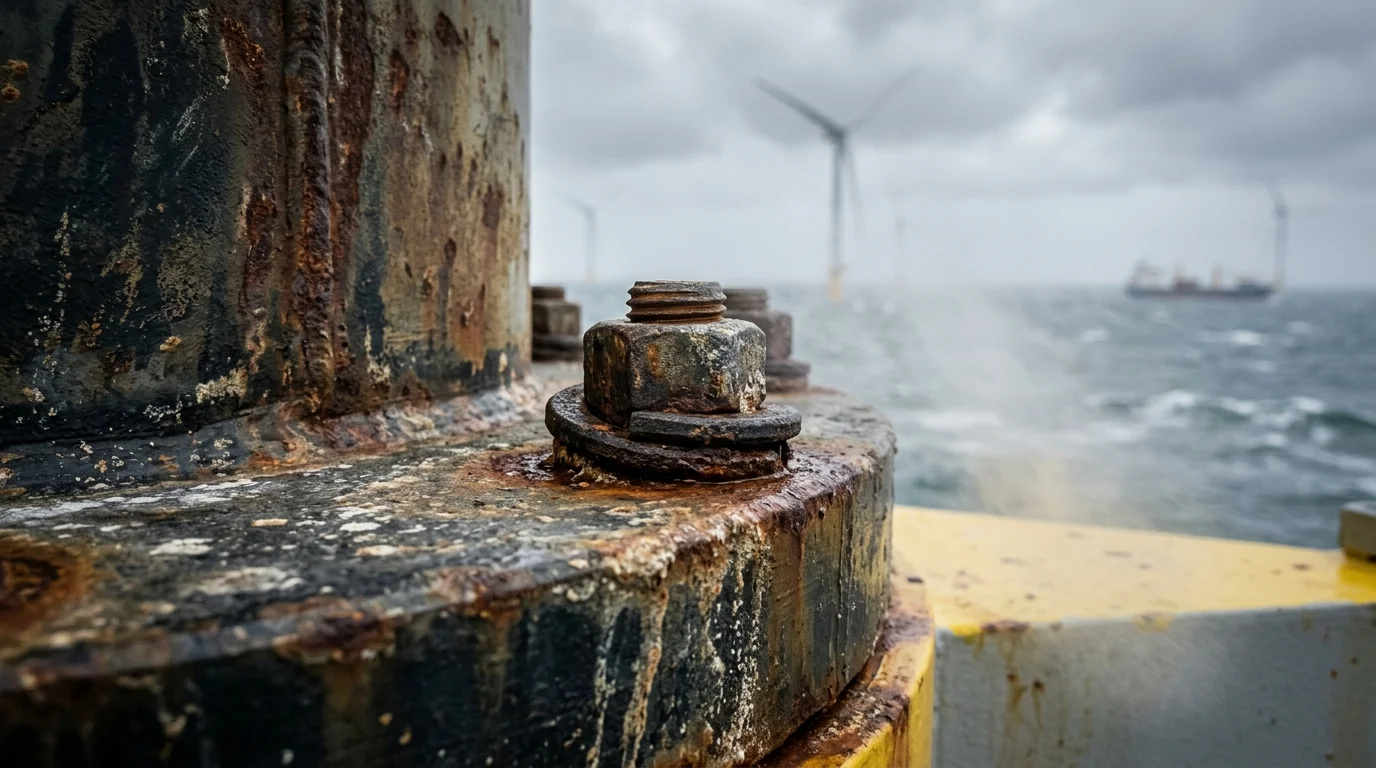
Offshore Wind Bolt Loosening: A Real-World Problem
Domestic power stations have reported batch fastener failures during operation, with root causes tracing back to the selection stage. An offshore wind maintenance engineer once asked: several bolts in the tower showed rapid preload loss during re-inspection, yet the spring washers appeared intact. Why did they still loosen?
This question reveals a common misconception. A spring washer that remains physically intact does not guarantee that the bolted connection has retained its clamping force under high vibration. The washer may still lie under the nut, but the preload may have dropped significantly.
Offshore wind environments are far more demanding than typical steel structures. Tower vibrations, rotor loads, salt spray, humidity, and limited maintenance windows combine to challenge fastener reliability. A locking element that relies solely on friction can easily lose control when transverse vibration and coating friction coefficient variations occur.
By the end you will know how to select and procure wedge lock washers for offshore wind turbine bolted joints, and be able to evaluate Junker test reports and certification requirements.
Related product solutions can be found at wind turbine high-strength lock washer solutions and wind turbine tower flange bolt solutions.
Spring Washers: Mechanism Limitations
Spring washers provide locking through elastic compensation and edge biting. In low-vibration, small-size, non-critical connections, they offer some assistance. However, offshore wind tower, nacelle, ladder, and cable bracket vibrations are not single impacts but long-term cyclic loads.
Once transverse vibration causes micro-slip at the joint interface, the thread pair releases preload. The limited elastic recovery of a spring washer is usually insufficient to restore it.
| Locking Solution | Working Mechanism | Offshore Wind Risk | Application Suggestion |
|---|---|---|---|
| Spring washer | Elastic compensation + edge biting | Rapid preload loss under transverse vibration | Non-critical, low-vibration points only |
| Double nut | Thread interlocking | High installation space and torque control requirements | Accessible, space-sufficient locations |
| nylon insert lock nut | Nylon ring friction locking | Aging under humidity, temperature, and UV | Not recommended for high-temperature or corrosive critical points |
| Wedge lock washer | Wedge surface tension locking | Higher cost, orientation-sensitive | Suitable for high-vibration critical connections |
DIN 25201 Junker transverse vibration test is commonly used to verify anti-loosening performance. It evaluates clamping force retention under transverse vibration, not static torque. This test logic aligns closely with offshore wind field conditions.
Wedge Lock Washer Principle: Tension Replaces Friction
Wedge lock washers (e.g., Nord-Lock) generate tension through the wedge-shaped inclined planes inside the paired washers when the bolt tends to loosen [6][12]. When the bolt loosens, the cam of the top washer passes over the cam of the bottom washer, generating additional preload [12]. The locking effect is independent of lubrication conditions and remains consistent even on bolts coated with anti-corrosion coatings.
Its key is not “more friction” but “the loosening tendency is converted into a tightening tendency.”
This is especially important for coated bolts. Offshore wind commonly uses hot-dip galvanizing systems, zinc-aluminum coatings, Dacromet-type coatings, or other anti-corrosion systems. These coatings make the friction coefficient less stable. Relying solely on friction locking can cause wide scatter between installation torque and actual preload.
Junker Test Data and Procurement Requirements
Nord-Lock wedge washers exhibit preload loss of less than 10% after 1,000 vibration cycles [13]. Other solutions show losses exceeding 50%. 1,000 cycles are equivalent to decades of actual service life for offshore wind equipment. Spring washers fail completely after 100 cycles.
When reviewing Junker test reports, look beyond the “Pass” statement. Examine the test curve: initial clamping force, amplitude, number of cycles, residual clamping force, bolt specification, and lubrication condition. Results under different conditions cannot be directly compared.
| Report Item | Why It Matters | Acceptable Direction |
|---|---|---|
| Initial clamping force | Determines if test matches actual conditions | Close to project design preload |
| Transverse amplitude | Too low amplitude underestimates risk | Clearly stated test conditions |
| Number of cycles | Shows long-term decay trend | At least covers comparison solutions |
| Residual clamping force | Not just “loose or not” but how much remains | Stable curve, controlled decay |
| Bolt and lubrication state | Friction conditions greatly affect results | Similar to project bolt and coating |
Procurement reminder: A “Pass” certificate without test conditions and curves is not sufficient as a basis for critical joint anti-loosening.
Certification and Material Specifications
Nord-Lock is the only wedge lock washer on the market to have obtained DNV type approval [10][14]. Procurement lists should require suppliers to provide this certification. DNV certification covers material composition, dimensional tolerances, coating thickness, salt spray testing, and other indicators. Standard material is steel with Delta Protekt® coating, with special environment materials also available [8]. Delta Protekt® coating provides over 1,000 hours of salt spray protection, while standard zinc plating provides 200 hours.
Material and coating specifications can refer to ISO 898-1:2013 Table 5 for bolt mechanical properties, and ISO 9227 for salt spray testing. Hot-dip galvanized washers and bolts follow GB/T 5267.3-2008 (local minimum 40 μm, average 50 μm); steel parts follow GB/T 13912-2020 Table 2 for coating thickness.
Ensure the hardness of the anti-loosening washer is not significantly lower than the mating surface. If the teeth cannot bite in, the wedge principle cannot work effectively.
Unsuitable Scenarios
When the bearing surface under the bolt head experiences transverse vibration, wedge lock washers may not be the best solution [2]. In such cases, consider alternatives such as hydraulic tensioners or Spiralock nuts [4]. When the clamping length is less than 3 times the bolt diameter, the locking effect of wedge washers decreases. When there is a sliding contact surface under the bolt head, the tension locking advantage may be limited.
Not all locations require high-cost anti-loosening elements. Offshore wind projects should adopt a graded strategy. Tower flanges, critical nacelle equipment, and connections involving life safety are high-risk; ordinary enclosures, small attachments, and frequently maintainable locations are low-risk. A one-size-fits-all approach increases both cost and inventory complexity.
Cost-Effectiveness
Wedge lock washers have a higher initial procurement cost than ordinary washers. The repair cost of a single bolt failure (vessel, lifting, downtime) can be thousands of times the washer cost. Based on 2,000 wedge washers per turbine, the total cost increase is approximately $20,000. The repair cost of a single bolt failure can reach $500,000 to $1,000,000. Bolt failure can lead to tower collapse, causing tens of millions of dollars in asset loss and personal injury risk.
Procurement Checklist
- Requirement confirmation: Is it for critical dynamic load connections? [13] Confirm whether the bolted connection belongs to tower flange, yaw bearing, pitch bearing, or main shaft connection.
- Certification requirement: Is DNV type approval required? [10] Verify the consistency between certificate number and product batch.
- Performance benchmark: Is Junker test preload loss <10% required? [13] Require third-party test report conforming to DIN 25201.
- Specification matching: Bolt size, material (steel/stainless steel), coating (e.g., Delta Protekt) [8].
- Supplier verification: Confirm supplier is the original manufacturer (e.g., Nord-Lock) [5]. Establish supplier audit checklist including production qualification, quality system certification, delivery lead time, and after-sales service.
Installation and Maintenance
Torque accuracy should be controlled within ±10%, using calibrated torque wrenches or hydraulic torque tools. Clean bolt holes and flange surfaces before installation. Washers are used in pairs, with wedge surfaces facing each other. Torque-angle method is recommended for preload control in offshore wind. Maintenance interval: torque check every 6 months. Smart washers can be installed on critical connections for real-time monitoring.
Summary of Key Decision Points
- For high-vibration critical connections, wedge lock washers are preferred; spring washers are almost ineffective in Junker tests.
- When reviewing Junker test reports, focus on residual clamping force and test conditions, not just the “Pass” conclusion.
Next Steps: Prepare These Parameters
- List of critical bolted joints with bolt specifications, materials, and coatings.
- Project design preload and torque requirements.
- Required certifications (e.g., DNV type approval) and test standards (e.g., DIN 25201).
- Supplier qualification documents and sample test reports.
Deep Reading
More systematic selection, procurement, or inspection guides.
- Farm Machinery Bolt Failures: From Root Causes to Reliable Selection and Maintenancewhitepaper
A more systematic guide on a related selection or inspection topic.
- Undercarriage Fastener Failures: Why Bolts Loosen and Pins Wear, and How to Make the Right Maintenance and Procurement Decisionswhitepaper
A more systematic guide on a related selection or inspection topic.
- Fastener Selection for Agricultural Processing Equipment: From Failure Mechanisms to Acceptance Decisionwhitepaper
A more systematic guide on a related selection or inspection topic.
This article helps with selection and application. But in real projects, specifying the right part is only step one, finding the right factory, controlling quality, and delivering on time is the real challenge. We cover fasteners, rubber, plastics, and industrial textiles across four categories, from Zhejiang industrial clusters to your project site, one team, end to end.
See Our Supply Chain Capabilities →