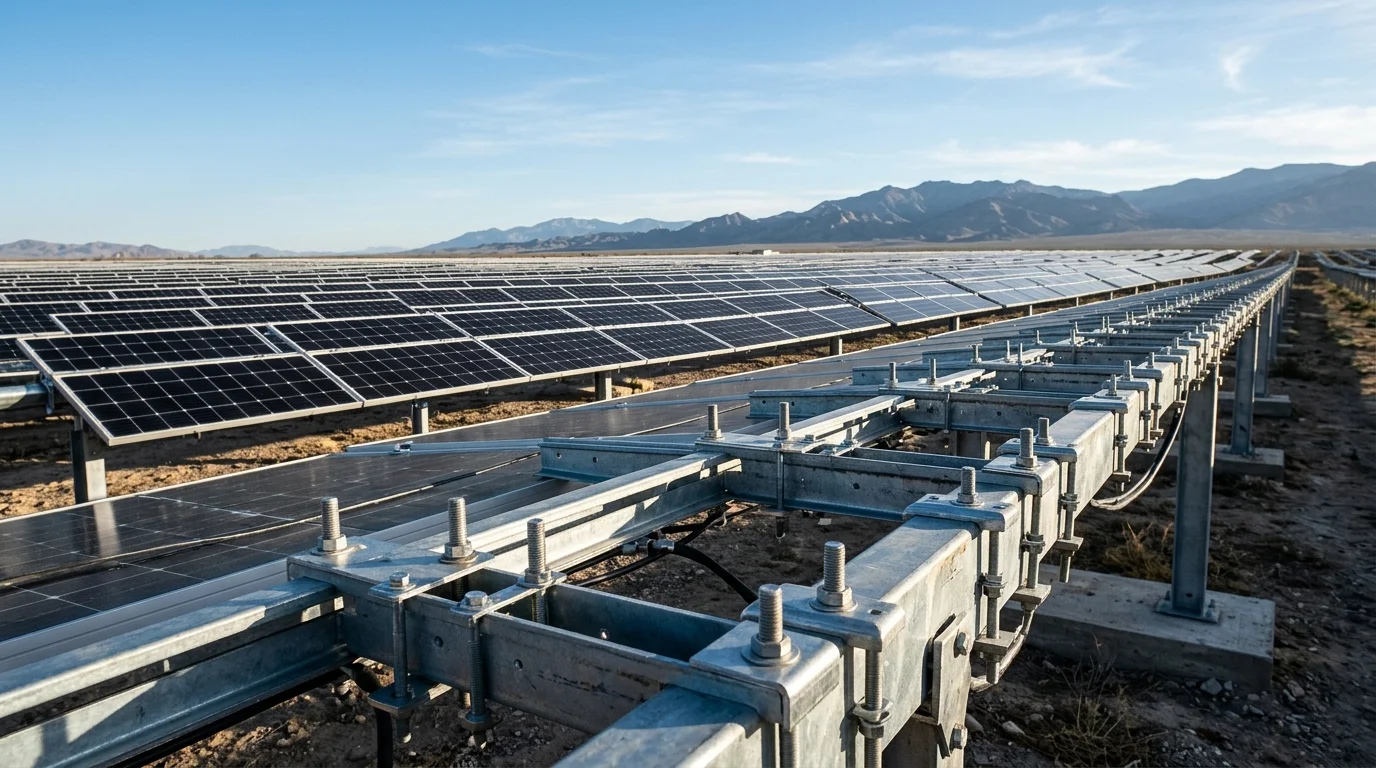
Hardware Selection Guide for Ground-Mount Solar PV Power Stations
Based on industry standards and publicly available technical references, we have systematically compiled selection recommendations for different operating conditions to help you quickly match the materials and specifications of foundation supports, connectors, and electrical accessories.
SOLUTION COMPARISON
Comparison of Solar Mounting Structure Foundation Solutions
Foundation costs account for 15-25% of the civil works budget for a PV power station. The selection directly impacts construction timelines, long-term stability, and lifecycle O&M costs. Below, we compare three mainstream solutions—ground screws, embedded bolt foundations, and concrete independent foundations—across four dimensions: geological suitability, construction efficiency, seismic performance, and overall cost, to help you quickly match project conditions.
| Solution | Applicable Geology | Construction Efficiency | Cost | Seismic Resistance | Recommendation |
|---|---|---|---|---|---|
| Ground Screw | Soft soil, sandy soil, plastic soil | Fast: screw-in installation, no curing required, ≤3 minutes per pile | Low Helical screws require no concrete, fast construction reduces overall cost | Good, geological adaptability is key | Projects with good geological conditions requiring fast construction, cost control priority |
| Embedded Bolt + Concrete Foundation TOP PICK | All types of geology, high load-bearing capacity required | Slow: requires formwork, pouring, and curing ≥7 days | Medium Concrete foundation materials are cheap but have a long curing period | Strong: good integrity, strong resistance to settlement | Permanent power stations with high load requirements, geologically complex areas |
| Concrete Independent Foundation | All types of geology, especially suitable for weak foundations | Slow: requires extensive earthwork and concrete construction, curing ≥14 days | High Precast blocks are factory-produced, high load-bearing requirements in windy areas drive up specifications | Strong: good stability, resistance to uneven settlement | Large-scale ground-mount power stations, uneven terrain, geologically complex sites |
The above information is compiled based on IEC 62817 and publicly available industry technical literature. Actual selection must be combined with a geotechnical investigation report.
SELECTION DECISION
Reference Selection Path for PV Mounting Connectors
Based on project environmental conditions and cost objectives, the following three paths are for your reference. For the specific connector specifications and solutions recommended in each path, please refer to the corresponding L3 page.
01
Path A · Economical & Practical
Applicable to: inland areas, wind speed <25m/s, cost control priority
- Fixed mounting + ground screw + hot-dip galvanized connectors (Grade 8.8, ≥65μm)
- Short construction period, no concrete curing required, relatively low overall cost
Path A · Economical & PracticalSolutions →
02
Path B · High Weather Resistance
Applicable to: within 3km of coast, industrial pollution zones, annual humidity >80%
- Tracking or fixed mounting + embedded bolt foundation + 304 stainless steel/Dacromet connectors (A2-70)
- Corrosion protection level meets C4-C5 environments, Dacromet coating has no hydrogen embrittlement risk
Path B · High Weather ResistanceSolutions →
03
Path C · Advanced Corrosion Protection
Applicable to: offshore PV, areas around chemical plants, high-concentration salt spray zones
- Fixed adjustable mounting + concrete foundation + 316 stainless steel/hot-dip plastic coated connectors (A4-80)
- 316 stainless steel has better resistance to chloride ion pitting corrosion than 304, suitable for extreme environments
Path C · Advanced Corrosion ProtectionSolutions →
📌 The strength grade of connectors is based on ISO 898-1:2013; the thickness of hot-dip galvanized coating is based on ISO 1461:2022 (≥65μm for C3-C4 environments).
ELECTRICAL CONNECTORS
Full Range of Hardware for PV Power Stations
Hardware for ground-mount PV power stations covers the full range of mounting connections, foundation piles, electrical connections, cable management, inverter installation, gaskets and seals, grounding protection, etc. Below are three key categories selected for quick selection:
PV Cables and Conduit Fittings
- Key Parameters:PV1-F DC cables, MC4 connectors, cable glands, weather-resistant cable ties
- Selection Suggestions:Match wire gauge to string current; for 1500V DC systems, prioritize twin-core cables to reduce installation work.
Combiner Box and Inverter Mounting Hardware
- Key Parameters:Combiner box screws, door locks, sealing strips, inverter wall-mount/floor-mount brackets
- Selection Suggestions:Ensure IP65 sealing level for combiner box hardware. Consider heat dissipation space for inverter brackets.
Grounding and Protection Accessories
- Key Parameters:W-type grounding clip, rail grounding clip, copper braided grounding strap, module frame grounding clip
- Selection Suggestions:Install at least one grounding point per 20 modules. Use copper-clad steel grounding rods with copper braided straps.
For more technical parameters of electrical connectors, please visit:PV Electrical Connectors L3 Page
📌 MC4 connector certification is based on IEC 62852:2014+A1:2020; DC cables are based on EN 50618:2014.
DECISION FLOW
Quick Selection Decision Process
STEP 01
① Confirm Corrosion Level
Refer to ISO 9223 or contact us for evaluation
STEP 02
② Determine Design Life
Three options: 20 / 25 / 30 years
STEP 03
③ Refer to Solution Matrix
Path A / B / C automatically matched
ENGINEERING CASES
Industry Typical Configuration Reference
The following configurations are compiled based on IEC 62548 'Code for Design of Photovoltaic Power Stations' and conventional schemes from mainstream design institutes, for reference only. Actual projects require specialized design based on geological, climatic, and load conditions.
| Configuration Item | Typical Specification/Requirement | Design Basis/Source |
|---|---|---|
| Mounting Type | Fixed hot-dip galvanized mounting (tilt angle according to local latitude) | IEC 62548 Section 6.6 |
| Mounting Material | Q235B hot-dip galvanized, zinc coating ≥65μm | ISO 1461, ISO 1461 |
| Connection Bolts | Grade 8.8 hot-dip galvanized bolts, zinc coating ≥65μm | ISO 898-1, IEC 62817 |
| Foundation Type | Ground screw (soft soil/sandy soil) or micro-pile | Reference: 'Comparative Analysis of PV Mounting Foundation Types' |
| Electrical Connectors | MC4 connectors (TUV/UL certified), PV1-F 4mm² DC cable | IEC 62852, EN 50618 |
| Grounding Materials | Copper-clad steel grounding rod (copper thickness ≥0.25mm) + exothermic welding | DL/T 5394-2021, IEEE 837 |
📌 Note: The above are common configuration templates. If your project environment is special (high altitude, strong corrosion, high wind speed), please contact us for targeted advice.
⚠️ The above configurations are typical reference solutions. Final selection must be determined by a certified electrical engineer based on actual operating conditions.
Free BOM Organization Service
Provide design drawings or a requirements list, and we will help you organize the BOM for free — listing specifications and quantity recommendations for all bolts, washers, clamps, and grounding materials (not engineering drawings, only for procurement reference).
Organize BOM for Free →Related Supporting Products for Ground-Mounted Photovoltaic Power Stations
The following products are also used in photovoltaic power stations. For detailed selection, please refer to the corresponding scenario pages:
💡 The parameters on the above pages are also applicable to photovoltaic scenarios. You only need to select the appropriate specifications based on the station capacity and soil resistivity.
TECHNICAL BASIS
Technical Basis and Reference Standards (Click to Expand)
The technical parameters on this page are organized based on the following public standards.
Fastener and Anti-Corrosion Standards
- ISO 898-1:2013 — Mechanical Properties of Fasteners
Applicable Scope:Strength Grade Selection - ISO 3506-1:2020 — Stainless Steel Fasteners
Applicable Scope:304/316L Selection - ISO 1461:2022 — Hot-Dip Galvanized Coatings
Applicable Scope:≥65/85μm Grading
Photovoltaic Standards
- IEC 62548 — Code for Design of Photovoltaic Power Stations
Applicable Scope:Support Foundation and Electrical Design - IEC 62852:2014 — Safety Requirements for Photovoltaic Connectors
Applicable Scope:MC4 Certification Standard - IEC 62305-3 — Lightning Protection
Applicable Scope:Ground Resistance <10Ω
📖 Standard Query
Disclaimer: Technical parameters are compiled from public standards. For specific designs, please consult a professional engineer.
FAQ
Frequently Asked Questions
Explore Our Supply Chain Capabilities
From factory QC to global logistics, one team, end to end
Explore Capabilities →About Yaxiio
Yaxiio is an industrial hardware foreign trade procurement solutions company. We help global clients find technically compliant and cost-controllable hardware suppliers in China, providing full-process procurement services from drawing evaluation, material matching, factory audit to inspection and delivery. In the field of ground-mounted photovoltaic power stations, we deeply understand key technical aspects such as support foundation selection, anti-corrosion of connectors, and electrical grounding, systematically studying authoritative technical documents including IEC 62548 Code for Design of Photovoltaic Power Stations, ISO 1461 Hot-Dip Galvanizing Standard, and IEC 62852 Standard for Photovoltaic Connectors.