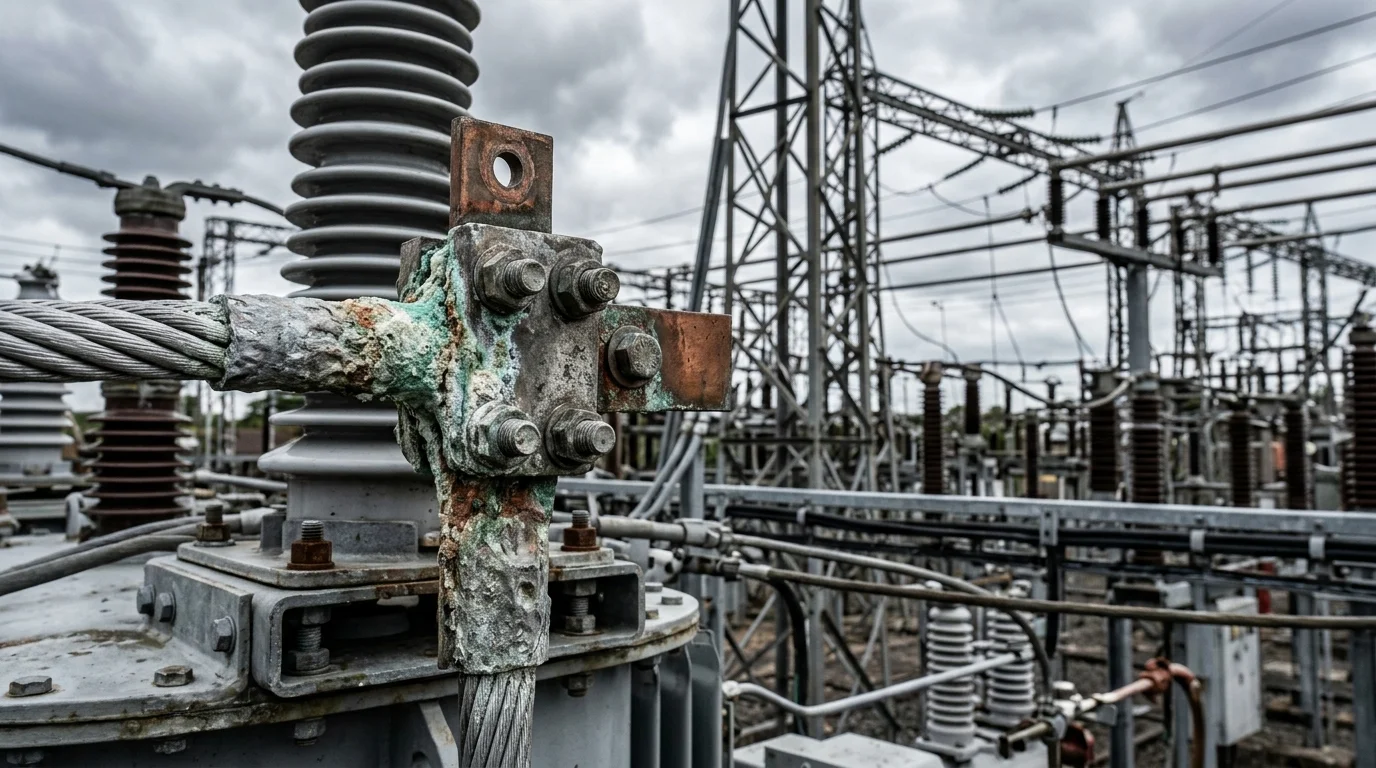
Selection Guide for Transmission and Substation Hardware
Transmission and substation projects must withstand high voltage, high current, and harsh outdoor environments. Select by voltage level (110kV/220kV/500kV) and provide line hardware, equipment connectors, and grounding systems compliant with ASTM B85 / EN 1706, IEC 61854, and other standards. Below is a classification by application scenario for quick hardware identification.
SOLUTION COMPARISON
Selection Comparison by Voltage Level
The core of transmission hardware selection lies in voltage level—different voltages impose significantly different requirements on current-carrying capacity, corona protection, and insulation coordination. Below is a comparison of typical configuration solutions for three voltage levels.
| Solution | Voltage Level | Core Products | Corrosion Protection Level | Standard Basis | Recommendation |
|---|---|---|---|---|---|
| 110kV Line Hardware Solution | 110kV and below transmission lines | Suspension clamp XGU-4 (failure load ≥70kN), tension clamp NLD-4, vibration damper FZ series. Conductor cross-section 240-400mm² | Low Batch forging of national standard hardware is mature, with the lowest cost | Aluminum alloy anodized, steel parts hot-dip galvanized ≥86μm | Suitable for regional distribution networks and 110kV main grid lines |
| 220kV Substation Connection Solution TOP PICK | 220kV substations and incoming/outgoing lines | Copper-aluminum transition clamps SLG-400/SYG-630 (friction welding process), tubular busbar fixing hardware MGH series, equipment clamps SYG type | Medium Cast aluminum has good conductivity but low strength, requiring larger cross-sections to compensate | Copper-aluminum transition interface tensile strength ≥80MPa, grounding resistance ≤0.25Ω | Primary equipment connections and busbar systems in 220kV substations |
| 500kV EHV Grounding System | 500kV EHV transmission and substations | Copper-clad steel grounding electrodes Φ14-20mm×2400mm (copper plating ≥0.25mm), exothermic welding kits, quad-bundle conductor hardware, deep well grounding electrodes | High Certification and testing costs for EHV hardware account for a high proportion | Copper-clad steel tensile strength ≥600MPa, service life ≥30 years. Grounding resistance ≤0.1Ω | 500kV hub substations and long-distance transmission lines |
The above information is compiled with reference to ASTM B85 / EN 1706, DL/T 759-2001, and industry public materials. Actual selection should be combined with engineering design and site conditions.
SELECTION DECISION
Detailed Selection of Transmission Hardware
The following three categories cover the core hardware for transmission and substation projects. Click to enter the L3 page for detailed selection comparison tables, specification parameters, and standard requirements.
01
Line Hardware
Applicable to 110kV-500kV overhead transmission lines, including suspension, tension, connection, and protective hardware
- XGU series suspension clamps + NLD series tension clamps + FZ series vibration dampers + grading rings. Conductor cross-section 240-630mm²
- Full series covering different voltage levels, failure load 70-400kN, meeting requirements for heavy ice zones and strong wind areas
Line HardwareSolutions →
02
Substation Connectors
Applicable to primary equipment connections in 110kV-500kV substations, including copper-aluminum transition and tubular busbar hardware
- SLG/SYG copper-aluminum transition clamps (friction welding) + MGH tubular busbar hardware + flexible busbar fixing hardware. Cross-section 400-800mm²
- Friction welding interface strength 30% higher than brazing, conductivity ≥97% IACS, passed IEC 61238 type tests
Substation ConnectorsSolutions →
03
Grounding System
Applicable to substation lightning protection grounding and line tower grounding, meeting different soil resistivity requirements
- Copper-clad steel grounding electrodes Φ16-20mm + exothermic welding kits + deep well grounding electrodes. Copper plating ≥0.25mm, down conductor 40×4mm hot-dip galvanized flat steel
- Copper-clad steel service life ≥30 years, exothermic welding joint resistance ≤0.1mΩ, meeting 0.1Ω grounding requirement for 500kV substations
Grounding SystemSolutions →
📌 Hardware selection based on ASTM B85 / EN 1706 and DL/T 759-2001. Friction welding process recommended for copper-aluminum transition (interface strength ≥80MPa). Grounding resistance per IEEE Std 80: 110kV ≤0.5Ω, 220kV ≤0.25Ω, 500kV ≤0.1Ω.
ELECTRICAL CONNECTORS
Full Range of Transmission and Distribution Hardware
Transmission and distribution engineering hardware covers line hardware, substation connections, grounding systems, cable trays, insulation accessories, vibration dampers, and other full scenarios. Below are three key categories selected for quick reference:
Cable Trays and Supports
- Key Parameters:Ladder cable trays, tray cable trays, support connectors, cover plate clips
- Selection Suggestions:For coastal/acid rain areas, FRP cable trays or 304 stainless steel cable trays are recommended, with a service life of over 25 years.
Insulators and Insulation Accessories
- Key Parameters:Suspension insulators, post insulators, pin insulators, insulator steel pins and caps
- Selection Suggestions:Select creepage distance according to voltage level; in areas with high pollution levels, increase the number of insulator units.
Vibration and Galloping Dampers
- Key Parameters:Vibration dampers, damping lines, spacer dampers, interphase spacers
- Selection Suggestions:The larger the conductor cross-section and the longer the span, the higher the vibration protection requirement. For bundled conductors, sub-span oscillation must also be considered.
DECISION FLOW
Transmission Hardware Selection Process
STEP 01
Determine Voltage Level
Select corresponding standards based on project voltage level (110/220/500kV) and hardware type
STEP 02
Calculate Load Conditions
Determine failure load requirements for suspension/tension clamps based on conductor cross-section and meteorological zone
STEP 03
Choose Corrosion Protection Scheme
Select corrosion protection scheme based on environmental corrosion level: standard hot-dip galvanizing ≥86μm, stainless steel for coastal areas
ENGINEERING CASES
Industry Typical Configuration Reference
The following configurations are compiled based on ASTM B85 / EN 1706 and typical design schemes of State Grid, for reference only.
| Configuration Item | Typical Specification/Requirement | Design Basis/Source |
|---|---|---|
| Suspension Clamp | XGU-4 type, failure load ≥70kN, applicable conductor LGJ-240/30 | ASTM B85 / EN 1706 |
| Tension Clamp | NLD-4 type, grip strength ≥95% of conductor calculated breaking force | DL/T 759-2001 |
| Copper-Aluminum Transition Clamp | SLG-400, friction welding process, interface tensile strength ≥80MPa | IEC 61238 |
| Copper-Clad Steel Grounding Electrode | Φ16mm×2400mm, copper plating ≥0.25mm, tensile strength ≥600MPa | IEEE Std 80 |
| Exothermic Welding | Welding powder 150g/set, joint resistance ≤0.1mΩ | IEEE 837 |
| Cable Tray | Hot-dip galvanized steel, zinc layer ≥65μm, load class C | EN 10327 |
⚠️ The above configurations are typical reference schemes. Final selection must be determined by electrical engineers based on engineering design.
Typical BOM List Example
Provide design drawings or technical specifications, and we will help you organize the BOM list for transmission and distribution hardware for free—listing all specifications, quantities, and standard requirements for suspension clamps, tension clamps, copper-aluminum transition clamps, and grounding materials.
Free BOM Organization →Related Supporting Products
The following products are commonly used in transmission, distribution, and photovoltaic scenarios. For detailed selection, please refer to the corresponding pages:
💡 The technical requirements for grounding systems and cable trays are essentially the same in transmission, distribution, and photovoltaic scenarios, and can share selection references.
TECHNICAL BASIS
Technical Basis and Reference Standards (Click to Expand)
The technical parameters on this page are compiled based on the following public standards.
Fastener and Corrosion Protection Standards
- ISO 898-1:2013 — Mechanical Properties of Fasteners
Applicable Scope:Strength Grade Selection - ISO 3506-1:2020 — Stainless Steel Fasteners
Applicable Scope:304/316L Selection - ISO 1461:2022 — Hot-Dip Galvanized Coatings
Applicable Scope:≥65/85μm Grading
Transmission Standards
- ASTM B85 / EN 1706 — General Conditions for Power Fittings
Applicable Scope:Line Hardware Standard - IEC 61238-1 — Short-Circuit Test for Copper-Aluminum Connectors
Applicable Scope:Transition Clamp Performance - IEC 62305-3 — Lightning Protection
Applicable Scope:Grounding ≤4Ω
Standard Inquiry
Disclaimer: Technical parameters are compiled from public standards. Please consult professional engineers for specific designs.
FAQ
Frequently Asked Questions
Explore Our Supply Chain Capabilities
From factory QC to global logistics, one team, end to end
Explore Capabilities →About Yaxiio
Yaxiio is an industrial hardware foreign trade procurement solutions company. We help global clients find technically compliant and cost-effective hardware suppliers in China, providing full-process procurement services from drawing evaluation, material matching, factory audits to inspection and delivery. In the field of transmission and distribution engineering, we deeply study key technologies such as line hardware, copper-aluminum transitions, and grounding systems, systematically learning authoritative standards like IEC 61238, ASTM B85 / EN 1706, and IEC 62305.