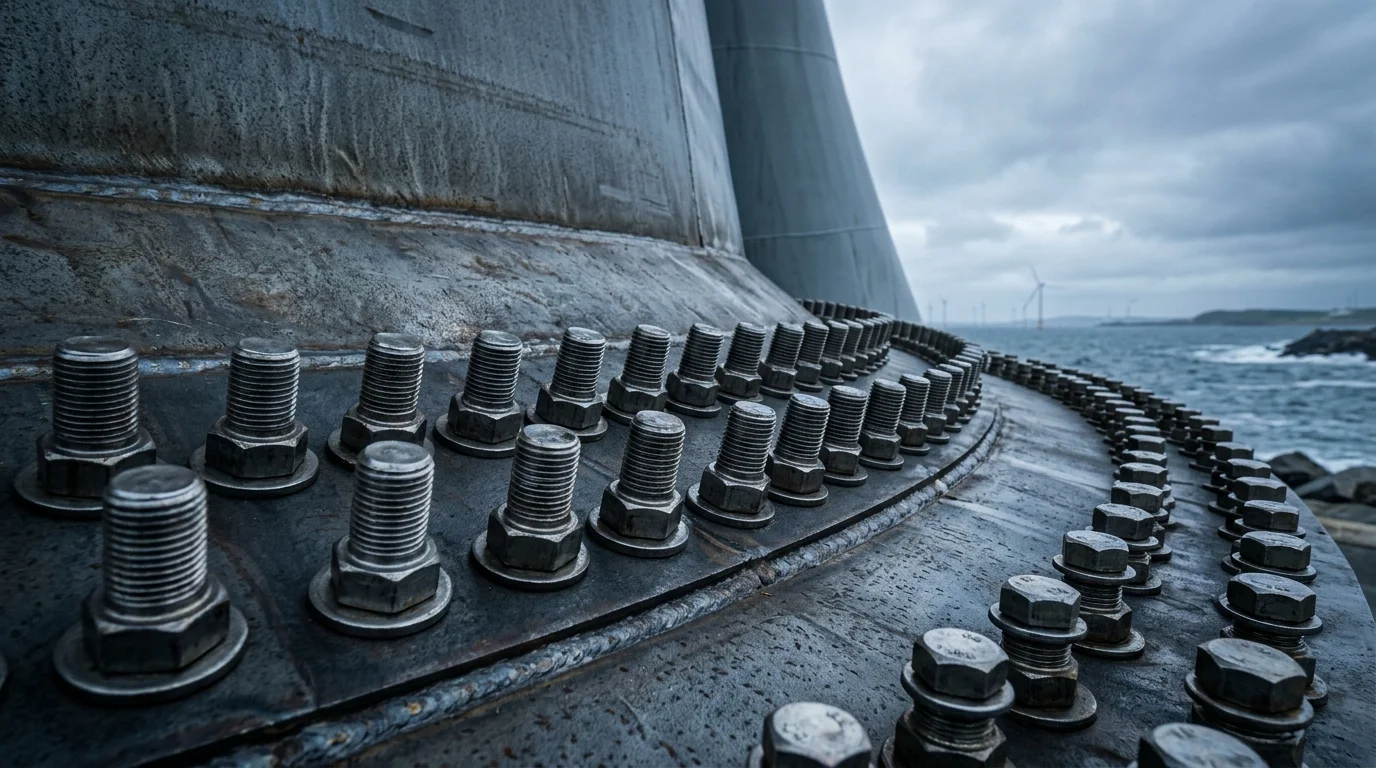
Wind Turbine Tower and Foundation Fastener Selection Guide
Selection reference for onshore and offshore wind turbine tower flange bolts, anchor cages, and nacelle anti-loosening fasteners. Compiled based on EN 14399, IEC 61400-6, IEC 61400-1 and other standards.
SOLUTION COMPARISON
Onshore vs Offshore Wind Power Fastener Selection Comparison
Onshore and offshore wind power differ significantly in corrosion level, anti-corrosion requirements, and maintenance difficulty. The comparison below helps you quickly identify your needs.
| Solution | Application Scenario | Anti-Corrosion Solution | Cost | Core Products | Recommendation |
|---|---|---|---|---|---|
| Onshore Wind Power (C3-C4) | Inland plains, hills, low-altitude coastal areas | Hot-dip galvanizing ≥85μm or Dacromet coating | Medium Onshore wind turbines have low corrosion protection requirements; Dacromet coating offers good cost performance | 42CrMoA 10.9S grade flange bolts + Nordlock washers | Mainstream onshore wind turbines, good maintenance accessibility |
| Offshore Wind Power (C5M-CX) TOP PICK | Nearshore, deep sea, intertidal zones | Thermal spray aluminum ≥150μm + multi-layer epoxy coating, total thickness ≥320μm | High Offshore C5-M corrosion protection requires duplex stainless steel + fluorocarbon coating, doubling material costs | 42CrMoA/34CrNiMo6 10.9S grade + 254SMO stainless steel washers | Large-capacity offshore wind turbines, long maintenance-free cycles |
| High-Altitude/Cold Region Wind Power | Northwest plateaus, northeast cold regions | Low-temperature impact toughness requirement, -40℃ Charpy V-notch ≥34J | Medium Low-temperature impact toughness requirements increase material and heat treatment costs | 34CrNiMo6 10.9S grade + low-temperature grease | Extreme temperature environments, material toughness prioritized |
The above information is compiled with reference to IEC 61400-6, IEC 61400-1, and ISO 12944 anti-corrosion standards. Hydraulic tensioners are recommended for preload control; torque method error can reach ±25%.
SELECTION DECISION
Detailed Wind Power Fastener Selection
The following three modules cover core wind power fastener categories. Click to view specific specifications and parameters.
01
Tower Flange Bolts
Large hex head high-strength bolts grade 10.9S, M30-M64
- 42CrMoA/34CrNiMo6 + matching 10H nuts + hardened washers
- Precise preload control, fatigue life ≥12 million cycles
Tower Flange BoltsSolutions →
02
Anchor Cages and Anchor Bolts
Secure the tower to the concrete foundation, withstand overturning moments
- 42CrMoA M48-M64 + upper/lower anchor plates Q345B + leveling feet
- Fatigue life ≥12 million cycles, anti-corrosion designed per ISO 12944
Anchor Cages and Anchor BoltsSolutions →
03
Nacelle Fasteners and Anti-Loosening Solutions
Reliable anti-loosening in high-vibration areas
- Nordlock wedge washers + disc springs + self-locking nuts
- Torque retention rate ≥85%, reusable
Nacelle Fasteners and Anti-Loosening SolutionsSolutions →
📌 High-strength bolts per EN 14399-3. Anti-corrosion design per ISO 12944. Offshore wind per DNV-ST-0126.
ELECTRICAL CONNECTORS
Full Range of Wind Power Engineering Hardware
Wind power engineering hardware covers all scenarios including tower flanges, anchor foundations, nacelle fastening, ladders, cable fixing, grounding, and ventilation. Below are three key categories for quick selection:
Tower Accessory Fasteners
- Key Parameters:Ladder fixing bolts, cable tray clips, stainless steel cable ties
- Selection Recommendation:For internal tower components, 304 stainless steel (A2-70) is recommended; pay attention to anti-loosening design.
Grounding and Lightning Protection Components
- Key Parameters:Copper braided grounding straps, tin-plated copper braided straps, grounding terminals, grounding clamps
- Selection Recommendation:Each tower flange section requires a bridging grounding strap; total tower grounding resistance should be ≤ 4 Ω.
Lock Washers
- Key Parameters:wedge-locking washers, disc spring washers, conical spring washers, serrated lock washers
- Selection Recommendation:Critical wind turbine bolts must use wedge-locking washer or equivalent lock washers; spring washers are strictly prohibited as substitutes.
DECISION FLOW
Quick Selection Process for Wind Turbine Fasteners
STEP 01
① Confirm turbine parameters and environment
Power, tower height, onshore/offshore, corrosion level
STEP 02
② Determine bolt specifications and grade
Select M30-M64 based on load calculation, primarily 10.9S grade
STEP 03
③ Match anti-corrosion and anti-loosening solutions
Hot-dip galvanizing for onshore / thermal spray aluminum for offshore, wedge-locking anti-loosening
ENGINEERING CASES
Typical Configuration Reference
The following configurations are compiled based on IEC 61400-1, EN 14399, and technical specifications from mainstream wind turbine manufacturers, for reference only.
| Configuration Item | Typical Specification / Requirement | Design Basis / Source |
|---|---|---|
| Flange Bolts | M42×210mm, Grade 10.9, 42CrMoA | EN 14399-3, IEC 61400-1 |
| Matching Nuts | M42, Grade 10H, 42CrMoA | EN 14399-4 |
| High-Strength Washers | M42, HRC35-45, 45# Steel | EN 14399-5 |
| Anchor Cage Bolts | M56×2500mm, Grade 10.9, 42CrMoA | IEC 61400-6 |
| Anti-Loosening Washers | Nordlock M42, Carbon Steel Zinc-Plated | Manufacturer Technical Specifications |
| Anti-Corrosion Treatment | Onshore: Hot-dip galvanizing ≥85μm; Offshore: Thermal spray aluminum ≥150μm + epoxy coating ≥320μm | ISO 12944-5/9 |
📌 The above are typical configurations for 100m towers/4-6MW wind turbines. Actual selection must be determined based on load calculations.
⚠️ The above configurations are typical reference solutions. Final selection must be verified by a certified structural engineer based on the wind turbine load report.
Typical BOM List Example
Provide the turbine model and tower height to receive a free BOM list for flange bolts, anchor cages, and nacelle fasteners.
Get Free BOM →Related Supporting Products
Wind power projects may also require the following hardware:
TECHNICAL BASIS
Technical Basis and Reference Standards (Click to Expand)
The technical parameters on this page are compiled based on the following publicly available standards.
Fastener and Anti-Corrosion Standards
- ISO 898-1:2013 — Mechanical Properties of Fasteners
Applicable Scope:Strength Grade Selection - ISO 3506-1:2020 — Stainless Steel Fasteners
Applicable Scope:304/316L Selection - ISO 1461:2022 — Hot-Dip Galvanized Coatings
Applicable Scope:≥65/85μm Grading
Wind Power Standards
- EN 14399 — High-Strength Bolts for Steel Structures
Applicable Scope:10.9S Flange Bolts - IEC 61400-6:2020 — Wind Turbine Tower Foundations
Applicable Scope:Flange and Anchor Design - VDI 2230-1:2015 — Bolted Joint Calculation
Applicable Scope:Preload Calculation
Disclaimer: Technical parameters are compiled from public standards; please consult a professional engineer for specific design.
FAQ
Frequently Asked Questions
Explore Our Supply Chain Capabilities
From factory QC to global logistics, one team, end to end
Explore Capabilities →About Yaxiio
Wind turbine fasteners face three technical challenges: preload decay (15-20% in year one), fretting wear, and hydrogen embrittlement. We provide full-category selection from tower internals (cable trays, ladder bolts, grounding) to offshore transition piece anti-corrosion bolts (2205 duplex). Every batch includes torque coefficient reports, spectrographic material certificates, and salt spray test reports.